Between 1947 and 1991, the Cold War produced more aviation innovation than any other period in history — and almost none of it was designed for civilian comfort. Every breakthrough in speed, altitude, stealth, and electronic warfare came from one question: how do we fly where the other side cannot stop us?
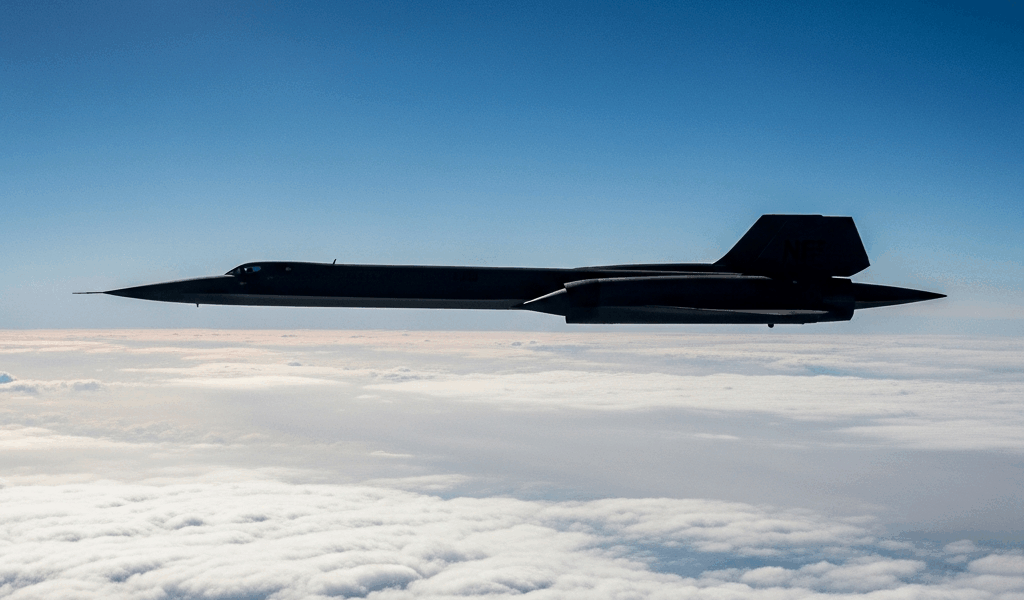
The SR-71 Blackbird: Still Unmatched After 60 Years
The SR-71 flew at Mach 3.2 and 85,000 feet. At that speed, the titanium airframe expanded several inches from friction heating — the aircraft was designed with gaps in its panels that only sealed when the skin reached operating temperature. It leaked fuel on the runway because the tanks did not seal until the aircraft was supersonic and hot.
Lockheed’s Skunk Works built the Blackbird in the early 1960s using titanium sourced covertly through third countries because the primary global supplier was the Soviet Union — the nation the SR-71 was designed to surveil. In its operational career from 1966 to 1998, no SR-71 was ever shot down. Over 4,000 missiles were fired at it. The aircraft’s defense was simple: fly faster than anything that could intercept it. That strategy worked for over three decades.
The U-2: When Flying Higher Was the Only Option
Before satellites, the only way to photograph Soviet military installations was to fly over them. The U-2, also from Skunk Works, cruised at 70,000 feet — above the operational ceiling of every Soviet interceptor and every surface-to-air missile when it was introduced in 1955.
That advantage lasted five years. On May 1, 1960, a Soviet SA-2 missile struck Gary Powers’ U-2 at altitude over Sverdlovsk. The shootdown was an international crisis and ended U-2 overflights of the Soviet Union. But the aircraft did not retire — it adapted. The U-2 continued serving for decades in other roles, and variants of the design still fly today. Its Cold War lesson: altitude buys time, not invulnerability, and every technological advantage has an expiration date.
The F-117 Nighthawk: Making Radar Obsolete
The F-117 looked like no aircraft before it — angular facets, no curved surfaces, an airframe that aerodynamic engineers said should not fly. It flew because the design priority was not aerodynamic efficiency. It was radar cross-section reduction. Every surface angle was calculated to deflect radar energy away from the transmitter rather than back to it.
The F-117 was a Cold War black program that did not officially exist until 1988, although it had been operational since 1983. Its first combat use was the 1989 Panama invasion, and its defining moment was the 1991 Gulf War, where F-117s struck the most heavily defended targets in Baghdad on the first night without a single aircraft lost. The stealth concept it proved — that shaping an aircraft’s surface to minimize radar return was more effective than electronic jamming — became the foundation for every tactical aircraft designed afterward, including the F-22 and F-35.
The B-52: The Bomber That Outlasted the Cold War
The B-52 Stratofortress first flew in 1952 and is expected to remain in service until the 2050s — a hundred-year operational career for an airframe designed to deliver nuclear weapons over the Soviet Union. No other military aircraft in history comes close to this longevity.
The Cold War role was straightforward: carry nuclear bombs to Soviet targets if deterrence failed. B-52s maintained continuous airborne alert during peak tensions, circling near Soviet airspace 24 hours a day with live nuclear weapons aboard. The aircraft survived because it was adaptable — when its high-altitude penetration mission became suicidal against modern Soviet air defenses, the B-52 switched to low-level penetration, then to cruise missile delivery, then to conventional precision bombing. The airframe designed for nuclear apocalypse ended up delivering GPS-guided bombs in Afghanistan.
The MiG-25 Foxbat: Soviet Speed as a Strategy
When Western intelligence first identified the MiG-25 in the mid-1960s, its enormous wings and twin engines suggested a highly maneuverable air superiority fighter. NATO panicked and accelerated the F-15 Eagle program in direct response. When Lieutenant Viktor Belenko defected to Japan in 1976 and the West finally examined a MiG-25 up close, the truth was different — it was an interceptor built for one thing: speed.
The MiG-25 could exceed Mach 3 in short bursts. Its airframe was mostly welded nickel steel, not titanium or aluminum — heavy, heat-resistant, and built for straight-line speed. It was designed to intercept American B-70 Valkyrie bombers that were never actually built. The aircraft the Soviets built to counter a threat that never materialized inadvertently triggered the American development of the F-15, which became the most successful air superiority fighter in history. Cold War aviation innovation often worked this way — each side building against the other side’s imagined next move.




Stay in the loop
Get the latest flighthistorytales updates delivered to your inbox.