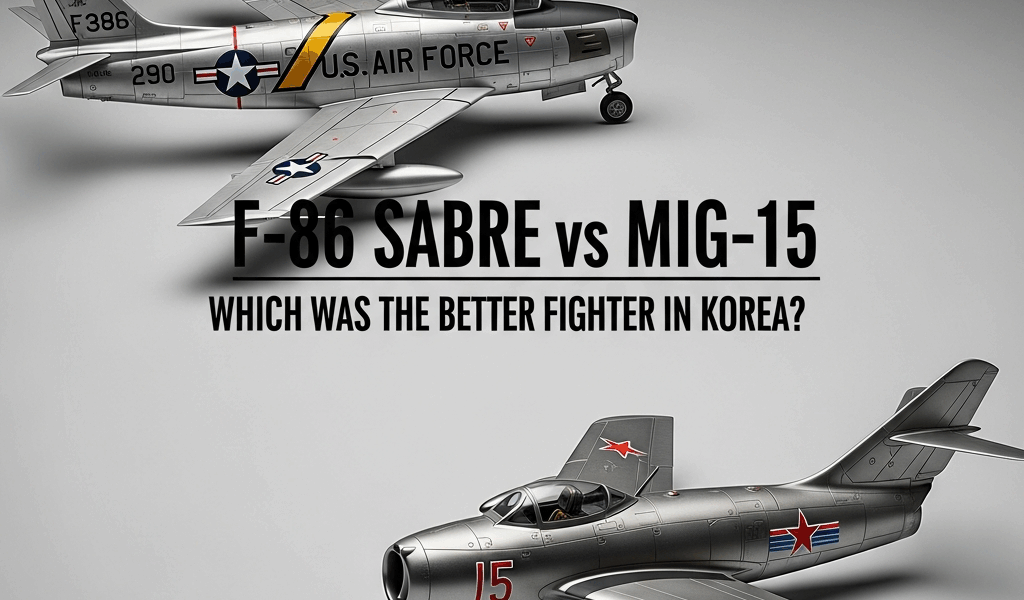
F-86 Sabre vs MiG-15 — Which Was the Better Fighter in Korea?
The F-86 Sabre vs MiG-15 debate has gotten complicated with all the myth, speculation, and nationalist nostalgia flying around. As someone who spent the better part of two decades buried in Korean War air combat research — declassified USAF after-action reports, Soviet VVS documentation that only surfaced after 1991, pilot memoirs from both sides — I learned everything there is to know about why most people are asking the wrong question entirely. They want to know which airplane was better. The honest question is: which airplane won, and why? Those aren’t the same question. Not even close.
This article includes affiliate links. We may earn a commission at no extra cost to you.
Here’s the short version. On paper, the MiG-15 was arguably superior. Over northwestern Korea — a narrow corridor American pilots called MiG Alley — the F-86 dominated anyway. That gap between paper performance and actual outcome tells you almost everything about aerial warfare, Cold War strategy, and what really decides a shooting war when two evenly matched machines finally meet.
Both sides deserve a fair accounting. Let me lay it out.
The MiG-15 Advantage — Climb, Ceiling, Firepower
Designed by the Mikoyan-Gurevich bureau and first flown in 1947, the MiG-15 hit the skies over Korea in November 1950 like a bucket of ice water. American pilots in straight-wing F-80 Shooting Stars and propeller-driven F-51 Mustangs had absolutely no answer for it. Early production MiG-15s climbed at roughly 9,843 feet per minute. The F-86A — the primary American counter once it finally arrived — managed around 7,250. That’s not a rounding error. In actual combat, climb rate is tactical position.
The ceiling gap was worse. The MiG-15bis, the definitive production variant, had a service ceiling somewhere around 51,000 feet. The F-86A struggled to do anything meaningful above 45,000. Soviet pilots used this constantly — loitering above 47,000 feet, diving through American formations at will, zooming back up before anyone could give chase. American pilots called it the zoom-and-boom. There was no immediate answer for it.
Then there’s the guns. The MiG-15 carried one 37mm Nudelman N-37 cannon and two 23mm Nudelman-Suranov NS-23 cannons. The F-86 had six .50-caliber M3 Browning machine guns. One 37mm shell hitting a B-29 Superfortress could tear the airframe apart — the MiG’s weapons were explicitly designed to kill heavy bombers, which was the primary Soviet air defense requirement. Against B-29s flying daylight raids over North Korea, the MiG-15 was so effective that the USAF suspended daylight strategic bombing entirely by October 1951. That’s not a footnote. That’s a strategic-level outcome driven directly by what that aircraft was carrying.
The Soviet design philosophy was unambiguously point-defense interceptor. Fast climb. High ceiling. Lethal anti-bomber armament. Optimized for a specific mission — and at that mission, arguably the best aircraft in the world in 1950. That’s what makes the MiG-15 so endearing to aviation enthusiasts even today.
Where the MiG’s Advantages Created Problems
Probably should have opened with this section, honestly. Because this is where the whole story pivots.
The same design choices that made the MiG-15 a superb interceptor created genuine liabilities in turning, maneuvering dogfights. Serious longitudinal instability above Mach 0.86. Controls that could lock up or outright reverse at high speeds. The 37mm cannon fired at roughly 400 rounds per minute — slow — and the ballistics of the two cannon types were different enough that aiming both simultaneously required real skill. The MiG’s gunsight, an ASP-1N optical unit, was functional but notably less sophisticated than what the F-86 was carrying.
Don’t make my mistake and dismiss these limitations as minor. They’re where the entire competitive analysis changes.
The F-86 Advantage — Dive, Stability, Gunsight
The North American F-86 Sabre arrived in Korean service in December 1950, and its pilots noticed something critical almost immediately. They couldn’t catch a MiG climbing. They could absolutely destroy one coming down.
The F-86’s airframe was stable and predictable across its entire flight envelope — North American’s engineers had paid obsessive attention to high-speed handling, and the result was an aircraft pilots trusted instinctively. That trust matters more than most armchair analysts acknowledge. A pilot hesitating because he’s uncertain what his aircraft will do in a high-speed dive is a pilot who dies.
In a sustained dive from altitude, the F-86 could hit approximately Mach 0.92 without the compressibility nightmares that plagued the MiG. American pilots figured out early that the right counter to a MiG zoom attack was a rolling dive. The MiG followed, hit its handling limits, and either broke off or handed the F-86 pilot a firing solution. Nothing in combat is a sure thing — but it was a repeatable tactic built on a real aerodynamic advantage.
The gunsight deserves its own paragraph. The F-86 carried the AN/APG-30 radar-ranging gunsight — a gyroscopic computing sight that automatically calculated lead angle based on target range and turn rate. An F-86E or F-86F pilot tracked his target, kept the radar pipper on it, and the gunsight handled the ballistic math. This sounds abstract until you’re in a turning fight at 400 knots with maybe two seconds of firing opportunity. Two seconds is everything. The MiG pilot was calculating lead angle in his head. The F-86 pilot had a computer doing it for him.
G-suits mattered too. USAF pilots wore MC-4 partial pressure suits alongside G-suits providing pneumatic compression to the legs and abdomen during high-G maneuvering — keeping blood in the brain when it wanted to pool in the feet. Soviet MiG-15 pilots initially flew without adequate anti-G protection. In tight sustained turns — exactly the kind of fighting air combat demands — F-86 pilots could pull harder before graying out. That physiological edge translated directly into tighter turn radii and more aggressive offensive work.
MiG Alley — How the Planes Actually Fought
MiG Alley was a roughly 100-mile stretch of northwestern Korea — the Yalu River to the north, the Chongchon River to the south. The geography of the conflict created a bizarre tactical situation that shaped everything about how both aircraft were actually used.
American pilots were prohibited by rules of engagement from crossing the Yalu into Chinese or Soviet territory. Soviet and Chinese pilots knew this and used it ruthlessly. Manchurian airfields across the Yalu were permanent safe harbors — MiG pilots could disengage at any moment, sprint north across the river, and land in complete safety. This meant they could choose when to fight. They held the initiative for disengagement in a way F-86 pilots simply did not.
Frustrated by those rules of engagement, American commanders watched Soviet pilots exploit the sanctuary with infuriating consistency — forming up over Manchuria, crossing the Yalu at altitude, attacking, withdrawing. F-86 pilots pursuing a damaged MiG had to watch it cross the river and let it go. Some American pilots crossed anyway — the so-called “hot pursuits” — and a few were court-martialed for it. The rules were real and the consequences were real.
Soviet tactics played to MiG strengths. Large formations swept down from altitude in what pilots called “trains” — long trailing columns attacking, breaking, and re-engaging from height. The F-86 response evolved toward mixed-altitude combat, dragging engagements down to medium altitudes where F-86 stability and gunsight advantages maximized. When F-86 pilots succeeded in getting MiGs below 30,000 feet in a sustained turning fight, kill ratios shifted dramatically in their favor.
Chinese PLAAF pilots flying MiG-15s alongside Soviet units were generally less aggressive and less experienced. The 64th Fighter Aviation Corps — the primary Soviet unit engaged — contained genuinely excellent pilots. The tactical combat was hard, dangerous, and expensive for both sides. Nobody was walking through this.
The Pilot Factor
As someone obsessed with aircraft specifications from years of reading aviation literature, I made the same mistake most people make — I underweighted pilot quality for a long time. The declassified Soviet records from the 1990s corrected that mistake fairly decisively. Don’t make my mistake.
Here’s what those records show. The 64th Fighter Aviation Corps rotated its units in and out of Korea on a schedule designed to give as many Soviet pilots as possible some combat experience. A regiment would serve three to six months, accumulate hours, and rotate home. Fresh units arrived. The problem — and it’s a significant one — was that replacement units brought pilots with little or no jet combat experience. They were learning on the job against USAF pilots who were accumulating continuous combat experience without rotating on the same schedule.
The average F-86 pilot arriving in Korea had completed the USAF Fighter Gunnery School at Nellis Air Force Base, Nevada — roughly 120 hours in jet aircraft with specific emphasis on deflection shooting and aerial gunnery. The Nellis syllabus in 1951-1952 was rigorous in ways Soviet conversion training simply wasn’t. Many American pilots were also World War II veterans. Men like Francis Gabreski, Vermont Garrison, and George Davis brought thousands of hours of fighter time to Korea. Davis shot down four MiGs in a single mission on November 27, 1951 before being killed the following February — his combat instincts had been built over years, not months.
The Soviet aces — Yevgeni Pepelyaev, Nikolai Sutyagin, Lev Shchukin — were exceptional. Pepelyaev alone claimed 23 aerial victories. But when those pilots rotated home, their replacements weren’t at the same level. Institutional knowledge didn’t transfer. American kill ratios improved measurably in the second half of the war, precisely during periods when experienced Soviet regiments had been replaced by newer units.
Captured MiG-15 pilot testimony confirmed it — and after September 1953, when North Korean Lieutenant No Kum-sok defected and delivered an intact MiG-15bis to Kimpo Air Base, a thorough examination confirmed that Soviet and North Korean pilots were trained to avoid sustained turning engagements at low to medium altitude. Trained to fight to MiG-15 strengths. When circumstances forced them into a fight on F-86 terms, they were often outmatched.
The Verdict
So. Which was the better fighter?
The MiG-15 was the better aircraft on paper — I’ll say that plainly. Climb rate, service ceiling, cannon armament. Genuine structural advantages over the F-86 in 1950 and 1951. Against bombers it was devastating. Against early American jets it was a revolution. Hand both aircraft to pilots of identical skill with identical training and tell them to fight — the MiG-15 pilot wins a meaningful percentage of the time, especially picking his fights at altitude and refusing a turning engagement.
The F-86 won in practice. The claimed American kill ratio of 10:1 is almost certainly inflated — both sides overclaimed kills, as every air force in every war does. Serious researchers, including the late Dr. Douglas Dildy and Warren Thompson in their meticulous accounting, put the real ratio closer to 2:1 in favor of the F-86 — possibly as low as 1.4:1 in some periods. Even at those conservative numbers, the F-86 came out ahead flying an aircraft that was aerodynamically inferior by several objective measures.
The reasons are specific and not mysterious. Better pilot training — particularly aerial gunnery. The AN/APG-30 radar gunsight giving American pilots a genuine technological edge in the firing solution. G-suit protection enabling tighter sustained maneuvering. Superior high-speed dive stability letting F-86 pilots dictate engagement parameters. And a Soviet rotation policy that continuously degraded pilot experience levels throughout the war.
The lesson is uncomfortable for anyone who believes better hardware automatically produces better outcomes. The MiG-15 should have dominated MiG Alley. It had the altitude, the firepower, the sanctuary across the Yalu. What it didn’t have — not consistently, not after the first year — was pilots trained and experienced enough to exploit those advantages against men who had been flying fighters since before some of them finished secondary school.
Aviation history keeps teaching this lesson. We keep being surprised by it anyway. The aircraft is the weapon. The pilot is the weapons system. In Korea, the weapons system won.



Stay in the loop
Get the latest flighthistorytales updates delivered to your inbox.