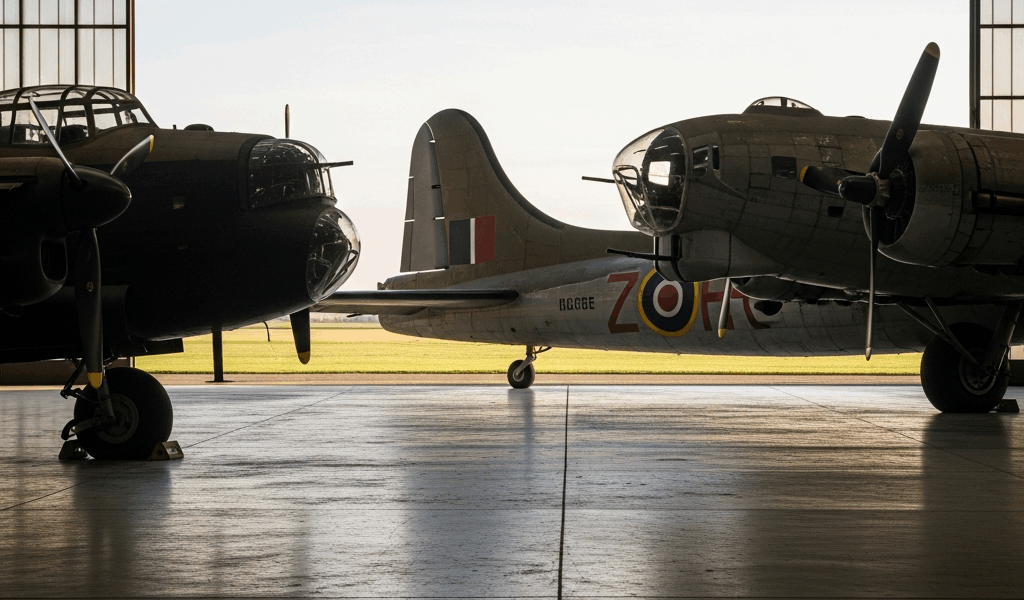
Two Bombers Built for Very Different Wars
Lancaster vs B-17 has gotten complicated with all the mythology and bar-stool certainty flying around. As someone who has been obsessed with this question since standing inside a restored Lancaster at the Canadian Warplane Heritage Museum in Hamilton, Ontario — probably around age twelve, genuinely rattled by how dark and cramped that fuselage was — I learned everything there is to know about this debate. Today, I will share it all with you.
Here’s the honest answer upfront: comparing these two aircraft straight across is like comparing a night-shift surgeon to a daytime one and asking who’s the better doctor. The Lancaster was purpose-built for RAF Bomber Command’s nighttime area bombing campaign over occupied Europe. The B-17 was engineered for USAAF high-altitude daylight precision raids. Different skies. Different hours. Different tactics entirely. Any comparison that ignores that context is just noise.
Payload, Range and What the Numbers Actually Meant
The Lancaster’s bomb bay is the thing. Open those doors and look — it runs nearly the full length of the fuselage, completely unobstructed. That single design decision changed everything. Standard raids saw the Lancaster carrying roughly 14,000 lbs of bombs. The B-17G, by comparison, managed around 6,000 lbs on long missions, maybe 8,000 lbs on shorter ones. On paper, the Lancaster is nearly twice the bomber. That’s a staggering gap.
But raw payload isn’t the full picture. The B-17 flew in massive daylight formations — sometimes 1,000 aircraft — where individual bomb loads combined into something like a strategic sledgehammer. The precision of daylight bombing meant smaller loads were theoretically placed more efficiently. Theoretically.
The Lancaster’s unobstructed bay also meant it could carry weapons no other Allied bomber touched. The 12,000 lb Tallboy. The 22,000 lb Grand Slam — an earthquake bomb designed by Barnes Wallis that collapsed underground infrastructure without even a direct hit, purely through seismic shock transmitted through the earth. No B-17 ever carried anything remotely close. The B-17’s segmented bomb bay simply couldn’t accommodate those monsters. That’s not a small footnote. The Grand Slam destroyed hardened U-boat pens and viaducts that months of conventional bombing had failed to scratch.
Range was more competitive. The B-17G had a combat range of roughly 2,000 miles. The Lancaster Mk III came in around 1,660 miles with a full load — though it could stretch further on lighter payloads. Neither aircraft could easily reach deep Germany and return without careful planning. The difference is the Lancaster’s payload advantage made every mile of that range more destructive.
Crew Survival — Which Bomber Gave You Better Odds
Probably should have opened with this section, honestly. This is where the comparison gets genuinely grim.
Lancaster crews drew brutal odds. Approximately 44% of RAF Bomber Command aircrew did not survive the war. Not wounded — dead or captured. A full tour meant 30 operations. Statistically, completing one tour without being killed or shot down was an achievement many crews simply never reached. Night operations over Germany in 1943 and 1944 — before effective radar countermeasures were widely deployed — meant Lancaster crews flew into defended airspace nearly blind, relying on darkness as their only real shield against Luftwaffe night fighters.
The B-17 story before mid-1944 is nearly as dark. During the second Schweinfurt raid in October 1943 — before the P-51D Mustang arrived as a long-range escort — the 8th Air Force lost 77 B-17s in a single day. Sixty men per aircraft. Do that math quickly. That one mission nearly ended the entire daylight bombing campaign on its own.
The B-17’s defensive armament was legendary — up to thirteen .50 caliber M2 Browning machine guns on the B-17G. The Lancaster carried eight .303 Brownings, which were frankly underpowered against late-war German fighters. But here’s what most people miss: the B-17’s guns weren’t really what kept crews alive. The tight combat box formation was the actual survival strategy. Dozens of aircraft flying in precisely coordinated geometry created overlapping fields of fire that no single fighter could easily penetrate. The guns mattered less than the formation.
Once P-51s arrived as escorts in early 1944, B-17 loss rates dropped sharply. Lancaster crews flying at night never had that option. Fighter escort at night wasn’t viable with the technology of the era. So Lancasters flew naked into defended airspace, raid after raid. Crews paid for it.
If you’re asking which aircraft gave a crewman better survival odds across the full war — the B-17, post-escort era, wins that argument. Pre-escort, it’s nearly a coin flip between two terrible sets of odds. Don’t make my mistake of oversimplifying that question.
Combat Record — Where Each Bomber Made Its Mark
Frustrated by the limitations of conventional bombs against hardened German infrastructure, Barnes Wallis designed the bouncing bomb specifically around the Lancaster’s modified bomb bay. On the night of May 16–17, 1943, 617 Squadron breached the Möhne and Eder dams in the Ruhr Valley using it. The Dambusters raid didn’t win the war — but it proved the Lancaster could execute missions of extraordinary precision that no other aircraft could attempt.
That same aircraft sank the Tirpitz — Germany’s most feared battleship — using Tallboy bombs in November 1944. Three hits. The ship rolled and sank in shallow water. Naval gunfire hadn’t managed it. Surface attack hadn’t managed it. A Lancaster squadron did it with bombs dropped from altitude.
Operation Manna in April 1945 showed the Lancaster’s other face entirely — 3,000 sorties dropping food to starving Dutch civilians, flying low and slow over occupied territory under a fragile ceasefire agreement. The aircraft that carried earthquake bombs carried 10 million pounds of food that same spring. That kind of operational range matters.
The B-17’s defining campaign was sustained — grinding, months-long. The 8th Air Force’s daylight offensive over Germany targeted ball bearing plants, oil refineries, aircraft factories. Schweinfurt proved it could go catastrophically wrong without fighter escort. By 1944 and 1945, though, combined escort and formation tactics had made the daylight campaign viable. B-17 formations over Germany became one of the defining images of the entire Allied war effort. The psychological and industrial impact of round-the-clock bombing — Lancaster at night, B-17 by day — is something neither aircraft could have achieved alone. That’s what makes the pairing endearing to us aviation enthusiasts.
The Verdict — And Why Commanders Wanted Both
Here’s what the records actually show. The Lancaster dropped more bombs per aircraft, per mission, more efficiently than the B-17. Full stop. RAF Bomber Command dropped approximately 608,000 tons of bombs during the war. The 8th Air Force dropped around 696,000 tons — but with significantly more aircraft flying significantly more missions. Per sortie efficiency goes to the Lancaster. That’s not a debatable point.
But what is the B-17’s legacy? In essence, it’s durability and doctrine. But it’s much more than that. Stories circulated of B-17s returning with entire fuselage sections missing, multiple engines out, tail surfaces shot nearly clean away — landing anyway. The aircraft absorbed punishment in ways that influenced every American strategic bomber designed afterward. The formation tactics developed around the B-17 became the template for postwar strategic air doctrine. The USAAF’s investment in daylight precision bombing — imperfect as it was in actual execution — shaped how air power was conceptualized through the Cold War era and well beyond.
I’m apparently wired to find the Lancaster more romantic, and it works for me as the more impressive individual weapons platform while the B-17 never quite carries that same visceral punch in my mind. But neither air force actually wanted the other’s bomber. RAF crews didn’t want to fly daylight raids in B-17 formations. USAAF planners didn’t trust night area bombing to hit their precision industrial targets. Both assessments were correct given their specific missions.
So, without further ado, here’s the one-sentence verdict: the Lancaster won the payload argument, but the B-17 won the doctrine argument — and doctrine outlasted the war by decades. This new approach to strategic air power took off several years later and eventually evolved into the precision airpower doctrine enthusiasts study and debate today.



Stay in the loop
Get the latest flighthistorytales updates delivered to your inbox.