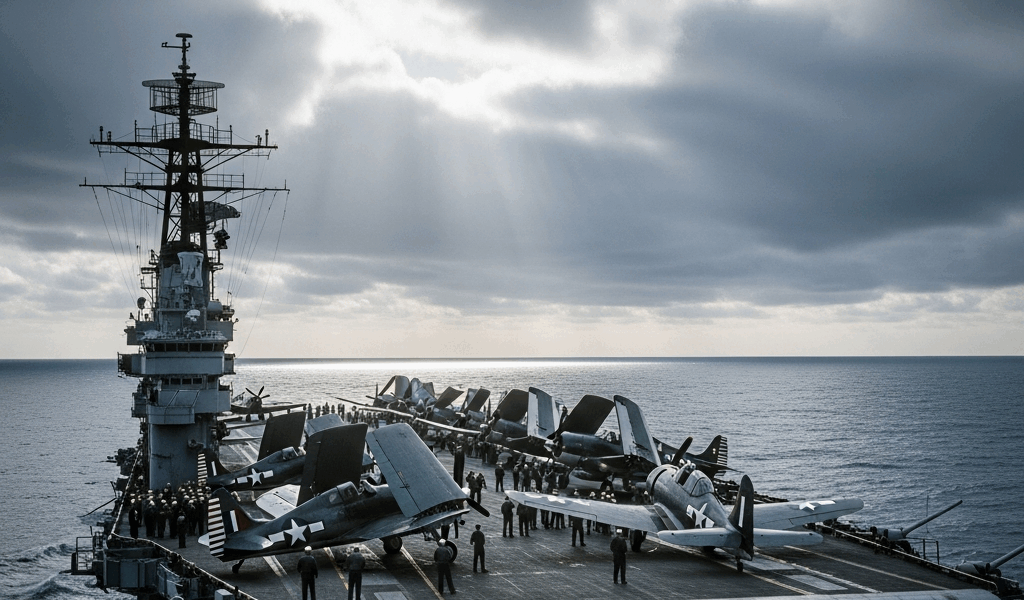
On December 7, 1941, Japanese aircraft launched from six carriers struck Pearl Harbor and demonstrated something the world’s navies had debated for twenty years — that carrier-based air power could destroy a battle fleet without a single surface ship firing a gun. The battleship era ended that morning. The aircraft carrier era had already begun.
The Battleship Problem Carriers Solved
Before carriers, naval warfare meant sailing within gun range of your enemy and trading shells until one fleet sank. Battleships were floating fortresses — massive armor, enormous guns, crews in the thousands. But they had a fundamental limitation: their guns could reach roughly 20 miles. A carrier’s aircraft could strike from 200 miles away. By the time a battleship knew carriers were in range, the attack was already airborne.
Japan understood this first. The Imperial Japanese Navy built its Pacific strategy around carrier strike groups while the United States and Britain still viewed carriers as scouting platforms for the real fleet — the battleships. Pearl Harbor forced the lesson in the most brutal possible way. The U.S. Pacific Fleet’s battleships sat burning in the harbor while the fleet’s carriers, which happened to be at sea that morning, survived to fight the war that followed.
Midway: The Battle That Proved Carrier Supremacy
Six months after Pearl Harbor, the Battle of Midway settled the carrier question permanently. Four Japanese carriers — Akagi, Kaga, Soryu, Hiryu — went to the bottom on June 4-5, 1942. The U.S. lost Yorktown. No battleships from either side fired at each other. The entire engagement was fought by aircraft launched from ships that never saw each other visually.
The Japanese carriers were caught while rearming their aircraft — bombs and torpedoes stacked on flight decks when American dive bombers arrived. The destruction took roughly five minutes. Five minutes destroyed the offensive capability that had dominated the Pacific for six months. Midway proved that carrier duels were decided by who found whom first and who got their aircraft into the air fastest. Gun caliber and armor thickness were irrelevant.
The Essex Class: America Builds the Carrier Fleet
After Midway, the United States committed to carrier production on a scale no other nation could match. The Essex-class carriers — 24 ships commissioned between 1942 and 1950 — became the backbone of the Pacific war. Each carried 90-100 aircraft and displaced 27,000 tons. They were fast enough at 33 knots to operate with any task force and tough enough to absorb kamikaze strikes and stay operational.
Japan could not match this production. After losing four fleet carriers at Midway and more at Philippine Sea and Leyte Gulf, Japan’s carrier force was effectively destroyed by late 1944. The industrial gap was the strategic reality — Japan built carriers one at a time while American shipyards launched them in series. By 1945, the U.S. Navy had more carrier decks operational in the Pacific than Japan had operational combat aircraft.
The Pacific Island Campaign: Carriers as Mobile Airfields
Carriers enabled the entire island-hopping strategy. Each island assault needed air cover — fighters to protect the invasion fleet, bombers to suppress coastal defenses, torpedo planes to sink any Japanese surface ships that responded. Land-based airfields were either nonexistent on target islands or in Japanese hands. Carriers brought the airfield with them.
Tarawa, Saipan, Iwo Jima, Okinawa — every major amphibious operation from 1943 onward was supported by carrier task forces providing air superiority over the beachhead. Once the island was secured and a runway built, land-based aircraft took over and the carriers moved to the next target. This leapfrog pattern could not have existed without mobile naval aviation.
The Atlantic: Escort Carriers Win the Submarine War
While fleet carriers fought the Pacific war, a smaller and less celebrated carrier type won the Battle of the Atlantic. Escort carriers — CVEs, nicknamed “jeep carriers” — were small, slow, built on merchant hull designs, and carried fewer than 30 aircraft each. Their job was submarine hunting.
German U-boats had been devastating Allied convoys in the mid-Atlantic air gap — the stretch of ocean beyond the range of land-based patrol aircraft. Escort carriers closed that gap. Their aircraft spotted surfaced U-boats, forced them underwater where they were slow and blind, and directed surface escorts to depth charge positions. The introduction of escort carriers in 1943 coincided with the turning point of the Atlantic submarine war. U-boat losses spiked and never recovered.
The Legacy: Why Every Modern Navy Wants Carriers
World War 2 established the aircraft carrier as the capital ship of modern naval warfare — a position it still holds. The ability to project air power anywhere a ship can sail, without depending on foreign bases or allied airfields, remains the carrier’s strategic advantage. Every major navy in the world either operates carriers or is building them because the lesson of 1941-1945 has never been overturned: whoever controls the air above the ocean controls the ocean.
The carrier-air-group decision becomes clearer in our F4U Corsair and F6F Hellcat comparison.



Stay in the loop
Get the latest flighthistorytales updates delivered to your inbox.