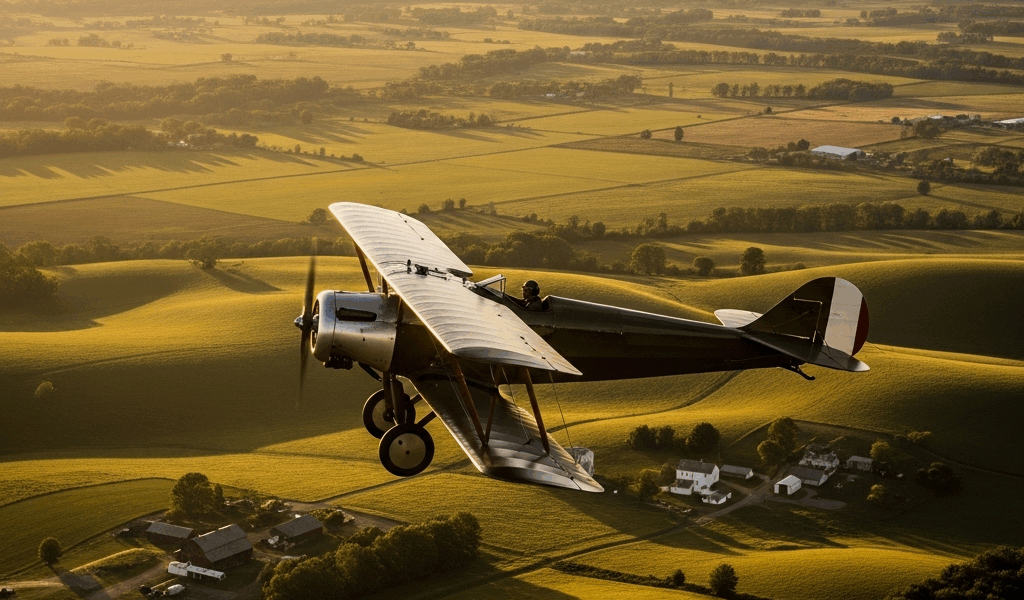
Between 1919 and 1939, a generation of pilots turned flying from a carnival stunt into a legitimate transportation system. They did it without radar, GPS, pressurized cabins, or reliable engines — and a significant percentage of them died doing it. The golden age of aviation was not golden because it was glamorous. It was golden because the people who flew during it were solving problems nobody had ever faced before.
Charles Lindbergh and the Proof of Concept
On May 21, 1927, Lindbergh landed the Spirit of St. Louis at Le Bourget Field outside Paris after 33.5 hours alone over the Atlantic. The flight itself was a feat of endurance and navigation — no copilot, no radio, a magnetic compass and dead reckoning across 3,600 miles of open ocean with no landmarks.
What mattered more than the flight itself was what happened next. Overnight, aviation went from a curiosity to a serious enterprise. Investment flooded in. Airline startups formed. Airports broke ground in cities that had never considered commercial aviation. Lindbergh did not just fly the Atlantic — he proved to investors and the public that aircraft were transportation, not toys. Within two years of his landing, airline passenger miles in the United States tripled.
Amelia Earhart and the Expansion of Who Could Fly
Earhart’s 1932 solo Atlantic crossing — the first by a woman — took 14 hours and 56 minutes from Newfoundland to Northern Ireland. She flew through ice storms and mechanical problems in a Lockheed Vega that was not designed for the conditions she encountered. The landing in a farmer’s pasture outside Londonderry was as improvised as everything else about early transatlantic flight.
Her contribution went beyond records. Earhart demonstrated that aviation skill was not gender-dependent at a time when women were actively excluded from commercial pilot roles. She co-founded the Ninety-Nines, the organization of licensed women pilots that still exists today. Her disappearance over the Pacific in 1937 became aviation’s most enduring mystery, but her impact on who the industry considered a qualified pilot outlasted everything else.
Wiley Post: High Altitude and Pressure Suits
Wiley Post is the golden age pioneer most people have never heard of, and his contributions may have mattered more than anyone else on this list. Post completed the first solo flight around the world in 1933 — 7 days, 18 hours in a Lockheed Vega named Winnie Mae. Then he turned his attention to the problem that would define the next era of aviation: flying higher.
Post discovered the jet stream while flying at altitudes above 30,000 feet. He could not have survived at those altitudes without the pressure suit he helped design — the first practical full-pressure suit in aviation history, built by B.F. Goodrich to Post’s specifications. The suit looked like something from a science fiction film, but it worked. Post’s high-altitude research and pressure suit development directly influenced the equipment that would eventually make stratospheric flight and spaceflight survivable.
Jimmy Doolittle: The Instrument Flight Revolution
In September 1929, Jimmy Doolittle completed the first fully blind instrument flight — takeoff, navigation, and landing using only cockpit instruments with a hooded cockpit and zero outside visibility. This was not a stunt. It was the moment aviation stopped being a fair-weather-only enterprise.
Before Doolittle’s instrument work, clouds meant grounding the aircraft. Airlines canceled flights for overcast. Pilots died in fog. Doolittle proved that a properly equipped aircraft with trained instruments could fly in any weather condition, and his subsequent development of instrument flight procedures became the foundation for modern IFR flying. Every instrument approach procedure used at every airport in the world traces back to the work Doolittle did in that hooded Consolidated NY-2 biplane at Mitchel Field.
The Airmail Pilots: The Ones Who Built the Routes
The most dangerous job in golden age aviation was not setting records — it was flying the mail. U.S. airmail pilots in the 1920s flew open-cockpit biplanes through mountains, thunderstorms, and night conditions with no instruments, no weather reporting, and no radio contact. The mortality rate was staggering. In the first five years of airmail service, 31 of the first 40 pilots hired were killed in crashes.
These pilots mapped the airways that became commercial routes. They identified the mountain passes, learned the weather patterns, built the bonfire beacons that guided night flight before electric lighting existed. Names like Jack Knight, who flew a critical overnight leg of the transcontinental mail run in February 1921 through blizzard conditions using bonfire navigation, saved the airmail program from congressional cancellation and proved that night airmail was viable.
The golden age of aviation was built on the backs of these pilots. Not the record-setters who got the headlines, but the airmail carriers who flew the same dangerous routes day after day because the mail had to move and there was no other way to get it there fast enough.




Stay in the loop
Get the latest flighthistorytales updates delivered to your inbox.