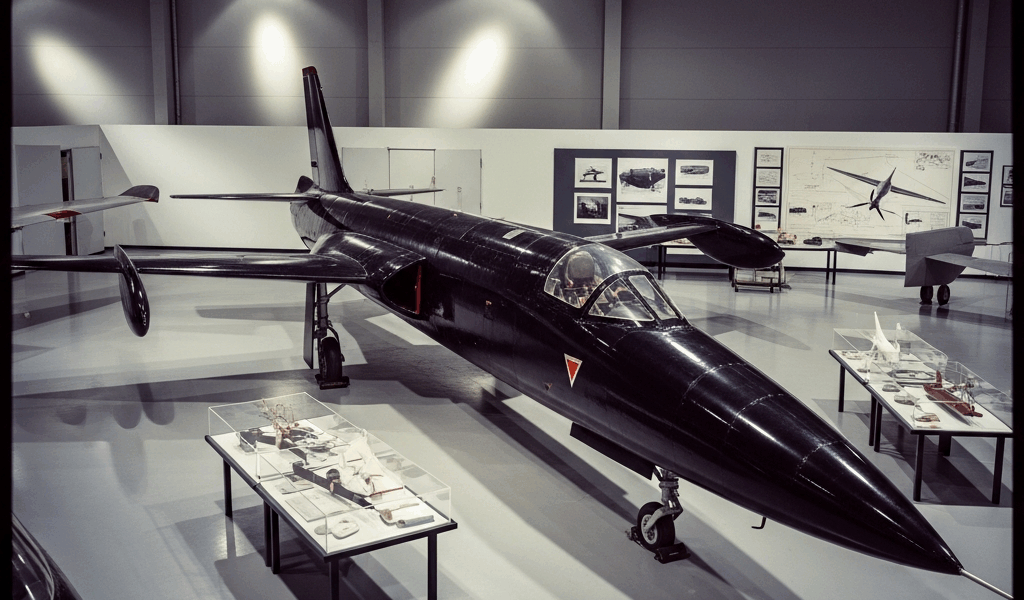
The SR-71 Blackbird — Why Nothing Has Flown Faster Since 1976
SR-71 Blackbird history has gotten complicated with all the myth and half-remembered aviation trivia flying around. As someone who spent the better part of three decades obsessing over this aircraft — starting with a four-dollar copy of Jane’s All the World’s Aircraft I found at a used bookstore in Tucson when I was seventeen — I learned everything there is to know about the Blackbird. Today, I will share it all with you.
I stopped cold on the page with its silhouette. A reconnaissance aircraft that outran missiles by simply going faster. An airframe designed in the 1960s that has never once been matched for operational sustained speed. The more you learn, the more absurd the whole thing becomes. Genuinely.
Mach 3.3 in 1976 — And Nobody Has Done It Since
July 28, 1976. SR-71 serial number 61-7958 hit 2,193.167 miles per hour — Mach 3.3. The record still stands. Not just for military jets. For any air-breathing aircraft ever flown, by anyone, anywhere on earth. We haven’t touched it in nearly fifty years, which is a sentence that should stop you cold if you spend any time thinking about how fast technology usually moves.
And it wasn’t a sprint. The aircraft cruised there — hours-long reconnaissance runs over denied territory, at speeds where air friction heated the skin past 600 degrees Fahrenheit. The cockpit canopy hit 250 degrees on the inside. Crews wore full pressure suits, essentially astronaut gear, because depressurization at that altitude was a death sentence without them. That’s what makes the Blackbird endearing to us aviation obsessives.
Here’s the engineering detail that gets me every single time. The SR-71’s titanium skin panels were manufactured slightly loose. They didn’t fit perfectly on the ground. Engineers deliberately designed the airframe with small gaps — the thing technically leaked fuel sitting on the tarmac, which is not something you’d expect from a $34 million aircraft. In 1966 dollars, no less. Those gaps existed because at Mach 3+, thermal expansion caused the entire structure to grow. The fuselage lengthened by several inches. The gaps closed. The airframe became sealed and rigid only when doing what it was designed to do.
Nothing about the Blackbird makes sense until you understand it was engineered to operate in a fundamentally different physical state than the one it sat in on the ground.
Titanium made all of it possible — handles thermal stress in ways aluminum simply cannot. But here’s the spectacular problem. In the early 1960s, roughly 93 percent of the world’s known titanium deposits sat inside the Soviet Union. The aircraft being built to spy on the Soviets needed Soviet material to exist.
Kelly Johnson and the Skunk Works Story
Probably should have opened with this section, honestly. None of the speed records and titanium panels make any sense without understanding the man behind them.
Clarence “Kelly” Johnson ran Lockheed’s Advanced Development Projects division — universally called Skunk Works — out of a facility in Burbank, California. The name came from the Li’l Abner comic strip, which tells you something about the culture in there. The facility was legendarily spartan. Engineers worked in close quarters, security was extreme, and Johnson ran everything according to fourteen management rules that basically amounted to: give smart people authority, cut the bureaucracy, and get out of the way. The U-2 came out of Skunk Works. The F-117 Nighthawk came out of Skunk Works. The SR-71 was arguably their masterpiece.
Frustrated by the problem of building something that could outrun any Soviet interceptor or surface-to-air missile, Johnson’s team started with the A-12 OXCART program in the late 1950s and eventually evolved it into the SR-71 configuration we know today. The titanium sourcing problem was real and acute. The CIA, working through a network of shell companies, purchased titanium directly from the Soviet Union. The Soviets apparently never connected the purchases to the aircraft program. That material arrived, was machined by American workers who had no idea where it came from, and was assembled into an aircraft designed to overfly the country that unknowingly supplied its skeleton.
Don’t make my mistake — I spent years assuming Skunk Works was just a clever marketing label Lockheed slapped on after the fact. It wasn’t. The secrecy was total. Workers on the SR-71 program didn’t discuss their jobs with their spouses. When early test flights happened over Nevada, civilian pilots who caught glimpses filed UFO reports, which is entirely understandable given the speed, altitude, and appearance of the thing. The Air Force quietly collected those reports and filed them away. The aircraft didn’t officially exist.
Johnson pushed his engineers on materials science in ways that had no precedent. Titanium was notoriously difficult to machine in the 1960s. Standard high-speed steel drill bits wouldn’t hold up. Cadmium-plated tools caused unexpected stress fractures. Chlorinated cutting fluids left residues that created micro-cracks under thermal stress — a discovery that came the hard way. Solving each problem required developing manufacturing techniques that simply didn’t exist yet. The SR-71 didn’t just advance aerospace engineering. It dragged materials science and manufacturing along behind it by brute force.
Why Satellites Replaced the Blackbird
The SR-71 was retired twice. First in 1990, brought back in 1995, then permanently stood down in 1998. Official explanations pointed at cost — roughly $200,000 per flight hour in 1990 dollars — but the operational story is more interesting than the budget story.
The Blackbird was never shot down. Not once. Missiles were fired at SR-71s over 1,000 times across operational history. The aircraft accelerated away from all of them. That’s an extraordinary record, and it makes the retirement feel counterintuitive — until you understand what changed around it.
Reconnaissance satellites changed everything. A satellite doesn’t create a political incident. When Gary Powers’ U-2 went down over the Soviet Union in 1960 — engine flameout dropped him to an altitude where a missile could reach him, which is a whole separate story — it became an international crisis. Eisenhower had to publicly acknowledge the overflight program. Diplomatic fallout was severe. The entire value proposition of the Blackbird was speed and uncatchability, but it still flew over sovereign territory, and sovereign nations noticed.
Satellites orbit in space. International law treats that differently than airspace. No overflight permission required. No political incident if the hardware fails. No pilot to capture and interrogate. By the early 1990s, the KH-11 KENNAN satellite — first launched in 1976, same year as the speed record — had improved to resolutions that could read license plates from orbit. What the Blackbird did became less uniquely valuable. That’s the honest answer.
There’s also the response-time question. Satellites pass on fixed orbital schedules. The SR-71 could be tasked and over a target within hours — genuine tactical flexibility that has real value. Part of why the Air Force brought it back in 1995. Part of why NASA flew two aircraft as research platforms through 1999. But flexibility alone couldn’t justify the per-hour operating cost against a satellite fleet that was already paid for.
Could We Build a Faster Plane Today?
But what is the actual barrier here? In essence, it’s a convergence of thermal management, propulsion physics, and manufacturing capability. But it’s much more than that.
Technically, faster is possible. The X-43A experimental NASA scramjet hit Mach 9.6 in 2004 — unmanned, rocket-boosted to operating speed, flew for roughly ten seconds under its own power, then went into the Pacific. The Boeing X-51 Waverider reached Mach 5.1 for about 210 seconds in 2013. DARPA’s hypersonic glide programs have shown speeds well above Mach 3.3. But these are ballistic or glide systems. Not aircraft in any operational reconnaissance sense.
A crewed, air-breathing, sustained-cruise aircraft above Mach 3.3 would require solving thermal management problems the Blackbird only partially solved, engine systems that can handle inlet temperatures at those speeds, and a materials ecosystem that doesn’t fully exist yet. Scramjet propulsion — the most likely path to a true successor — remains genuinely hard. Combustion happens in supersonic flow. It’s a bit like lighting a match in a hurricane and expecting it to stay lit.
Lockheed Skunk Works has discussed an SR-72 concept publicly since around 2013 — unmanned, hypersonic, targeting Mach 6, ISR and strike capable. No confirmed prototype has been publicly revealed. That’s either normal black program secrecy, normal defense acquisition timeline reality, or a genuine indicator the engineering problems remain unsolved. Possibly all three. I’m apparently the type who finds that ambiguity fascinating rather than frustrating, and following the SR-72 thread works for me while chasing cleaner answers never really does.
What I keep returning to, after years of reading about this aircraft, is the sheer audacity of what Kelly Johnson’s team actually built and flew. Not theorized. Not simulated. Not tested for ten seconds over the ocean. Flew operationally, for decades. Thirty-two aircraft were built. Pilots took off from real runways in England and Okinawa, flew real missions, and came back with real intelligence photographs.
The fact that we haven’t matched it in a production aircraft in nearly half a century isn’t a failure of modern engineering. It’s a testament to how far ahead of its time the thing actually was. So, without further ado — go find a good book about Kelly Johnson. Start there. The Blackbird will make a lot more sense afterward.

Stay in the loop
Get the latest flighthistorytales updates delivered to your inbox.