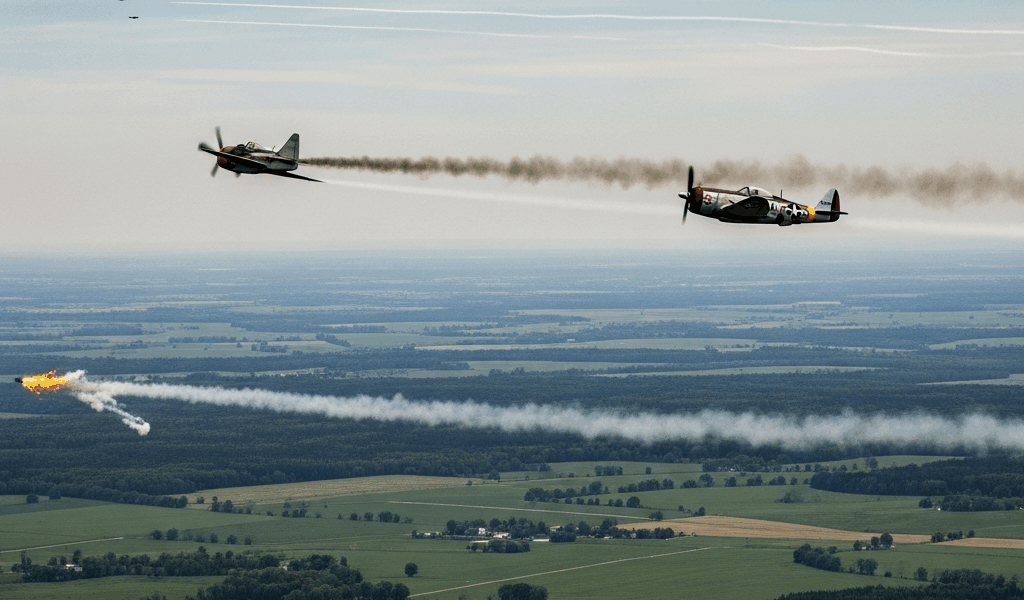
Two Heavyweights Built for Different Wars
The P-47 Thunderbolt vs FW 190 debate has gotten complicated with all the myth and half-remembered legend flying around. As someone who spent an embarrassing number of late nights cross-referencing mission reports, pilot memoirs, and Luftwaffe records until the details stopped blurring together, I learned everything there is to know about this rivalry. Today, I will share it all with you.
Here’s the honest takeaway upfront: this wasn’t a clean rivalry. It was a brutal, evolving contest — played out over occupied France, the Low Countries, and the German frontier from 1942 until the last months of the war. The answer depends entirely on where the fight happened and what each pilot was actually trying to do.
The P-47 was built around the Pratt & Whitney R-2800 Double Wasp — an 18-cylinder radial so physically large that Republic Aviation engineers basically designed the rest of the aircraft around it. American engineering logic taken to its extreme: make the engine big enough, and everything else follows. The FW 190, designed by Kurt Tank and introduced in 1941, was Germany’s answer to the Spitfire’s dominance over the Channel. It shocked the RAF immediately. Where most European fighters were sleek, liquid-cooled thoroughbreds, the Focke-Wulf arrived with its own radial — the BMW 801 — and handled unlike anything Allied pilots had faced. These two aircraft came from fundamentally different design philosophies. As it turned out, they excelled in different parts of the same sky. That’s what makes this matchup so endearing to us aviation history obsessives.
So, without further ado, let’s dive in.
Speed, Firepower and Engine — The Numbers That Mattered
The FW 190A-8 topped out around 408 mph at 20,600 feet. The P-47D reached roughly 433 mph at 30,000 feet. On paper that looks like a clean Thunderbolt win. Altitude changes everything, though. Below 15,000 feet, the FW 190 was genuinely faster and noticeably more maneuverable. That gap mattered enormously in the real world of strafing runs and low-level intercepts.
Climb rate is where the FW 190 drew blood in the early war. It reached 20,000 feet faster than the early P-47C variants — which left American escort pilots in a genuinely bad spot when bounced from above. Later P-47D and M models narrowed this gap. The FW 190 kept its climb advantage at lower altitudes throughout the war, though. Full stop.
Firepower is where things get interesting. The FW 190A-8 carried two 13mm MG 131 machine guns in the cowl and four 20mm MG 151 cannons in the wings. A mixed punch — the cannons were devastating but carried a lower muzzle velocity than American .50 calibers, meaning more lead time required in a deflection shot. The P-47 came with eight Browning M2 .50-caliber machine guns, four per wing, running at 800 rounds per minute each. A one-second burst put over 100 rounds downrange. Against lightly armored ground targets or unprotected aircraft fuel tanks, that was catastrophic. In a short snap-shot engagement — the kind lasting under two seconds — the sheer volume from the Thunderbolt’s eight guns often decided things before the FW 190’s cannons could do surgical work.
Engine survivability deserves its own mention. But what is radial engine resilience, exactly? In essence, it’s the ability to absorb battle damage that would instantly kill a liquid-cooled powerplant. But it’s much more than that — it’s the reason both of these aircraft could limp home on a wing and a prayer. The BMW 801 in the FW 190 could absorb serious punishment and keep turning. No closed coolant loop means a punctured line doesn’t automatically mean you’re gliding home. Same logic applied to the R-2800 in the P-47. Both aircraft held this survival advantage over liquid-cooled fighters like the P-51 and Bf 109, where a single hit to the coolant system ended the flight immediately.
Where the FW 190 Had the Edge
Probably should have opened with this section, honestly — because understanding where the FW 190 dominated is what makes the P-47’s eventual advantages meaningful rather than just statistical noise.
Frustrated by Spitfire Mk V losses over the Channel in late 1941, RAF pilots briefly mistook the new German fighter for a Curtiss Hawk — a recognition failure that cost lives before anyone sorted out the difference. Once they understood what they were actually dealing with, the picture wasn’t reassuring. The FW 190 outperformed the Spitfire Mk V at low and medium altitude. It introduced a rolling attack style that Allied pilots had no clean answer for in the early going.
Below 20,000 feet, the FW 190 was the more agile aircraft. Full stop. Its roll rate was exceptional — faster than the P-47, faster than the Spitfire Mk V — fast enough that experienced Luftwaffe pilots weaponized it as a defensive maneuver. A sharp aileron roll and a split-S could disengage from almost any attacker who hadn’t anticipated it. I’m apparently someone who has read every documented engagement report from the 56th Fighter Group’s 1943 operations, and the FW 190’s low-altitude roll rate shows up constantly while the early P-47 tactics never quite worked against it.
Early P-47 pilots, trained on the assumption that altitude meant safety, learned hard lessons through 1943. Caught low during escort returns, Thunderbolts were genuinely outclassed. The official guidance that emerged from those losses was blunt: never follow an FW 190 into a turning engagement below 15,000 feet. Use your dive speed instead. Some pilots ignored that guidance. They didn’t repeat the mistake. Don’t make my mistake of romanticizing the Thunderbolt’s early-war performance — it struggled down low, and pretending otherwise misses the whole story.
Where the P-47 Dominated
Above 25,000 feet, the FW 190’s BMW 801 ran out of breath. Simple as that. The P-47’s R-2800, fed by a General Electric CH-5 turbo-supercharger, kept producing power at altitudes where the German radial genuinely struggled. Thunderbolt pilots who understood this exploited it ruthlessly — climbing to altitude before engagements, forcing the fight upward where their equipment held the advantage.
The P-47’s dive performance was nearly unmatched among propeller aircraft of the entire war. Compressibility effects aside, a diving Thunderbolt built speed faster than most pursuers could realistically follow. The 56th Fighter Group — arguably the most accomplished P-47 unit in the Eighth Air Force — built their entire tactical doctrine around exactly this reality: climb high, hit fast, dive away, re-engage on your own terms. It worked consistently. Their kill ratios proved it.
Struck by cannon fire during a mission over Germany in late 1943, one documented P-47D returned to Halesworth with an entire cylinder blown off the engine, hydraulic lines severed, and over 100 holes counted in the airframe. The pilot landed, walked away, and the crew chief filed a damage report rather than a loss form. That kind of survivability wasn’t luck. It was engineering — the heavy airframe, the radial engine, the redundant systems. The P-47 weighed nearly 17,500 pounds fully loaded. That bulk absorbed punishment that would have destroyed lighter aircraft outright.
In the ground-attack role, the Thunderbolt outlasted every Allied fighter in the European Theater. Carrying a 2,500-pound bomb load in late-war configurations, P-47s hammered German rail lines, supply depots, and armored columns across France through 1944. The FW 190 was adapted for the Schlachtgeschwader ground-attack role as well, and it performed capably — but it lacked the range and payload that made the P-47 the Ninth Air Force’s preferred blunt instrument from D-Day onward. The numbers here aren’t close.
The Verdict — Which Fighter Actually Won
Here’s the honest answer, and I won’t hedge it.
The FW 190 wins the low-altitude dogfight. In a turning engagement below 15,000 feet, with pilots of equal skill, the Focke-Wulf’s superior roll rate and agility deliver the decisive edge. That’s not a caveat — it’s simply true. Ignoring it would be dishonest to every pilot who learned it the hard way over the Channel.
The P-47 wins the high-altitude escort engagement. Above 25,000 feet, protecting B-17 formations over Germany, the Thunderbolt held the power advantage, the durability advantage, and eventually — with 150-gallon drop tanks fielded from early 1944 — enough range to stay with the bombers all the way to the target. The FW 190 struggled badly at those altitudes. Luftwaffe pilots knew it and adjusted their intercept profiles accordingly, diving through formations fast rather than climbing to sustain a fight.
This new reality took hold across 1944 and eventually evolved into the air superiority situation enthusiasts know and study today — American fighters holding the high ground, Luftwaffe pilots burning precious fuel trying to reach the bombers before the escorts reacted.
In the broader context of the actual war — the one that decided things — the P-47 contributed more. Over 15,000 were built. It flew more combat sorties in the ETO than any other American fighter. It destroyed more locomotives, bridges, and armored vehicles than any aircraft in the Ninth Air Force inventory. The FW 190 was a superb fighter that the Luftwaffe never had enough of, operating on dwindling fuel reserves with increasingly inexperienced pilots as the war ground on through 1944 and into 1945.
The FW 190 was the better knife fighter. The P-47 was the better war machine. In a duel, bet on the German. In the war, bet on the one that kept showing up.


Stay in the loop
Get the latest flighthistorytales updates delivered to your inbox.