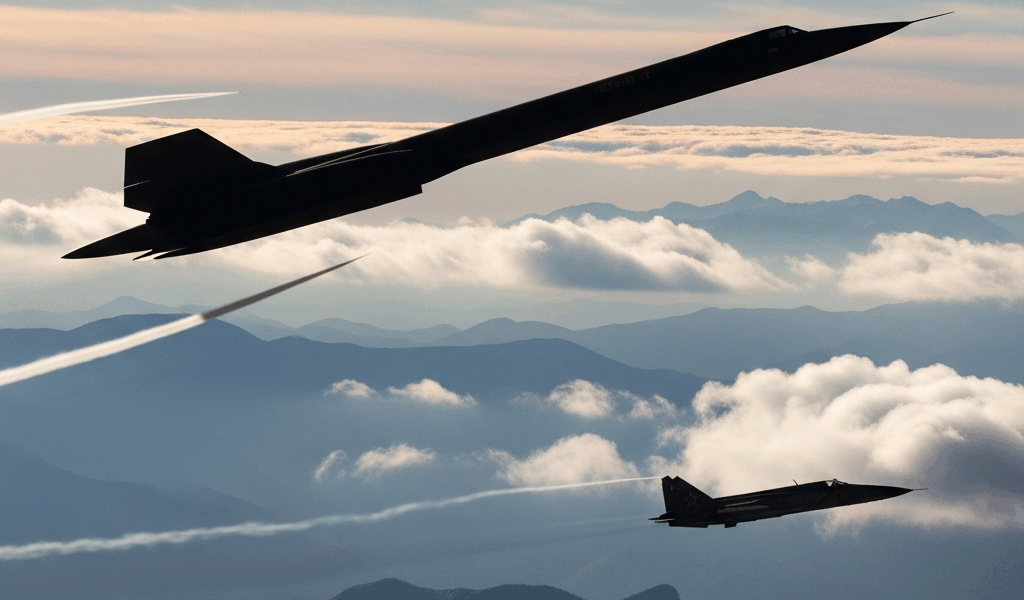
The SR-71 Blackbird and MiG-25 Foxbat were both Mach-class Cold War aircraft, but they were designed for different jobs. The American SR-71 was an unarmed, long-range strategic reconnaissance aircraft built to sustain very high speed and altitude while collecting intelligence. The Soviet MiG-25 family included interceptors and reconnaissance variants; the interceptor carried radar-guided and infrared-guided missiles.
A useful comparison therefore is not simply “which was faster?” It must separate mission, variant, sustained performance, range, sensors, weapons, and intercept geometry. The aircraft never fought a conventional one-on-one engagement.
SR-71 vs MiG-25 at a Glance
| Characteristic | SR-71A Blackbird | MiG-25 Foxbat |
|---|---|---|
| Primary role | Long-range strategic reconnaissance | High-speed interception or reconnaissance, depending on variant |
| Crew | Two: pilot and reconnaissance systems officer | One in principal interceptor and reconnaissance variants |
| Armament | None | Interceptor variants could carry four air-to-air missiles |
| Official speed figure | Mach 3+; 2,193.167 mph class record | Mach 2.83 in the U.S. Air Force museum fact sheet |
| Official altitude figure | Over 85,000 ft; 85,068.997-ft class record | Varied by variant, load, and flight profile; do not compare record zoom climbs with operational ceiling |
| Official range figure | More than 2,900 statute miles in the USAF museum fact sheet, with aerial refueling supporting longer missions | Mission radius and range varied substantially by variant and profile |
| Construction emphasis | Titanium-intensive high-temperature airframe and sustained Mach 3 cruise | Predominantly stainless-steel structure optimized for speed, production, and high-altitude interception |
Different Missions Shaped Everything
The National Museum of the U.S. Air Force describes the SR-71 as a long-range, advanced strategic reconnaissance aircraft developed from the A-12 and YF-12A. It carried no weapons. Its two-person crew operated the aircraft and reconnaissance systems while flying a planned collection route.
The same museum describes the MiG-25 as a high-speed interceptor and reconnaissance aircraft. These roles were distributed among different variants. An interceptor was intended to reach a target track, use radar and ground-control support, launch missiles, and recover. A reconnaissance Foxbat carried a different mission system and should not be treated as an armed interceptor for every comparison.
That mission split explains the basic design difference. The SR-71 needed sustained high-speed cruise, long-range navigation, aerial refueling, sensors, and recovery after an intelligence mission. The MiG-25 interceptor needed rapid climb and acceleration, a powerful radar, missiles, and enough endurance to defend assigned airspace.
Which Aircraft Was Faster?
The strongest documented SR-71 number is its 1976 class record of 2,193.167 mph. The Air Force museum describes it as Mach 3+ and says it remained the world’s fastest and highest-flying operational aircraft during its service. NASA likewise describes Mach 3+ performance.
The Air Force museum lists the MiG-25’s maximum speed as Mach 2.83. Claims that both aircraft were simply “Mach 3.2” often mix a brief MiG-25 overspeed, a design or limit claim, and the SR-71’s sustained operating regime. Maximum indicated Mach number, allowable time at that condition, engine temperature, loadout, altitude, and maintenance consequences all matter.
On the available official figures, the SR-71 had the higher demonstrated sustained high-speed reconnaissance performance. That does not make the MiG-25 slow; Mach 2.83 was extraordinary for an operational interceptor.
Altitude and Climb Performance
The SR-71 fact sheet lists a ceiling above 85,000 feet and documents its 85,068.997-foot class record. From 80,000 feet, the museum states, it could survey 100,000 square miles of Earth’s surface per hour.
MiG-25 altitude claims require more care. A combat-loaded interceptor’s operating ceiling is not the same as a zoom-climb record achieved by converting speed into altitude. A zooming aircraft may briefly reach a remarkable height while losing speed and without the ability to remain there. Comparisons should identify the exact MiG-25 variant, configuration, and whether the number is a service ceiling, dynamic ceiling, or record profile.
The practical issue in an intercept was not altitude alone. The interceptor had to arrive at the correct place, time, heading, and energy state, establish a valid radar and missile solution, and launch while the target continued moving at more than three times the speed of sound.
Why Intercept Geometry Matters
An interceptor does not usually chase a faster aircraft from directly behind and hope to catch it. Ground controllers can place it ahead of the projected route for a crossing or head-on opportunity. Radar performance, warning time, climb schedule, missile envelope, target maneuver, and the target’s ability to leave the engagement zone determine whether a shot is possible.
That is why comparing only top speeds can be misleading. A missile is faster than either aircraft, but it has finite propulsion and loses energy while climbing and maneuvering. A valid launch still depends on range, closure, aspect, altitude, guidance, and the target’s trajectory.
Public accounts often turn these events into precise cockpit stories with dialogue, missile counts, and guaranteed outcomes. Unless an account can be tied to mission records, official histories, or identified participants, it should not be presented as established fact.
Radar, Sensors, and Electronic Countermeasures
The MiG-25 interceptor used a powerful radar and could carry four air-to-air missiles. The Air Force museum notes that analysis after Soviet pilot Viktor Belenko defected to Japan in 1976 revealed a simple but functional design, including vacuum-tube electronics and limited use of titanium.
Vacuum tubes do not by themselves mean the radar was ineffective. They could tolerate temperature and electromagnetic conditions and were part of a system designed for Soviet air-defense operations. Actual capability depended on variant, modernization, ground-control integration, target aspect, and countermeasures.
The SR-71 was not defenseless merely because it carried no weapons. Its protection combined speed, altitude, mission planning, warning equipment, electronic countermeasures, and the ability to change course or increase speed. The Air Force museum preserves an A2C electronic countermeasure specifically designed for the SR-71, contradicting the claim that it had no meaningful defensive electronics.
Airframe and Engine Design
SR-71
Sustained Mach 3 flight created severe heating and inlet-control problems. The SR-71 used a titanium-intensive structure, Pratt & Whitney J58 engines, variable inlet geometry, and specialized fuel. Its airframe and propulsion system were designed to operate together over long supersonic segments.
MiG-25
The MiG-25 used two large Tumansky R-15 turbojets and extensive welded stainless-steel construction. Steel was heavier than a titanium solution but supported a producible airframe able to tolerate high-speed heating. The design was not a crude attempt to copy the Blackbird; it reflected a different mission, industrial approach, and air-defense system.
Did a MiG-25 Ever Shoot Down an SR-71?
No SR-71 was lost to enemy fire. Beale Air Force Base states that none of the 32 aircraft flying operational missions were lost to enemy action. That record includes threats from more than one interceptor and surface-to-air missile system; it does not prove that every reported MiG-25 story occurred exactly as later retellings describe.
The absence of a shootdown is the defensible conclusion. Claims about a specific Middle East engagement, missiles fired, precise miss distances, or cockpit reactions require stronger sourcing than is usually supplied in popular comparisons.
What Viktor Belenko’s Defection Revealed
When Belenko landed a MiG-25 in Japan in September 1976, Western analysts gained direct access to an aircraft that had inspired substantial speculation. The Air Force museum summarizes the finding as a simple-yet-functional design with vacuum-tube electronics, massive turbojets, and sparing use of advanced materials such as titanium.
The inspection corrected exaggerated Western assumptions, but it did not make the Foxbat irrelevant. It remained a capable high-speed interceptor and reconnaissance platform and was widely exported.
Which Aircraft “Won”?
For the narrow question of whether the MiG-25 successfully stopped SR-71 reconnaissance, the Blackbird’s record is decisive: no SR-71 was shot down by enemy action. For the larger engineering question, declaring one universal winner is less useful.
- The SR-71 was the superior sustained high-speed, high-altitude strategic reconnaissance system.
- The MiG-25 was an armed interceptor and reconnaissance family that could be produced and integrated into Soviet air defense.
- The SR-71 had much greater mission-range support through aerial refueling.
- The MiG-25 interceptor could threaten targets; a failed shootdown does not mean it had no military value.
Frequently Asked Questions
Was the MiG-25 built specifically to shoot down the SR-71?
It was designed for high-speed, high-altitude interception amid concern about advanced American bombers and reconnaissance aircraft. Reducing its entire design requirement to one target oversimplifies the Soviet air-defense problem.
Could the MiG-25 fly at Mach 3?
Reports exist of brief speeds around or above Mach 3, but the U.S. Air Force museum lists Mach 2.83 as maximum speed. A brief overspeed should not be treated as equivalent to the SR-71’s sustained Mach 3+ reconnaissance performance.
Did the SR-71 leak fuel on the ground?
Fuel seepage is associated with the thermal expansion and sealing challenges of the Blackbird airframe, but simplified claims that every aircraft always “poured fuel” should be avoided. Maintenance condition, fuel load, temperature, and location mattered.
How many SR-71s were shot down?
Zero were lost to enemy action, according to official Air Force histories.




Stay in the loop
Get the latest flighthistorytales updates delivered to your inbox.