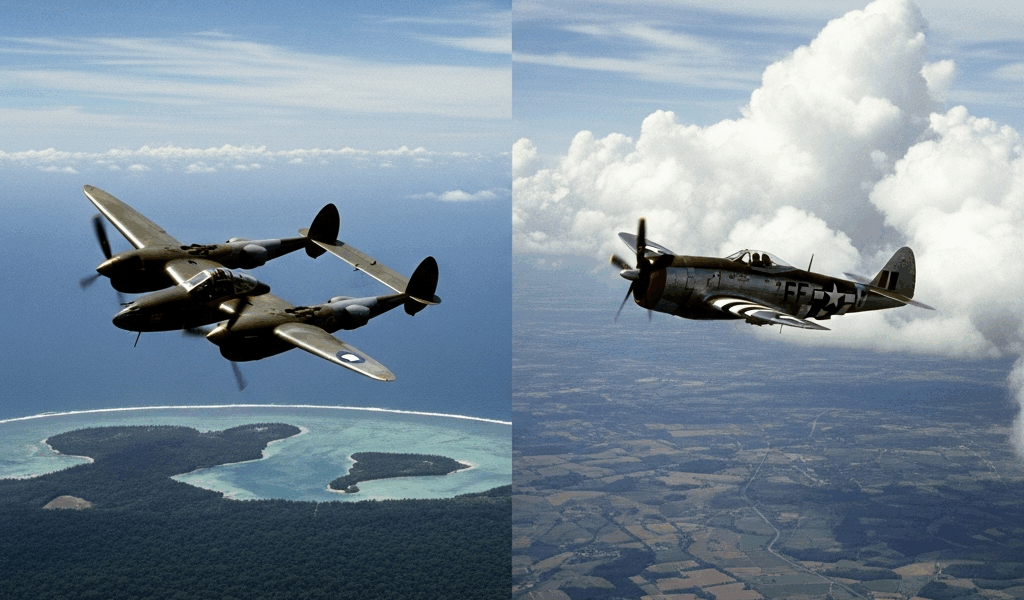
Two Very Different Ideas About What a Fighter Should Be
The P-38 Lightning vs P-47 Thunderbolt debate has gotten complicated with all the armchair analysis flying around — and most people answer it wrong. Not because they get the facts wrong. Because they ask the wrong question entirely. Lockheed built the Lightning around one obsession: reach. Twin Allison V-1710 engines, a twin-boom airframe that looked like nothing else in the sky, and a range that let it go places no single-engine fighter could follow. Republic went the opposite direction. One massive Pratt & Whitney R-2800 Double Wasp radial, an airframe so heavy it outweighed some medium bombers, and a design philosophy that said survivability and firepower mattered more than elegance. These weren’t two answers to the same question. They were answers to completely different questions. That distinction is what this article is actually about. So, without further ado, let’s dive in.
Speed, Range, and Ceiling — Where the Numbers Actually Matter
Let me put the core specs on the table. But I’m going to be direct about what each number actually meant when pilots were making life-or-death decisions at 25,000 feet — because raw figures without context are just trivia.
- P-38J Lightning — Top speed: 414 mph at 25,000 ft. Combat range: approximately 1,300 miles with drop tanks. Service ceiling: 44,000 ft.
- P-47D Thunderbolt — Top speed: 433 mph at 30,000 ft. Combat range: approximately 800 miles with drop tanks. Service ceiling: 42,000 ft.
The Thunderbolt was marginally faster at altitude. Marginally. But that 500-mile range gap was not marginal in any sense. In the Pacific, where island bases were separated by hundreds of miles of open ocean, the P-38’s range was the difference between a mission being possible and it being a suicide note. The P-47 simply could not fly those distances. Full stop.
Flip the theater. Over Western Europe, bomber escort runs to targets inside Germany demanded endurance — but not Pacific-scale range. What they required was surviving a head-on pass from a Focke-Wulf 190, absorbing 20mm cannon fire, and still getting home with fuel to spare. The P-47’s R-2800 radial could take punishment a liquid-cooled engine cannot. Air-cooled radials don’t bleed out when a coolant line takes a round. That mechanical toughness was a tactical asset as real as any speed figure on a spec sheet.
The P-38’s dive behavior was another story. Hit around 500 mph indicated and the Lightning ran into compressibility problems — control got sloppy, recovery felt dicey, and pilots couldn’t reliably chase Luftwaffe fighters down and away. Republic’s engineers accidentally solved this problem with sheer weight. The Thunderbolt dived like a falling anvil and could run down almost anything in a descent. Bounce-and-break tactics — standard Luftwaffe counters to American formations — became a lot less effective against P-47 pilots who understood the vertical.
The Pacific Was Built for the Lightning
As someone who has been fascinated by the Pacific air war since picking up a dog-eared copy of The Ace Factor at a used bookstore for three dollars back in 1998, I keep returning to one mission that defines what the P-38 meant in that theater. Operation Vengeance. April 18, 1943.
American codebreakers had cracked Japan’s naval codes and learned that Admiral Isoroku Yamamoto — architect of Pearl Harbor and the most important operational commander in the Imperial Japanese Navy — would fly from Rabaul to Balalae aboard a pair of Mitsubishi G4M bombers with a Zero escort. The intercept point sat over 400 miles from Henderson Field on Guadalcanal. No P-40. No P-39. No P-47. Only the P-38 could make that flight, execute the intercept, fight the Zeros, and return with the pilots still breathing. Eighteen Lightnings flew the mission at near-wave-top altitude to dodge radar detection. They shot down both bombers. Yamamoto died in the jungle on Bougainville.
That mission wasn’t just a tactical success — it was a demonstration of what range buys you strategically. The P-38’s long legs turned a piece of radio intelligence into a decapitation strike. That’s what makes the Lightning endearing to us Pacific theater enthusiasts.
Then there are the aces. Richard Bong flew the P-38. Forty confirmed kills — the highest total of any American pilot in World War II. Tommy McGuire flew the P-38. Thirty-eight kills, second on the list. Both flew almost exclusively in the Pacific, mostly under Kenney’s Southwest Pacific Air Forces command. Driven by relentless competition and a theater that rewarded range and altitude performance, both men pushed the Lightning to its absolute limits. McGuire died in one, actually — low-speed maneuvering at low altitude, a situation that exposed the P-38’s worst handling characteristics. That’s the honest part of the story. The Lightning demanded respect and punished pilots who gave it none. Don’t make his mistake.
Over Europe, the Thunderbolt Found Its Role
The 56th Fighter Group flew P-47s through the entire war in Europe. Never transitioned to Mustangs. Hub Zemke — their commanding officer — built the group into one of the highest-scoring outfits in the Eighth Air Force using tactics developed specifically around what the Thunderbolt could and couldn’t do. They climbed high, bounced from altitude, and when a fight went sideways they dove away clean. The group finished the war with 674.5 aerial victories. That’s not fate. That’s a commander who understood his equipment and built a system around it.
The Thunderbolt’s eight .50-caliber M2 Browning machine guns — four per wing — produced a volume of fire that was genuinely devastating against aircraft and ground targets alike. Each gun fired at roughly 850 rounds per minute. Eight guns together produced a concentration that would destroy a locomotive, a truck column, or a fighter aircraft with equal efficiency. When the strategic bombing campaign shifted toward interdiction and ground attack in 1944, the P-47 became the preferred weapon. Fast enough to evade light flak, tough enough to absorb medium flak hits, and lethal enough to actually matter on the ground.
Probably should have opened with this section, honestly — the ground-attack role is where the Thunderbolt’s reputation was permanently cemented, and it gets lost in the escort conversation more often than it should. Yes, the P-51 Mustang eventually replaced the P-47 as the premier long-range escort once drop tank logistics improved and the Merlin-engined Mustang proved what it could do deep inside Germany. That replacement doesn’t erase what the Thunderbolt accomplished from 1942 through 1944. It just means the Thunderbolt got reassigned to a job it was genuinely better at anyway.
So Which Fighter Actually Won — and Why It Depends on the Map
Here is the answer, stated plainly. In the Pacific theater, the P-38 Lightning was superior. Its range wasn’t a minor advantage — it was the only reason certain missions existed at all. Bong and McGuire didn’t become America’s top aces in an inferior aircraft. They became America’s top aces because the P-38 gave them exactly what the Pacific demanded: altitude, range, and enough firepower concentrated in the nose to end engagements fast.
In the European theater, the P-47 Thunderbolt was the better fit. Its survivability in a high-threat environment, its firepower, and its natural talent for ground attack made it a weapon the USAAF would have been measurably weaker without. The eventual shift to the P-51 for deep escort duty reflected a specific logistical and strategic evolution — not a verdict on the Thunderbolt’s quality as a fighter.
But what is the real takeaway here? In essence, it’s that neither aircraft is universally superior. But it’s much more than that — it’s a reminder that the question “which fighter dominated” only gets a real answer when you specify where the fighting was happening. Context isn’t a hedge. It’s the actual answer. The map decided this one. Not the spec sheet.

Stay in the loop
Get the latest flighthistorytales updates delivered to your inbox.