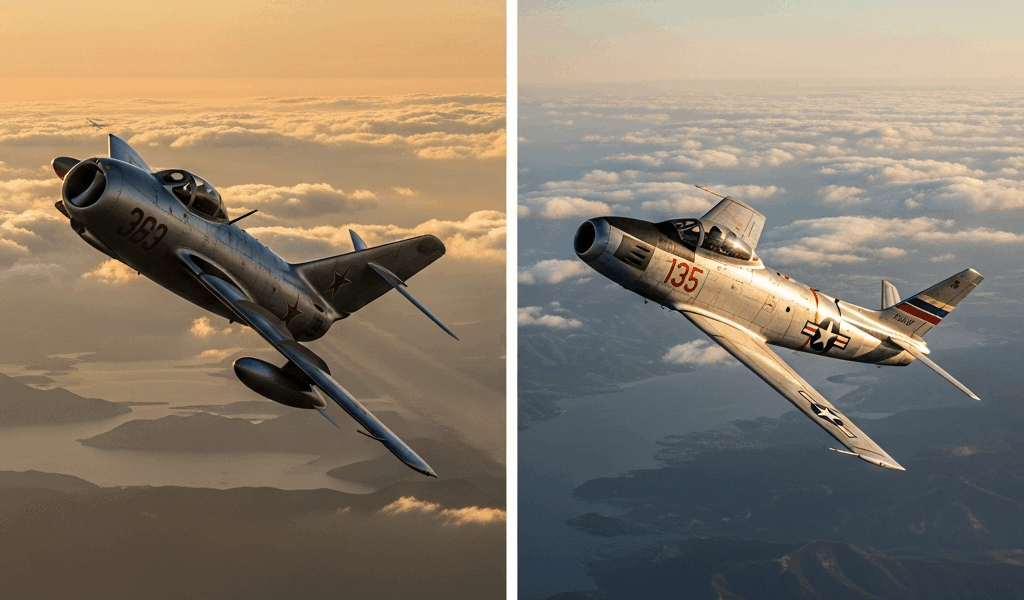
Two Jets That Shocked the World
The MiG-15 vs F-86 Sabre debate has gotten complicated with all the myth, nationalistic revisionism, and flat-out bad math flying around. As someone who has spent probably too many late nights digging through declassified USAF after-action reports, Soviet archival material that only surfaced after 1991, and first-person pilot memoirs, I learned everything there is to know about this air war. Today, I will share it all with you — including the parts most comparison articles quietly skip.
Korea was the first sustained jet-vs-jet conflict in history. Neither Washington nor Moscow saw it coming, which is maybe the most important thing to understand before any of the specs matter. When MiG-15s tore through a B-29 Superfortress formation over North Korea in November 1950, they didn’t just destroy bombers. They ended an assumption. The idea that propeller-era air superiority doctrine could survive into the jet age died somewhere over the Yalu River, and both superpowers spent the next decade scrambling to figure out what replaced it.
MiG-15 vs F-86 By the Numbers
But what is the MiG-15, really? In essence, it’s a swept-wing, single-engine Soviet interceptor that entered service in 1949. But it’s much more than that — it was the aircraft that proved the USSR could match Western aerospace engineering almost overnight, partly because the West handed them a shortcut.
Both jets were powered by derivatives of the same British Rolls-Royce Nene turbojet. The Soviets licensed it in 1947. That fact still feels almost too strange to be true. The Americans had their own development path, but the technology family tree is uncomfortably close — closer than Cold War mythology tends to admit.
Where the MiG Had the Edge
- Service ceiling: The MiG-15bis reached approximately 50,800 feet. The F-86A topped out closer to 47,200 feet. That 3,600-foot gap sounds like a rounding error on paper. In combat, it was enormous.
- Climb rate: The MiG climbed faster, period. Soviet test data puts the bis variant at roughly 10,600 feet per minute at sea level — a number that made USAF planners genuinely uncomfortable when it first surfaced.
- Armament: Two 23mm NR-23 cannons plus one 37mm N-37. Brutal hitting power at a level the Sabre couldn’t match round-for-round. A single 37mm hit could take a wing clean off a B-29.
- High-altitude speed: Above 35,000 feet, the MiG had the speed advantage. North Korean and Chinese pilots — when they were coached correctly — learned to attack from altitude and extend away when the fight turned against them.
Where the Sabre Had the Edge
- Handling below 30,000 feet: The F-86’s hydraulically boosted controls gave pilots a responsiveness the MiG simply couldn’t match in a low-altitude turning fight. This one characteristic shaped American tactical doctrine for the entire war.
- Visibility: The Sabre’s bubble canopy was a genuine life-or-death advantage. MiG pilots were stuck with a framed canopy that created real blind spots. In a scissors maneuver — where situational awareness is everything — that visibility difference cost lives.
- Gun-ranging radar: The F-86E and later variants carried an AN/APG-30 radar ranging system. Not glamorous. Not the kind of thing that ends up on a recruitment poster. But it made the six .50-caliber M3 machine guns dramatically more accurate on deflection shots.
- Dive speed: The Sabre could push close to Mach 1 in a dive without the severe control reversal problems that plagued the MiG-15 at high indicated airspeeds — a quirk Soviet test pilots had flagged before the war and never fully resolved.
The .50-caliber vs. 23mm/37mm debate deserves its own paragraph. The MiG’s cannons hit harder per round — no argument there. But they fired slowly and demanded precise tracking to land hits. The Sabre’s six M3s produced a combined rate of fire around 6,000 rounds per minute. In snapshot engagements lasting under two seconds, volume of fire mattered more than individual round energy. Most kills in Korea happened fast. Very fast.
MiG Alley and What Actually Happened Up There
MiG Alley wasn’t invented by journalists looking for a headline. It was the working name USAF pilots used for a corridor along the Yalu River in northwestern Korea — roughly between Sinuiju and Sinanju. Flying there meant flying near the Chinese border. And flying near the Chinese border meant flying under political constraints that Soviet and Chinese pilots simply didn’t face.
American pilots could not cross into Manchuria, even in hot pursuit. That was the rule, and it was enforced. MiG pilots could disengage, climb above engagement altitude, and reset whenever the fight went against them. That’s not a hardware advantage — it’s a rules-of-engagement advantage, and it saved a significant number of MiGs that would otherwise have been finished off.
Frustrated by how consistently this gets buried in Western accounts, I went back through the memoirs of Colonel Francis “Gabby” Gabreski, a double ace from World War II who flew Sabres in Korea using his own well-worn copy of the same tactical instincts that had kept him alive over Europe. His accounts describe MiG formations that clearly included experienced Soviet pilots — aggressive, tactically sound, willing to press an attack — mixed with Chinese and North Korean pilots who were nowhere near that standard.
The Soviets were officially not there, of course. The 64th Fighter Aviation Corps flew with Soviet markings stripped from their aircraft, pilots occasionally using broken English on radio to pass as Chinese or Korean fliers. It fooled nobody. Captain Joseph McConnell, the top American ace of the war with 16 kills, described engagements where he could identify the difference in pilot quality purely from how the aircraft was handled — before a single shot was fired. Against Soviet veterans, the fight was close and dangerous. Against inexperienced Chinese pilots, the Sabre’s handling advantages were overwhelming. That pilot quality gap explains more about the outcome of the air war than any spec sheet comparison ever will.
The Kill Ratio Controversy
Probably should have opened with this section, honestly — it’s where the entire debate actually lives.
The USAF officially claimed a 10:1 kill ratio by war’s end. 792 MiGs destroyed against 78 Sabres lost in air-to-air combat. That number was briefed to Congress, published in press releases, and repeated in virtually every Western aviation history written before 1990. It became gospel. It was also almost certainly wrong.
The revisionist case gained serious traction in the 1990s when Soviet and Chinese archives became partially accessible. Researcher Xiaoming Zhang’s work on Chinese air force records — and material published in Air Power History in 2002 — suggested actual ratios closer to 2:1, maybe 3:1 on a strong day for the USAF. The discrepancy is large enough that it demands a real explanation, not a dismissal.
Here’s where the inflation came from. American pilots claimed kills based on seeing aircraft smoking or spinning away — reasonable in the heat of a two-second engagement, but not always confirmed. MiG wrecks that fell in Manchuria were uncountable by definition. The USAF had institutional incentives to report high ratios. So did Soviet and Chinese commands, which systematically underreported their own losses. Both sides lied, in other words. The truth is probably somewhere in the gap between two competing sets of propaganda, and anyone who tells you they’ve pinned it down precisely is selling something.
What the kill ratio debate actually measures is contested — and that’s the part that matters most. If the MiG-15 was technically competitive with or superior to the F-86 in several key performance categories, then any ratio above 1:1 in favor of the Sabre demands an explanation. The explanation isn’t the aircraft. It’s the pilots, the tactics, the experience gap, and the geographic constraints that let American pilots choose their engagements far more selectively than the raw numbers suggest.
So Which Jet Actually Won Korea
Shaped by years of reading pilot accounts and staring at performance charts that seem to contradict each other, I’ve landed somewhere that will frustrate anyone looking for a clean verdict. The F-86 Sabre won in practice. The MiG-15 was never outclassed in the air. Those two statements are compatible — and understanding why they’re both true is the whole point.
American pilots — many of them veterans who had fought Messerschmitt Bf 109s and Focke-Wulf Fw 190s over occupied Europe — brought a tactical maturity that no aircraft upgrade can replicate. They knew how to manage an engagement. They knew how to use the Sabre’s low-altitude handling to negate the MiG’s ceiling advantage, and how to deny Soviet pilots the high-altitude perch from which the MiG-15 was genuinely lethal. That’s not luck. That’s training, institutional culture, and hard-won knowledge carried over from a previous war.
I’m apparently stubborn about this point, and every primary source I’ve read reinforces it while secondary sources keep muddying it. The MiG-15 in experienced Soviet hands was a serious, dangerous machine. Several USAF veterans said exactly that in after-action interviews, and there’s no reason to dismiss their honesty. The aircraft could climb above a Sabre formation, pick its moment, and be back over Manchuria before a pursuit could close the range. Don’t make my mistake of assuming the specs alone tell you who had the better fighter. They don’t.
This new idea — that human performance ceilings matter more than hardware ceilings — took off several years later and eventually evolved into the Red Flag exercises at Nellis Air Force Base in Nevada that fighter pilots know and train through today. That program, launched in 1975, exists specifically to give pilots realistic adversarial experience before they need it in actual combat. The MiG-15 and the Sabre didn’t just fight each other over the Yalu River. That’s what makes this rivalry endearing to us aviation history obsessives — they quietly rewrote how the entire Western world thought about what it actually takes to win an air war.


Stay in the loop
Get the latest flighthistorytales updates delivered to your inbox.