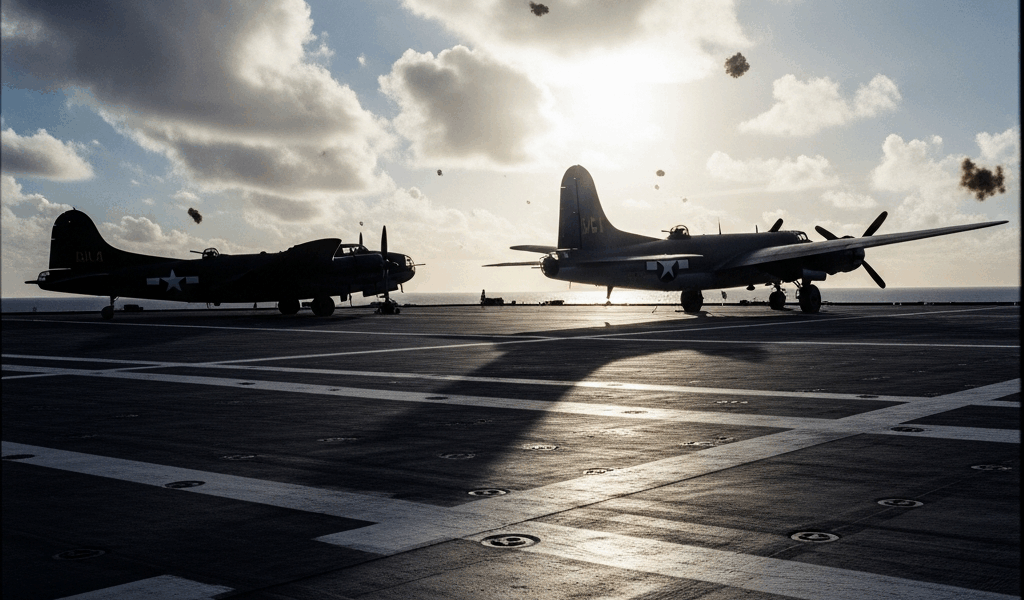
B-17 vs B-29 — Which Bomber Actually Won WW2
The B-17 vs B-29 debate has gotten complicated with all the spec-sheet noise flying around. It sounds like a trivia question. It isn’t. As someone who spent years buried in mission reports, crew memoirs, and declassified AAF loss statistics, I learned everything there is to know about what these two aircraft actually did — and what it cost the men inside them. Today, I will share it all with you.
The honest answer is messier than any horsepower comparison makes it look. These aircraft weren’t rivals. They were built for completely different strategic realities, separated by four years of hard and bloody lessons. One bomber shaped the doctrine. The other delivered the verdict.
Two Bombers, Two Wars, Two Jobs
But what is the B-17 Flying Fortress, in its strategic context? In essence, it’s a 1930s idea made airborne — that a heavily armed, self-defending bomber in tight formation could fight its way to a target and back without fighter escort. In essence, it was audacious theory. But it was much more than that — it was a doctrine written in crew blood before anyone knew the true cost.
The B-17 entered serious combat in 1942. The B-29 Superfortress flew its first combat mission in 1944 — built around an entirely different premise. Pressurized cabin. Remote-controlled gun turrets tied to a central fire-control system. An operational ceiling above 30,000 feet. A range that made the B-17 look short-legged. Boeing’s internal model number for the Superfortress contract was the Model 345. The B-17 was the Model 299. The gap between those numbers is, roughly, the gap in philosophy.
Europe demanded sustained medium-altitude precision strikes against an industrial nation with a mature air defense network. The Pacific demanded reaching targets across thousands of miles of open ocean. So, without further ado, let’s dive in — because this isn’t apples to oranges. It’s asking which tool solved which problem, and which solution actually ended the war.
What the B-17 Actually Did Over Europe
Probably should have opened with this section, honestly. Nothing else in this comparison lands until you feel what a 25-mission tour in 1943 actually meant.
Flying a B-17 over Germany in 1943 was one of the most statistically lethal assignments in the entire war. Early in the Eighth Air Force’s daylight bombing campaign, the odds of finishing a 25-mission tour sat somewhere below 50 percent. Some estimates push survival odds closer to one in three for crews flying in late 1942 through most of 1943. Those aren’t movie numbers. That’s a coin flip — badly weighted against you.
The Schweinfurt-Regensburg raid on August 17, 1943 proved both the B-17’s toughness and the fatal limits of the self-escorted daylight bombing concept simultaneously. Sixty aircraft lost — 600 men — out of 376 dispatched. One mission. The second Schweinfurt raid in October 1943 cost another 60 bombers. In a week. The B-17 could absorb flak damage that would have disintegrated a lesser aircraft. Crews flew home on two engines with hydraulics shot out and half a tail missing. The stories are real. The loss rates were also real.
What changed everything was the P-51D Mustang — the long-range North American Aviation P-51D-15-NA, to be exact — arriving in numbers by early 1944. Suddenly the B-17 wasn’t fighting alone anymore. The Combined Bomber Offensive that followed genuinely dismantled German oil production, transportation networks, and fighter manufacturing. By spring 1945, the Luftwaffe was running out of fuel. The B-17 didn’t win by being invincible. It won by absorbing catastrophic losses long enough for the doctrine to get fixed around it. That’s what makes it endearing to us aviation history people — the sheer stubborn cost of what it proved.
What the B-29 Changed About Strategic Bombing
The B-29 was a technological leap so large it nearly killed itself during development. The Wright R-3350 Duplex-Cyclone engines — 2,200 horsepower each — had a documented tendency to catch fire in the nacelles behind the cowling baffles. Early B-29 crews called it “the three-engine airplane.” Zero affection in that nickname. Test pilot Eddie Allen died in a B-29 engine fire over Seattle in February 1943. The aircraft was dangerous before it ever crossed the Pacific.
Frustrated by persistent engine fires and unreliable cowl flap cooling, Boeing engineers and Army Air Forces maintenance crews eventually wrestled the R-3350 down to an acceptable — if never entirely comfortable — failure rate using revised baffles and modified oil systems. Then General Curtis LeMay made a decision that almost no other commander would have made. High-altitude precision bombing of Japan wasn’t working. Jet stream interference at altitude, unpredictable weather, and the scattered nature of Japanese industry made it ineffective. So LeMay stripped the defensive gun systems from his B-29s, loaded them with M69 incendiary clusters at roughly 17,000 pounds per aircraft, and sent them in at night at 5,000 to 9,000 feet.
The March 9–10, 1945 firebombing of Tokyo killed an estimated 80,000 to 100,000 people in a single night. Sixteen square miles of the city gone. That raid — and the dozens that followed against Osaka, Nagoya, Kobe, and 58 other Japanese cities — broke Japanese industrial capacity in ways that high-altitude precision bombing never approached. Hiroshima and Nagasaki on August 6 and 9, 1945 used the same B-29 airframes. The Enola Gay was a modified B-29B, tail number 44-86292, assigned to the 509th Composite Group at Tinian. Those two missions get all the historical attention. The firebombing campaign that came before them was arguably more decisive in total damage delivered.
The B-29 was terrifying to fly — and also the most sophisticated production aircraft built to that point, with pressurized forward and aft crew compartments connected by a tunnel running over the unpressurized bomb bays. Missions from the Mariana Islands to Japan ran 14 to 16 hours round trip. I’m apparently someone who fixates on crew endurance data, and the B-29’s operational profile works for me analytically while the B-17’s European numbers never quite leave you alone emotionally. Don’t make my mistake of treating these as simple comparisons.
Crew Experience, Range, and Survivability Compared
Here are the numbers that matter — anchored to what they meant for the men inside.
- Combat radius — B-17G: approximately 800 miles with a standard bomb load. B-29: approximately 1,600 miles with comparable payload. The B-29 could reach targets the B-17 couldn’t touch from any available base.
- Bomb load — B-17G: roughly 4,500 to 6,000 pounds on long missions. B-29: up to 20,000 pounds. More than three times the payload per aircraft.
- Service ceiling — B-17G: rated at 35,600 feet, though operational loads pushed crews closer to 25,000–27,000 feet in practice. B-29: 31,850 feet operational — though LeMay flew them at 5,000–9,000 feet for the incendiary campaign, which tells you altitude was never the whole answer.
- Crew size — B-17: 10 men. B-29: 11 men. Similar exposure per mission, radically different tactical environments surrounding them.
B-17 crews survived through collective defense. Tight 12-ship box formations created overlapping fields of fire from their thirteen .50-caliber M2 Browning guns. Drift out of formation — mechanical trouble, a wounded pilot, shot-out engines — and you were finished. The formation was your armor. Period.
B-29 crews survived through altitude, speed, and darkness. LeMay’s low-altitude incendiary shift removed most of those advantages, which is why B-29 losses to Japanese night fighters and anti-aircraft fire climbed after the tactical change. Still, B-29 crew loss rates over Japan never approached the catastrophic figures the Eighth Air Force posted over Germany in 1943. The Pacific air defense environment was simply less lethal than the German one — not because the B-29 was inherently safer hardware.
Which Bomber Actually Mattered More to the War’s Outcome
Here is the verdict. No hedging.
The B-29 ended the war in the Pacific. Full stop. No other aircraft in the Allied inventory could have done it — sustained strategic bombing from island bases across open ocean, carrying the payload needed to burn Japan’s cities, and then deliver two nuclear weapons to Hiroshima and Nagasaki. That strategic impact is not up for debate.
But the B-17 paid for everything the B-29 later used. The doctrine of high-altitude strategic bombing was tested, broken, and rebuilt in European skies between 1942 and 1944. The industrial base that eventually produced 3,970 B-29s was funded by the same wartime production surge that built 12,731 B-17s. The hard lesson that heavy bombers needed long-range fighter escort — learned in blood over Schweinfurt — was applied in the Pacific before the B-29 campaign ever got started. The B-17 paid for those lessons in crew lives. That was 1943. The bill was enormous.
So here’s the actual call. The B-29 wins on strategic impact — it delivered the blow that ended the war. The B-17 wins on historical significance to American air power doctrine — without the lessons it proved and the losses it absorbed, the B-29 campaign doesn’t happen, or it happens wrong and costs far more. One bomber was the education. The other was the final exam. That’s what makes the comparison endearing to us who study this period — both answers are correct, and neither one cancels the other out.
Giving the B-29 the victory here isn’t disrespect to the men who flew B-17s into the worst odds of the war. It’s the opposite. Their sacrifice built the foundation. Both bombers mattered. But only one of them ended a war in a matter of months — and that answer deserves to be said plainly.

Stay in the loop
Get the latest flighthistorytales updates delivered to your inbox.