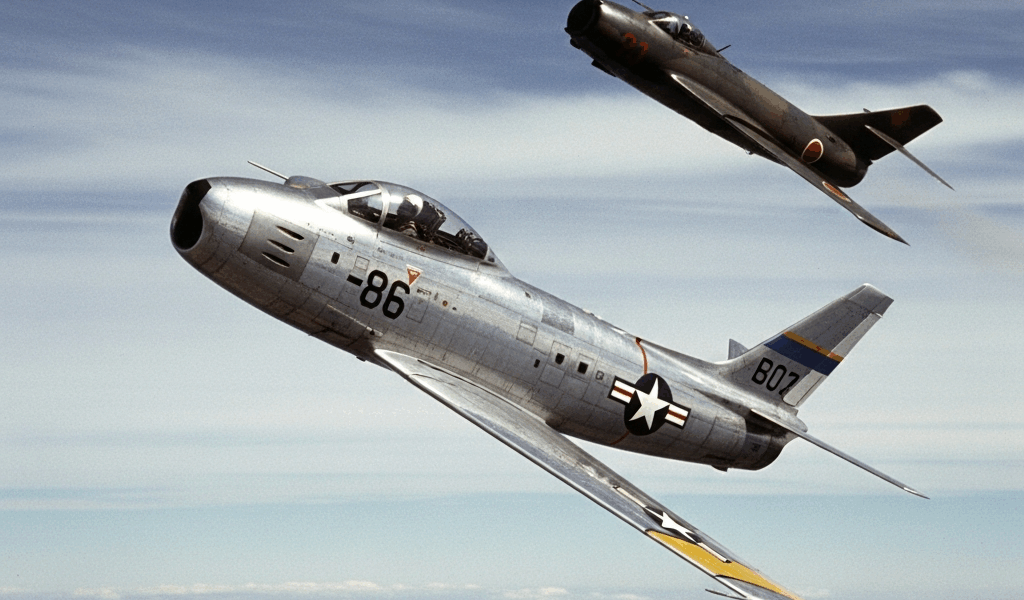
F-86 Sabre vs MiG-15 — Which Korean War Fighter Was Actually Better?
The F-86 Sabre vs MiG-15 debate has gotten complicated with all the mythology and museum-placard thinking flying around. As someone who spent years buried in declassified after-action reports, Soviet archival material, and pilot memoirs that only surfaced after the Cold War finally loosened its grip, I learned everything there is to know about this matchup. What I found genuinely surprised me. The aircraft that dominated the kill board wasn’t necessarily the better machine — and that distinction matters more than most people want to admit.
This article includes affiliate links. We may earn a commission at no extra cost to you.
Two Jets, One Alley — The Setup
Between 1950 and 1953, a narrow corridor of airspace over northwestern Korea became the proving ground for the entire jet age. MiG Alley — American pilots coined that name — ran roughly from the Yalu River south toward Pyongyang. Maybe 100 miles of sky. That’s where two completely different design philosophies collided at 500 miles per hour.
First sustained jet-versus-jet air combat in history. Full stop. World War II ended before jets ever met in meaningful numbers. Korea changed that overnight.
The United Nations air forces, led by the USAF, flew the North American F-86 Sabre. North Korean and Chinese forces flew Soviet-built MiG-15s — and for long stretches of the war, actual Soviet pilots sat in those cockpits, operating under a thin fiction Moscow called “volunteering.” Everyone knew better, including Moscow.
Geography shaped everything here. MiG bases sat in Manchuria, across the Chinese border, where UN aircraft were forbidden to follow. A MiG pilot having a bad day could simply fly north. That strategic reality — the permanent exit ramp — lived inside every engagement. It also means the kill ratios people love to cite exist inside a context that’s easy to strip away when all you want is a clean number.
The MiG-15 Advantage — Climb, Speed, Firepower
But what is the MiG-15, really? In essence, it’s a Soviet swept-wing fighter that shocked Western observers when it first appeared. But it’s much more than that — it’s what happens when you hand a capable engineering team a Rolls-Royce engine and tell them to build something dangerous.
Don’t make my mistake. I assumed early on that the F-86 was the superior aircraft because it won. Backwards reasoning. It took reading actual Soviet pilot accounts — translated, annotated, unglamorous stuff — to correct that assumption.
The MiG-15bis, the definitive production variant showing up in numbers by 1951, was a genuinely formidable machine. Its Klimov VK-1 engine traced its lineage directly to the Rolls-Royce Nene that Britain sold to the Soviets in 1947 — a decision Churchill later called one of the greatest acts of folly he’d witnessed. That engine pushed the MiG to roughly 668 mph at altitude. The F-86A hit around 685 mph at sea level but fell off more sharply as altitude climbed.
The MiG’s climb rate was brutal. Forty thousand feet faster than the Sabre could follow. In practical terms, MiG pilots could dictate the engagement — climb above the Sabres, pick their moment, dive through the formation with those heavy cannons blazing, then zoom back up before anyone could respond. Energy advantage. Decisive in fighter combat, always.
Armament favored the MiG considerably. One 37mm N-37 cannon, two 23mm NR-23 cannons — versus the Sabre’s six M3 .50-caliber machine guns. The 37mm round was slow, around 690 meters per second muzzle velocity, which made deflection shooting genuinely difficult. But when those shells connected, aircraft came apart. One 37mm round finding a bomber was typically catastrophic, full stop.
Service ceiling: roughly 50,850 feet for the MiG versus about 48,000 feet for the F-86A. At extreme altitude the Sabre’s controls went heavy and sluggish. The MiG could park above that ceiling and be essentially untouchable.
On paper — if you’re buying aircraft for a war and you’ve never trained a single pilot — you probably buy the MiG-15.
The F-86 Sabre Advantage — Diving, Turning, Gunsight
Sabre pilots learned quickly to turn the MiG’s strengths into liabilities. That’s what makes the F-86 endearing to us aviation enthusiasts — not raw performance numbers, but the way the aircraft became a tool that skilled hands could wield cleverly.
The Sabre dove faster. Not by a little. Its all-moving horizontal stabilizer — a design detail that sounds dry until you understand the implications — gave pilots full pitch control even in transonic flight. The MiG’s conventional stabilizer caused control reversal problems near Mach 1. Sabre pilots learned this, apparently fairly early, and exploited it without mercy. When a MiG dove after them, they pushed over harder. The MiG either followed into serious controllability trouble or broke off entirely.
Below 30,000 feet, the F-86 turned tighter. Sabre pilots developed a habit of dragging MiGs down from altitude — accepting the climbing disadvantage upfront just to get the engagement started below their enemy’s comfort zone. Tactical patience, basically.
The AN/APG-30 radar-ranging gunsight deserves more credit than it typically gets. This wasn’t a sophisticated targeting computer — it was a relatively simple radar unit that measured range and automatically adjusted the gunsight’s lead computation. Pilots still had to fly the solution themselves. But the system removed one of the hardest mental calculations in aerial gunnery, right at the moment stress made that calculation nearly impossible. The MiG ran optical gunsights. Good ones — but optical. In a high-speed turning fight, that gap mattered.
American pilots also wore anti-G suits — inflatable bladders sewn into the legs and abdomen, squeezing blood back toward the brain during hard maneuvering. Soviet pilots in Korea often flew without them or with noticeably inferior versions. A pilot who grays out at 6 Gs loses the fight instantly. The suit sounds mundane. It wasn’t.
Pilot Quality Made the Real Difference
Probably should have opened with this section, honestly. Everything above — the gunsight, the dive characteristics, the anti-G suit — becomes secondary once you understand who was actually sitting in these cockpits.
Early Soviet pilots in MiG Alley were genuinely good. Several were World War II veterans carrying hundreds of combat hours. Ivan Kozhedub — highest-scoring Allied ace of the entire war — commanded a MiG regiment in China during the conflict, though he apparently never flew combat missions over Korea himself. The pilots he trained did, and early engagements in 1950 and into 1951 were legitimately dangerous for Sabre pilots. No comfortable margin there.
Then something shifted. Soviet leadership rotated experienced pilots out — partly to maintain the fiction of non-involvement by cycling personnel before anyone could be captured or properly identified, partly to spread combat experience across the broader Soviet air force. What replaced those veterans were often Chinese and North Korean pilots with minimal jet time and zero combat experience.
Frustrated by the institutional pressure to rotate talent out, some Soviet commanders apparently argued against the policy. Didn’t matter. Those replacement pilots — trained on fundamentals but handed perhaps 20 hours of jet time before combat — flew the mechanically superior MiG-15 against American aviators averaging over 100 combat hours in jets, many with World War II propeller experience stacked on top. The outcome was predictable.
The officially claimed kill ratio ran 10:1 in favor of the F-86. Postwar analysis, including direct examination of Soviet records that opened up decades later, suggests the real figure sat closer to 2:1 or 3:1. Still a meaningful American advantage — just not the lopsided rout the official numbers implied.
Francis “Gabby” Gabreski — one of the top USAAF aces of World War II, flying Sabres in Korea by then — described engagements where MiG pilots simply didn’t know what to do when a fight devolved into close turning work. They had the aircraft to win it. They didn’t have the instincts to execute.
The Verdict — The F-86 Won the War in the Air
The MiG-15 was the better aircraft. I’ll commit to that without hedging. On climb rate, service ceiling, raw firepower, and high-altitude performance, the MiG-15bis beats the F-86A — and holds its own against the later F-86F variants that arrived in 1953. Soviet and Chinese engineers built something genuinely excellent, especially considering they were working from a near-standing start in jet aviation just a few years after the war ended.
This new idea — the swept-wing, cannon-armed interceptor — took off several years after initial development and eventually evolved into the MiG legacy that aviation enthusiasts know and argue about today.
But the F-86 won the war in the air over Korea. And the reasons tell you something real about what air superiority actually demands.
While you won’t need every tactical advantage in the book, you will need a handful of critical edges working together simultaneously. First, you should have pilots who can execute complex maneuvers under genuine stress — at least if you want them to survive long enough to matter. The gunsight might be the best option, as aerial combat requires instant, accurate gunnery solutions. That is because the cognitive load of manual lead calculation under high-G stress exceeds what most humans can reliably manage.
The Sabre delivered a complete package — capable airframe, a gunsight that reduced cognitive load at the worst possible moments, an anti-G suit keeping pilots conscious through hard turns, and a training pipeline producing aggressive, experienced aviators. The MiG handed its pilots a faster, higher-climbing machine — and, increasingly, not nearly enough preparation to exploit it.
When people ask which jet I’d rather have flown in MiG Alley, the answer is always the Sabre. Not because it climbed better. Not because it was faster at altitude — it wasn’t. Because I’d rather have the gunsight, the G-suit, and 500 hours of hard training than an aircraft that theoretically outperforms mine if I can somehow figure out how to use it under fire. Combat doesn’t offer figuring-out time. You execute what you already know, or you don’t come home.
The F-86 Sabre won. The MiG-15 was better on paper. Both things are true, and neither one cancels the other out.


Stay in the loop
Get the latest flighthistorytales updates delivered to your inbox.