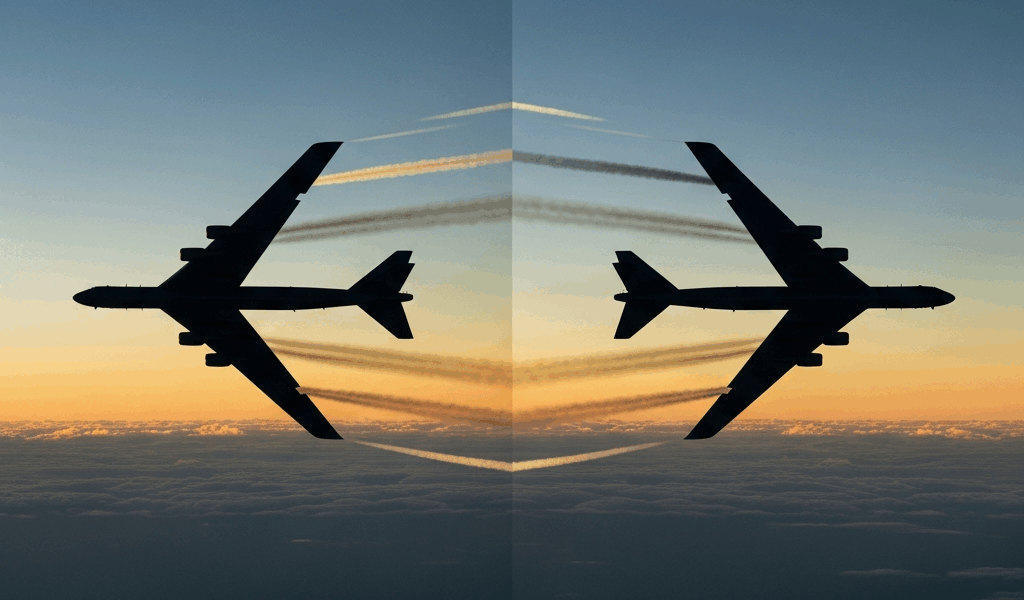
B-52 Stratofortress vs Tu-95 Bear — Cold War Skies
Two Bombers Built to End the World
The B-52 Stratofortress vs Tu-95 Bear cold war skies matchup has gotten complicated with all the myth and oversimplification flying around. As someone who spent years buried in declassified mission reports, crew memoirs, and RAND Corporation analyses on strategic airpower, I learned everything there is to know about what made these machines genuinely terrifying. Today, I will share it all with you.
What keeps pulling me back isn’t the specs — it’s the weight of what these aircraft actually represented. Two superpowers, separated by an ocean and an ideology, each built a bomber capable of erasing cities. Each then spent roughly forty years daring the other to blink. The B-52 first flew in April 1952. The Tu-95 followed that November. Both were conceived inside the same brutal logic: that peace required the constant, credible threat of annihilation. That context — mutual assured destruction as a literal design requirement — is what makes this comparison worth your time.
Design and Engineering — How They Were Built to Survive
But what is the core difference between these two programs? In essence, it’s a choice between jet efficiency and turboprop endurance. But it’s much more than that.
Boeing went with eight turbojet engines and a swept-wing configuration built for high altitude and speed. The B-52B entered service producing roughly 12,100 pounds of thrust per engine — J57-P-1W powerplants, if you want to get specific. Clean. Modern. A jet solution to the problem of intercontinental nuclear delivery.
Tupolev’s engineers made a different call entirely. They chose turboprop engines — specifically the Kuznetsov NK-12, a genuinely massive piece of hardware spinning contra-rotating propellers and producing around 15,000 shaft horsepower per unit. Four of them. The sound is something NATO intercept crews never forgot — a deep mechanical shriek, unmistakable on radar approaches. Unsettling doesn’t cover it. The turboprop choice came down to fuel efficiency at cruise altitude, which translated directly into range. Some Tu-95 variants could reach approximately 9,400 miles unrefueled. The Bear was built to loiter. The Stratofortress was built to penetrate. That distinction defined everything that came after.
That penetration mission eventually created a serious problem. By the late 1950s, Soviet surface-to-air missile technology — the S-75 Dvina, NATO designation SA-2 — made high-altitude intrusion suicidal. Francis Gary Powers found that out in May 1960. The B-52 had to evolve fast. SAC crews began training for low-level terrain-following runs, sometimes at 500 feet or below, threading under radar coverage. The airframe wasn’t designed for that kind of sustained buffeting — fatigue cracking became a real structural headache on early models. The Tu-95 never made that transition. It leaned into standoff capability instead, eventually becoming a cruise missile carrier rather than a penetrating platform. Two different answers to the same missile problem. That’s what makes this rivalry endearing to those of us who study strategic airpower.
Combat and Cold War Deployments — What They Actually Did
Probably should have opened with this section, honestly. This is where both aircraft stop being engineering exercises and become actual history.
The B-52 Over Vietnam and the Gulf
Operation Arc Light began June 18, 1965 — 27 B-52Fs out of Andersen Air Force Base on Guam, hitting Viet Cong positions in Binh Duong Province. The strike was a logistical near-disaster. Two aircraft collided during mid-air refueling. Eight crew members died. Despite that, it launched a campaign that eventually saw B-52s fly more than 126,000 sorties over Southeast Asia — conventional iron bombs, not nuclear weapons, dropped in massive area saturation attacks. Survivors on the ground described it as an earthquake that moved horizontally.
Linebacker II in December 1972 put the B-52 into a different kind of fight. North Vietnamese SA-2 batteries downed fifteen B-52s over eleven days. Crews called it the most intense air defense environment American bombers had faced since the Schweinfurt raids. The aircraft took that punishment and kept flying. Don’t underestimate what that means operationally.
Then Desert Storm, 1991. B-52Gs flying out of Barksdale Air Force Base in Louisiana completed what was then the longest combat mission in history — a round trip of roughly 14,000 miles — launching AGM-86C conventional air-launched cruise missiles at Iraqi targets. A jet built to deliver hydrogen bombs had become a precision standoff platform. That adaptability is the B-52’s defining characteristic, full stop.
The Tu-95 Probing NATO’s Edges
The Bear’s combat record looks quieter on paper. That’s partly because its primary mission was strategic deterrence — show up, get seen, leave. Soviet Tu-95 crews flew regular penetration routes toward NATO airspace throughout the Cold War, and the intercepts became almost ritualistic. RAF Lightnings, later Tornados, American F-15s scrambling out of Lakenheath — they’d pull alongside a Bear somewhere over the Norwegian Sea at around 25,000 feet, and occasionally the crews would wave at each other. Professional. Tense. Completely insane when you consider what each aircraft was carrying.
One specific incident worth naming: following the shootdown of Korean Air Lines Flight 007 in September 1983 and the subsequent spike in Cold War tensions, Tu-95 patrols over the North Atlantic increased dramatically. NATO fighter scrambles hit frequencies not seen since the early 1960s. The Bears weren’t attacking anything. They were signaling. Presence as a weapon — that distinction defined the Tu-95’s entire Cold War role.
The aircraft also flew real combat missions eventually. In 2015 and 2016, Tu-95MS bombers launched Kh-101 cruise missiles at targets in Syria from standoff positions over the Caspian Sea — giving the Russian military its first genuine real-world validation of the modernized Bear’s strike capability. Old airframe. Very new teeth.
Which Bomber Had the Edge — and Where It Mattered
Range: The Tu-95 wins this one. Its fuel efficiency at cruise altitude gave Soviet planners more strategic reach with fewer aerial refueling complications. Verdict — Bear.
Survivability: The B-52 wins decisively here. Low-level penetration capability, a continuously evolving electronic countermeasures suite, and a demonstrated ability to absorb losses in contested airspace gave it options the Tu-95 never developed. The Bear needed standoff distance to survive. The Stratofortress was built to fight through. Verdict — B-52.
Payload flexibility: Not even close. Over its service life the B-52 has carried nuclear gravity bombs, conventional iron bombs, naval mines, cruise missiles, hypersonic test vehicles, and precision-guided munitions. The Tu-95 eventually became a capable cruise missile platform — and stayed there. Verdict — B-52.
Adaptability over decades: Both aircraft adapted. The Bear evolved from nuclear delivery aircraft to cruise missile carrier. The Stratofortress became a fundamentally different aircraft every decade — same airframe, completely different mission set. Verdict — B-52, narrowly.
The honest answer to “which was better” depends entirely on the mission. Needed to loiter near an adversary’s coastline for hours, signal capability, and leave without triggering a shooting war? The Tu-95 was purpose-built for exactly that. Needed to actually deliver ordnance through a defended target area and bring your crew home? You wanted the B-52. Different problems. Different tools.
Why Both Are Still Flying in 2024
Fascinated by the idea that aircraft designed during the Truman and Eisenhower administrations are still flying operational missions today, I spent a lot of time working through the USAF’s B-52J Commercial Engine Replacement Program documentation. The Air Force is swapping out TF33-P-103 engines — installed on B-52Hs since the early 1960s — for Rolls-Royce F130 turbofans. Contract awarded 2021, valued at approximately $2.6 billion. Eight new engines per aircraft, 76 aircraft total. I’m apparently obsessed with engine replacement contracts and this one works for me while the original powerplant never fully shed its maintenance headaches. Don’t make my mistake of assuming the upgrade is cosmetic — the F130 changes the aircraft’s entire operational economics.
The Tu-95MS has undergone its own quiet transformation. Russian aerospace firms integrated the Kh-101 stealth cruise missile — reported range exceeding 3,400 miles — onto the Bear’s hardpoints, turning a 1950s turboprop into a platform capable of striking targets anywhere in Europe or Asia without entering contested airspace. The Syria missions proved the concept. That new idea of the Bear-as-standoff-launcher took off several years after initial integration and eventually evolved into the operational doctrine Russian planners use today.
Neither aircraft was retired for a straightforward reason: nothing built since has combined their specific mix of range, payload, and operating cost at the strategic scale both air forces actually require. The B-21 Raider will eventually absorb the B-52’s penetrating strike role — but budget realities mean that transition is still decades away. Russia has no replacement program for the Tu-95 anywhere close to operational status.
While you won’t need to have lived through the Cold War to understand what these aircraft meant, you will need a handful of uncomfortable facts to appreciate why they’re still relevant. First, you should reckon with the fact that the crews flying these missions today were born after the Berlin Wall fell — at least if you want to grasp how strange that operational continuity actually is. The B-52 might be the best example of institutional longevity in aviation history, as strategic bombing requires both reach and adaptability at scales no newer platform has yet matched. That is because the economics of replacing 76 aircraft with something genuinely superior have never quite lined up with available defense budgets. The Cold War’s two great aerial rivals are still out there — still watching each other across the same contested airspace, still signaling the same credible threats. The hardware changed. The geometry didn’t.


Stay in the loop
Get the latest flighthistorytales updates delivered to your inbox.