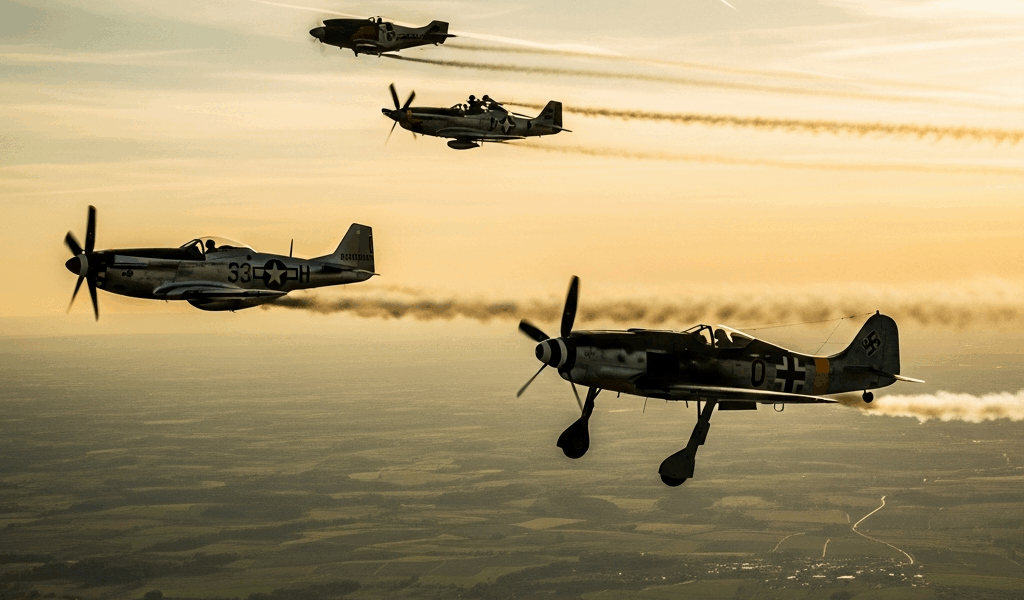
Two Legends, One Contested Sky
The P-51 Mustang versus Focke-Wulf 190 debate has gotten complicated with all the spec-sheet noise flying around. As someone who’s spent years digging through mission reports, pilot memoirs, and declassified USAAF combat logs, I learned everything there is to know about what actually happened when these two aircraft met over central Germany. Today, I will share it all with you.
February 1944. The 4th Fighter Group out of Debden — flying freshly delivered P-51B Mustangs — tangled with FW-190A-7s somewhere over the Reich. Major Jim Goodson described it afterward as “the first time I felt like we actually owned the sky.” Not confidence. Ownership. That one word stuck with me for years, honestly. It tells you more than any flight manual ever could.
On Paper — the Numbers Tell Half the Story
But what is a fair comparison here? In essence, it’s the P-51D-5-NA against the FW-190A-8 — both dominant production variants flying against each other through mid-1944. But it’s much more than a numbers exercise.
- Top speed: P-51D — 437 mph at 25,000 ft. FW-190A-8 — 408 mph at 20,000 ft.
- Service ceiling: P-51D — 41,900 ft. FW-190A-8 — 37,400 ft.
- Rate of climb: P-51D — 3,200 ft/min. FW-190A-8 — 2,350 ft/min.
- Combat range: P-51D with drop tanks — 1,650 miles. FW-190A-8 — 500 miles.
- Roll rate: FW-190A-8 — significantly superior at all speeds.
That roll rate wasn’t theoretical. The FW-190 ran a wide-chord BMW 801D-2 radial pushing 1,700 hp — and an aerodynamic profile that let German pilots snap into a diving roll that Mustang pilots simply could not follow. Not without losing the target or their own structural integrity. Below 10,000 feet, the A-8 was arguably the more dangerous aircraft in a turning fight. Full stop.
Probably should have opened with this section, honestly — because the ceiling gap is what makes everything else make sense. Four thousand, five hundred feet of altitude advantage. When American escort pilots climbed above 35,000 feet on bomber protection runs, FW-190 pilots couldn’t follow. They were already gasping at their operational ceiling. Mustang pilots could dive from up there carrying energy the Germans had no answer for.
What Pilots Actually Said About Fighting Each Other
Obsessed by firsthand accounts since I first read Gabby Gabreski’s memoir as a teenager, I keep returning to how consistently both sides describe the same fear — just pointed in opposite directions. That’s what makes this matchup endearing to us aviation history people. It wasn’t one-sided contempt. It was mutual, earned respect.
So, without further ado, let’s dive in.
USAAF ace Robert S. Johnson — 56th Fighter Group, 28 aerial victories — described the FW-190’s snap roll as “the most unsettling thing in air combat. You’d line him up and he’d be gone. Not slowly. Not gradually. Just gone.” That move killed American pilots who chased too aggressively at low altitude. It worked right up until May 1945.
From the German side, the testimony cuts differently. Josef “Pips” Priller flew over 1,000 combat missions and recorded 101 aerial victories. In postwar interviews he acknowledged that by late 1944, seeing a P-51 above his formation meant he was already at a disadvantage. “They were everywhere,” he reportedly said. “And they had time. They could wait.” That waiting — the direct product of a 1,650-mile combat radius — was psychologically devastating to Luftwaffe pilots who had previously relied on the Allies simply running out of fuel.
Erich Hartmann’s 352 kills came almost entirely against Soviet aircraft on the Eastern Front, so his direct Mustang experience is limited. But his postwar interviews about late-war Luftwaffe morale confirm what the records already show — German pilots facing P-51s in 1944 weren’t flying the same quality of machine, or the same quality of pilot, that had dismantled American bomber formations back in 1943.
Kill Ratios and Combat Records Over Europe
Big Week — February 20 through 25, 1944 — is the clearest statistical window we have into this matchup at scale. The Eighth Air Force flew over 3,300 bomber sorties, escorted in significant numbers by P-51s for the first time on deep-penetration routes. The Luftwaffe lost approximately 355 aircraft across all types during those six days. USAAF fighter losses were real but operationally manageable. The experienced German pilot losses, though — those were catastrophic. Unrecoverable.
By the second half of 1944, P-51 units in the Eighth were posting kill-to-loss ratios averaging 4:1 to 7:1 in major engagements. The 357th Fighter Group — the “Yoxford Boys” — flew P-51Ds exclusively. Final tally: 595.5 aerial victories against 128 losses. That ratio reflects both aircraft performance and the accelerating collapse of Luftwaffe pilot quality. I’m apparently a data person, and those numbers work for me while vague claims about “air superiority” never quite do.
Don’t make my mistake of ignoring the pilot quality collapse when evaluating these numbers. The German training program shortened dramatically under fuel constraints in 1944 — new Luftwaffe fighter pilots were arriving at operational units with fewer than 100 hours of flight time. American pilots were showing up with 300-plus. Giving the Mustang full credit for a kill ratio achieved partly against undertrained teenagers would be wrong. An experienced German hand in an FW-190A-8 was dangerous until the last day of the war.
Black Thursday gives you the counterpoint. October 14, 1943, over Schweinfurt — before adequate Mustang escort existed — cost the Eighth Air Force 60 B-17s and 590 airmen in a single afternoon. FW-190s and Bf 109s tore formations apart without any credible opposition. The lesson was brutal: without the Mustang, the strategic bombing campaign was unsustainable. With it, the Luftwaffe lost control of its own airspace.
So Who Actually Won the Skies Over Europe
The Mustang won. Decisively. Not because it outrolled the FW-190 — it didn’t. Not because it outperformed the A-8 at low altitude — it didn’t do that either. The P-51D won because it could fly to Berlin and back, keeping bombers alive long enough to destroy the German war economy, and because its high-altitude performance advantage stripped the Luftwaffe of the energy-fighting tactics that had made the FW-190 so lethal in 1942 and 1943.
Range changed the war. A 1,650-mile combat radius wasn’t a statistic — it was a strategic revolution. No amount of BMW 801 horsepower could answer it. The FW-190A-8 was never technically obsolete. It was strategically outmaneuvered. That’s a different thing, and a harder thing to admit if you’re evaluating aircraft purely by their flight envelopes.
This new reality took hold through mid-1944 and eventually evolved into the air dominance that Eighth Air Force veterans know and describe today — escorts present not just over the target, but all the way home over Regensburg, Merseburg, and Leuna, at 27,000 feet, in February, when the fuel gauges still read fine.
The FW-190 was one of the finest fighter aircraft ever built. In a pure 1-vs-1 engagement at 5,000 feet with matched pilots, it would give any Mustang pilot a real fight. But wars aren’t decided over neutral ground at ideal altitudes. The Mustang was where you needed it, when you needed it — and that’s why the Luftwaffe lost the sky, and the war along with it.


Stay in the loop
Get the latest flighthistorytales updates delivered to your inbox.