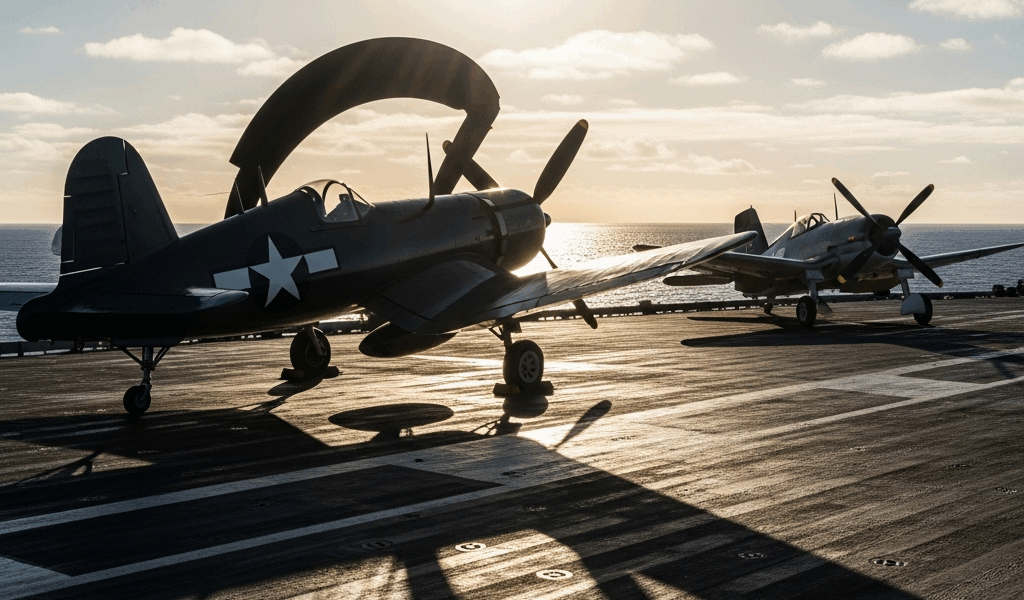
Two Great Fighters, One Brutal War
The Corsair vs. Hellcat debate has gotten complicated with all the armchair analysis flying around. As someone who spent years buried in combat memoirs, maintenance logs, and after-action reports from the Pacific theater, I learned everything there is to know about both aircraft. Today, I will share it all with you.
Most comparisons throw specs at you and call it done. Top speed. Ceiling. Rate of climb. Fine. But those numbers were recorded over Connecticut and California — not in the screaming chaos above Rabaul or the Mariana Islands. The real answer lives somewhere messier than a spec sheet.
By late 1942, the US Navy had a genuine crisis on its hands. The Mitsubishi A6M Zero had been humiliating Allied pilots for two straight years. Lighter, more maneuverable, flown by aviators with thousands of hours of combat time. America needed a counter, and it needed one fast. Two answers showed up almost simultaneously — from two very different engineering philosophies.
Grumman’s F6F Hellcat was drawn up with a single objective: kill Zeros and bring pilots home alive. Engineers reportedly pulled feedback from veterans who’d actually fought the Zero, tore apart a captured example, and built accordingly. Tough. Predictable. Ready for the carrier deck on day one. Vought’s F4U Corsair came from a completely different direction. The engineers started with the most powerful engine available — the Pratt & Whitney R-2800 Double Wasp — and designed an airframe to hang around it. That inverted gull wing? It exists because a 13-foot, 4-inch propeller needed ground clearance. The Corsair was born from ambition. The Hellcat was born from urgency.
Both planes were American. Both were lethal. But they were never quite the same kind of weapon. That’s what makes this comparison endearing to us aviation enthusiasts — the contrast cuts deeper than the numbers suggest. So, without further ado, let’s dive in.
Performance Numbers That Actually Mattered
Specs matter when they translate to survival. Here’s a quick rundown before we put them back in proper context.
- F4U Corsair top speed: approximately 446 mph at altitude
- F6F Hellcat top speed: approximately 380 mph at altitude
- Corsair range: roughly 1,015 miles — extended further with drop tanks
- Hellcat range: roughly 945 miles in standard configuration
- Both aircraft: six .50 caliber M2 Browning machine guns, 400 rounds per gun
The Corsair was faster. Meaningfully faster. In a dive it pulled away from nearly anything Japan sent up. That speed mattered enormously in the Pacific specifically — combat happened hundreds of miles from a carrier or base. Fuel to get there, fuel to fight, fuel to limp back. The margin over open ocean was razor thin.
The Hellcat climbed hard and handled predictably at low speeds. Which is exactly where carrier approaches and turning dogfights happen to live. A pilot controlling his aircraft at 90 knots with full flaps and a crosswind was a pilot who came home. The Corsair, in those same low-speed conditions during 1942 and early 1943, got unpredictable. That one distinction drove everything that followed.
The Carrier Problem That Changed Everything
Probably should have opened with this section, honestly — it’s the piece most comparison articles skip entirely.
The Corsair was banned from US Navy carrier operations. Full stop. The Bureau of Aeronautics pulled it from fleet carrier decks in early 1943, and that decision reshaped the entire Pacific air war. Three problems drove the ban. First, the long nose — essential for housing that massive R-2800 — blocked forward visibility on the landing approach completely. A pilot descending toward the deck couldn’t see the Landing Signal Officer until dangerously late. Second, the Corsair bounced hard on touchdown, sometimes violently enough to clear the barrier wires. Third, the starboard wing had a stall quirk during slow-speed approaches — dropping the right side with almost no warning.
Frustrated by losing their fastest fighter from fleet operations, the Navy handed the Corsair to Marine Corps squadrons flying from land bases in the Solomons. That turned out to be an inspired accident. From Henderson Field and Munda, Corsairs ran long-range escort and intercept missions where raw speed and range were decisive — and carrier deck behavior was completely irrelevant.
The British Fleet Air Arm solved the carrier problem the Americans hadn’t. Royal Navy pilots developed a curved approach — banking in from the side rather than flying straight down the slot — giving them a continuous sight line past that obstructing nose. They also raised the tail wheel oleo strut 7 inches to kill the bounce. The fix wasn’t glamorous. It worked. British Corsairs flew from escort carriers in the Indian Ocean and off the Norwegian coast while the US Navy was still waving them off its decks.
The Hellcat had none of these problems. Designed explicitly for carrier operations, it showed in every sortie. Forgiving, predictable, tolerant of the hard arrivals that happen when exhausted pilots return from six-hour missions. Grumman built it expecting abuse — because they knew exactly what was coming.
Kill Ratios, Pilot Accounts, and the Real Record
But what is a 19:1 kill ratio? In essence, it means for every Hellcat lost in aerial combat, nineteen Japanese aircraft went down. But it’s much more than that — it’s the most dominant performance record in the history of carrier aviation.
Between 1943 and 1945, Hellcat pilots destroyed over 5,000 enemy aircraft, accounting for roughly 75 percent of all US Navy aerial kills in the Pacific. The number is real. It shows up everywhere for good reason.
Context still matters, though. By 1943, Japanese pilot quality had collapsed. The veterans of Pearl Harbor, Coral Sea, Midway — most of them were dead. Japan couldn’t replace experienced aviators fast enough, and the replacements arriving in combat units were undertrained and under-resourced. American pilots, by contrast, came from an expanded training pipeline and were vectored to their targets by ship-based radar. The Hellcat was the right aircraft in the right place at the right moment in history. Don’t make the mistake of separating the machine from that context.
Lieutenant Alex Vraciu, flying a Hellcat during the Marianas Turkey Shoot in June 1944, described the intercepts plainly: radar-directed, altitude advantage pre-established, Japanese formations arriving piecemeal. He shot down six aircraft in eight minutes. The Hellcat made that possible — but so did everything surrounding it.
The Corsair’s record reads differently. Arguably more impressive per pilot. Major Gregory “Pappy” Boyington of VMF-214 — the Black Sheep Squadron — scored 22 confirmed kills flying F4Us from jungle strips in the Solomons. No radar direction. No altitude setup handed to him by a cruiser’s CIC. Targets that were frequently escorted and expecting a fight. Corsair pilots out there were running a harder war with far less infrastructure. Their numbers reflect exactly that.
One VMF-214 pilot described the Corsair as “a mean girlfriend — she’d hurt you if you weren’t paying attention, but God help the Zero that got in front of her.” That tracks with every documented account I’ve read. I’m apparently a detail-obsessed aviation reader and primary sources work for me while sanitized online summaries never do. The pilot accounts consistently show a more complicated picture than the kill ratios suggest.
So Which Fighter Would You Actually Want?
The honest answer depends entirely on who you are and where you’re launching from.
It’s 1943. You have 300 hours total flight time. You’re launching off USS Essex in heavy swells — the ship is pitching roughly 8 feet at the deck edge — with a 90-minute flight ahead of you. You want the Hellcat. No hesitation. It will forgive your landing, survive the damage, and get you home when the Corsair might not. Grumman built it to win a war, not an air show.
But if you have 1,000 hours in your logbook, you know the Corsair’s quirks cold, and you’re launching from a land base where the runway doesn’t pitch under your wheels — the Corsair is the more capable machine. Faster, longer-legged, and absolutely devastating in a dive. In the hands of an experienced pilot, it was probably the most dangerous American fighter flying in the Pacific theater. Full stop.
The Hellcat was the war-winning fighter. The Corsair was the better airplane. Those two things coexist without contradiction. The Hellcat flew its last day of US Navy carrier operations in 1954. The Corsair was still flying combat missions — in French hands over Indochina — that same year, twelve years after its first flight. That longevity says something the kill ratios don’t.
Ask which plane ruled the Pacific and history answers clearly: the Hellcat, by the numbers and by any reasonable measure. Ask which plane you’d want if your life depended on what happened in the next five minutes of a turning fight at low altitude — and the Corsair starts looking very good, very fast.


Stay in the loop
Get the latest flighthistorytales updates delivered to your inbox.