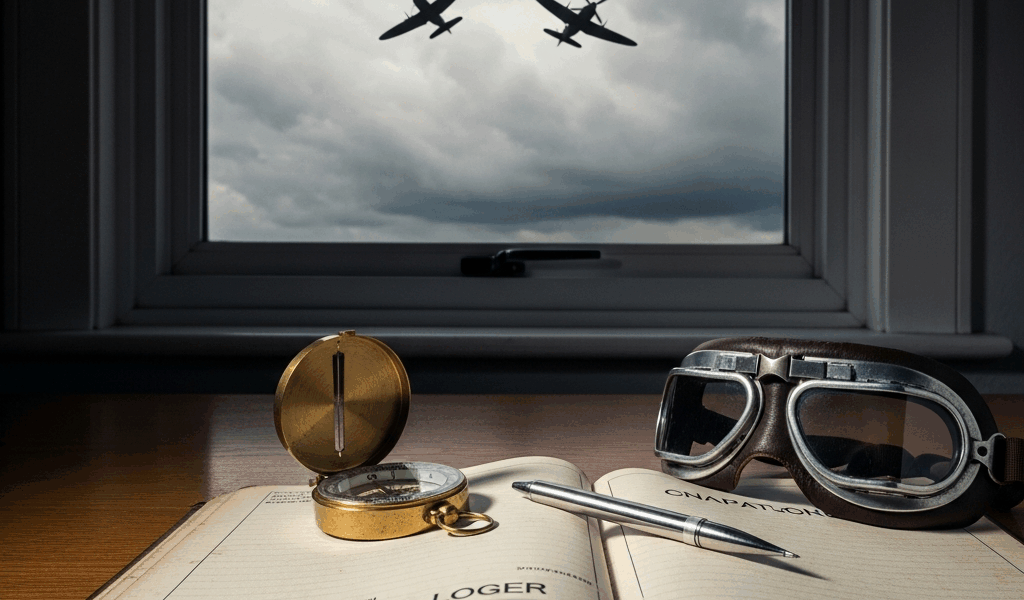
Two Legendary Fighters, One Summer That Changed Everything
The Messerschmitt Bf 109 vs. Spitfire debate has gotten complicated with all the myths and half-truths flying around. Eighty-plus years of arguments in aviation circles, and honestly, it deserves every single one of them. What unfolded over southern England between July and October 1940 wasn’t just a military campaign — it was the moment two extraordinary piston-engine fighters got thrown at each other under conditions that ripped open every flaw and magnified every strength each design had.
Here’s the moment I keep returning to. August 24, 1940. Pilot Officer Alan Deere, 54 Squadron, survived a head-on collision with a Bf 109 somewhere over the Channel. His Spitfire’s propeller sheared down to stumps. Engine screaming. He belly-landed in a field near Manston and walked away. The German pilot didn’t. Deere later wrote that his Spitfire “absorbed punishment that should have killed it.” That’s not a spec sheet talking. That’s a machine showing you exactly what it’s made of under the worst test imaginable.
Both aircraft were genuinely serious. The Bf 109E — the variant that actually flew the Battle of Britain — was a thoroughbred interceptor built by Bayerische Flugzeugwerke around a Daimler-Benz DB 601 cranking out roughly 1,175 horsepower. The Supermarine Spitfire Mk I and Mk II ran Rolls-Royce Merlin III or XII engines pushing between 1,030 and 1,175 horsepower, depending on variant and altitude. On paper, remarkably close. Over Kent and Surrey in the summer of 1940, the differences were everything.
How the Bf 109 and Spitfire Actually Performed in the Air
Top speed at altitude is where most comparisons start and stop. Fine — the Bf 109E topped out around 354 mph at 12,300 feet. The Spitfire Mk I managed roughly 353 mph at 19,000 feet. Essentially identical in a straight line. But combat is almost never a straight line. The numbers that actually determined who came home were climb rate, roll rate, and what happened the instant a pilot shoved the stick forward into a dive.
The DB 601 used direct fuel injection. The Merlin used a float carburetor. That single engineering decision — one mundane component — had enormous tactical consequences that pilots felt immediately. Push a Spitfire into a negative-G dive to break from an attacker, and the carburetor starved momentarily. Engine cut. Sometimes a full two seconds of silence. At combat speed, two seconds is roughly 700 feet gone. German pilots figured this out fast. Push the nose down hard, watch the Spitfire cough, follow it into the dive where the 109 accelerated away clean and easy.
RAF engineer Beatrice “Tilly” Shilling eventually solved it in early 1941 — a simple restrictor orifice, now called “Miss Shilling’s orifice” — but during the Battle of Britain itself, that carb cut was a genuine, killing liability. Pilots improvised a half-roll technique to enter dives under positive G. It worked. It also cost precious fractions of a second they often didn’t have.
Where the Spitfire dominated was the turn. At low to medium altitudes, it could out-turn the Bf 109 consistently, especially below 15,000 feet. The 109 carried higher wing loading and developed increasingly stiff controls at speed — particularly in roll. Spitfire pilots learned early: force a turning fight whenever possible. Drag it down and around. Bleed the 109’s energy advantage away, then wait for the shot.
Then there was fuel. The Bf 109E carried roughly 88 Imperial gallons. Flying from bases around the Pas-de-Calais, German pilots had approximately 20 to 25 minutes of total time over England. Maybe 10 minutes of actual combat over London before the gauge forced them home or into the Channel. That’s not a minor inconvenience. That shaped the entire Luftwaffe campaign — and ultimately helped doom it.
What RAF and Luftwaffe Pilots Said About Each Other’s Planes
Probably should have opened with this section, honestly. Pilot accounts are where the comparison stops being abstract and starts being real.
Adolf Galland — top Luftwaffe ace, commander of JG 26 — was famously asked by Göring what he needed to win the Battle of Britain. His answer: “A squadron of Spitfires.” Not flattery. Galland genuinely respected its maneuverability and the way trained RAF pilots could use it. He also understood its weaknesses. Experienced 109 pilots, he noted, learned to avoid prolonged turning fights and instead use the 109’s superior dive speed and initial climb rate to control the terms of each engagement.
On the other side, Wing Commander Bob Stanford Tuck — flew Spitfires, later Hurricanes, with real success — called the Bf 109 “a nasty surprise at altitude.” The dangerous 109 pilots, he said, were the ones who hit from above and behind, dove to disengage, and never let the fight develop into a turning match. The ones who tried to dogfight a Spitfire on equal terms usually regretted it.
Captured Luftwaffe pilots interviewed by RAF intelligence in 1940 kept flagging the range problem with barely concealed frustration. One account in the official combat reports has a German pilot saying he had “barely enough fuel to fight and none to spare for mistakes.” That one sentence explains the Bf 109’s entire strategic problem over England.
Worn down by weeks of attrition and constant fuel anxiety, many Bf 109 pilots started flying defensively over England rather than aggressively. That instinct handed tactical initiative straight to the RAF — and it never came back.
Where Each Fighter Had the Clear Edge
High-Altitude Interception
The Bf 109 was better here. Climb rate of around 3,280 feet per minute against the Spitfire Mk I’s roughly 2,530 feet per minute — that gap let German pilots choose engagement altitude, and above 20,000 feet the 109’s performance advantage widened noticeably. The Merlin III lost power at altitude in ways the DB 601’s supercharger handled more cleanly in certain conditions. If a 109 pilot could pick his altitude and angle of attack, he was sitting in the stronger aircraft. No debate.
Escort Duty
The Bf 109 was catastrophically misused here — and that’s not a small thing. Göring ordered close escort to the bombers. Tied to lumbering Heinkel He 111s and Dornier Do 17s, the 109s couldn’t maneuver freely or use their energy advantage for anything. RAF pilots learned to go straight for the bombers, knowing the escort 109s were hobbled. This strategic mistake cost Germany the campaign more than any technical shortcoming ever did. Don’t make my mistake of blaming the aircraft for decisions made by the high command.
Low-Altitude Turning Fights
The Spitfire owned this. Below 15,000 feet, in a sustained turn, it could get inside a 109’s radius almost every time. Heavier control forces made sustained tight turns genuinely hard in the 109 at speed. Spitfire pilots who forced the fight down and turned hard generally survived. Bf 109 pilots who let it happen generally didn’t.
Dive and Disengagement
The 109 was superior here, full stop — especially while the carb-cut problem existed. A German pilot with energy who pushed the nose down could often escape a Spitfire that had no clean answer to that negative-G dive. That changed when Miss Shilling’s fix arrived in early 1941. During the Battle of Britain itself, it was a real problem with no real solution.
So Which Fighter Actually Won the Battle of Britain
Here’s the honest answer. The Bf 109 was arguably the better pure air-superiority fighter in a neutral one-on-one environment. Meaningful edge in climb, dive acceleration, high-altitude performance. In skilled hands with tactical freedom, it was lethal — Galland, Mölders, and Wick proved that repeatedly through the summer of 1940.
But the Battle of Britain wasn’t fought in a neutral environment. It was fought at the far end of a 400-mile operational radius, over enemy territory, with fuel gauges giving pilots roughly ten minutes to decide the fate of Western Europe. It was fought under orders that stripped the 109 of altitude, speed, and tactical initiative. And it was fought against the Dowding System — an integrated radar and ground control network that vectored Spitfires and Hurricanes onto inbound raids with a precision the Luftwaffe simply had no answer for. That’s what makes that system so endearing to historians who study this period today.
The Spitfire didn’t beat the Bf 109 in individual combat statistics. Germany lost the Battle of Britain because it misdeployed the 109, underestimated British radar and ground control, and switched targets from RAF airfields to London at the exact worst moment — just when Fighter Command was approaching its breaking point. That decision, made in September 1940, handed the RAF the breathing room it needed.
So which fighter won? The Spitfire — combined with the Hurricane, the radar chain, the ground controllers, and the mechanics working 20-hour days on frozen grass — won the campaign. The Bf 109, flown by better-trained pilots on average during that summer, won a significant share of individual engagements. Both things are true at the same time. That’s the only honest answer worth giving.

Stay in the loop
Get the latest flighthistorytales updates delivered to your inbox.