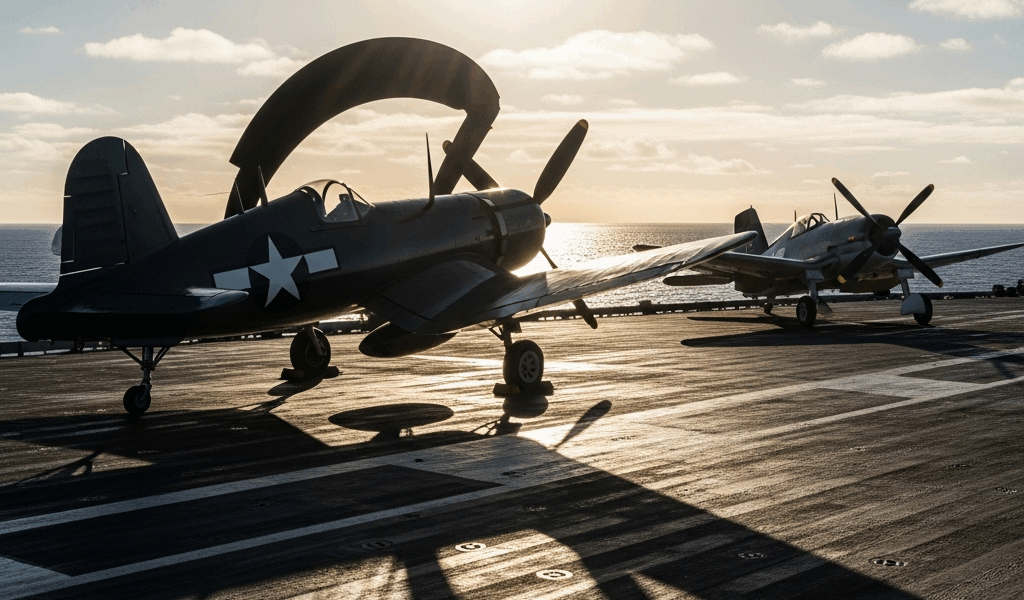
The F6F Hellcat had the greater impact on U.S. Navy carrier warfare in 1943–45; the F4U Corsair offered higher speed in comparable late-war variants and grew into a longer-lived, highly adaptable fighter-bomber. The Hellcat is the better answer to “which dominated wartime U.S. carrier operations?” The Corsair is the better answer to “which design had more postwar growth and combat longevity?”
Neither was universally the “better airplane.” Variant, date, altitude, load, carrier qualification, pilot training, radar control, maintenance, and mission all change the comparison.
Corsair vs Hellcat: quick comparison
| Factor | F4U Corsair | F6F Hellcat |
|---|---|---|
| First flight | May 1940 | June 1942 |
| Initial U.S. combat | Marine land-based combat in early 1943 | Navy carrier combat in 1943 |
| Engine family | Pratt & Whitney R‑2800 | Pratt & Whitney R‑2800 |
| Typical late-war fighter armament | Six .50-caliber machine guns on F4U‑1/1D; four 20 mm cannon on F4U‑1C | Six .50-caliber machine guns on principal F6F‑3/5 fighters |
| Carrier integration | Difficult early development; British and later U.S. carrier service | Designed and fielded as a U.S. carrier fighter from the outset |
| Wartime role strength | Fast fighter, escort, interception, and increasingly fighter-bomber work | Fleet air defense and carrier fighter operations at enormous scale |
| Postwar combat life | Extensive; later versions served multiple nations into the 1960s | Shorter front-line combat career, with postwar night-fighter and secondary service |
Use named variants, not one mythical specification
“F4U” covers aircraft from early F4U‑1s through much faster and more powerful postwar variants. “F6F” usually means the F6F‑3 or F6F‑5, but equipment and weight also varied. A Corsair figure near 446 mph generally describes a later F4U‑4, not the early aircraft that first fought from island bases in 1943.
The Smithsonian’s F4U‑1D Corsair record lists 417 mph maximum speed and a 36,900-foot service ceiling for that version. Published F6F‑5 figures commonly place maximum speed near 380 mph and ceiling above 37,000 feet. Those figures support the conclusion that a comparable Corsair was faster, but they do not prove every combat outcome.
Range is especially easy to misuse. Combat radius, normal range, maximum range, and ferry range with drop tanks are different measurements. A comparison that gives one aircraft a drop-tank ferry figure and the other an internal-fuel combat figure is not evidence of operational superiority.
Why both aircraft used the R‑2800
Both designs were built around versions of Pratt & Whitney’s 18-cylinder R‑2800 Double Wasp. Vought’s large propeller and need for landing-gear clearance contributed to the Corsair’s distinctive inverted gull wing. Grumman used a conventional low wing and wide-track inward-retracting landing gear suited to repeated carrier operations.
Sharing an engine family did not make the aircraft equivalent. Airframe drag, propeller, supercharging, weight, cooling, control surfaces, and later engine ratings affected performance. The Corsair’s cleaner design generally delivered more speed. The Hellcat emphasized predictable deck handling, visibility, ruggedness, maintainability, and rapid fleet introduction.
Was the Corsair banned from U.S. carriers?
No blanket “ban” accurately describes the history. The early Corsair had serious carrier-suitability problems, including limited forward visibility on approach, landing-gear rebound, and abrupt low-speed stall behavior. The U.S. Navy did not initially deploy it broadly as its fleet carrier fighter, and Marine squadrons used it very effectively from land bases.
That was a development and qualification problem, not a permanent prohibition. The British Fleet Air Arm operated Corsairs from carriers using a curved approach that improved the pilot’s view of the deck. Hardware and technique changes addressed landing behavior, and U.S. carrier operations expanded later in the war. By 1945, Navy and Marine Corsairs were flying from U.S. carriers in substantial combat operations.
The Hellcat did not require that same detour. Its wide landing gear, approach characteristics, and carrier-centered development let the Navy place it aboard fleet carriers quickly and in large numbers. That operational availability is a core reason it became the dominant U.S. Navy carrier fighter of the later Pacific war.
Speed, climb, turn, and dive
The Corsair’s higher speed was valuable for interception, disengagement, escort, and fighter-bomber missions. Its acceleration and climb depended on variant and altitude. The Hellcat was slower but competitive where fleet defense required reliable takeoffs, formation work, interceptions, and recoveries from moving decks.
Neither aircraft should be summarized as “the turning fighter.” Instantaneous turn, sustained turn, roll, climb, and acceleration change with speed, altitude, fuel, ammunition, stores, and pilot technique. U.S. pilots were trained to exploit speed, altitude, teamwork, and firepower instead of accepting a low-speed horizontal contest on an opponent’s best terms.
The relevant question is not which airplane wins an imaginary equal-altitude duel. It is which aircraft, supported by radar, fighter direction, trained maintainers, spare parts, and a coordinated formation, could complete the assigned mission and return to base or carrier.
Armament differences
Most F6F‑3 and F6F‑5 fighters carried six wing-mounted .50-caliber machine guns. Most F4U‑1-series fighters did as well. The F4U‑1C substituted four 20 mm cannon, and later Corsairs carried increasingly heavy bomb and rocket loads.
“Six guns with 400 rounds each” is not a safe universal specification for every Corsair and Hellcat variant. Ammunition arrangements varied, and the cannon-armed Corsair is an important exception. Weapon effectiveness also depended on harmonization, ammunition, firing range, target, and pilot aim.
What the credited kill ratios do—and do not—prove
U.S. Navy historical summaries credit Hellcats with more than 5,000 aerial victories and commonly cite a roughly 19:1 victory-to-air-combat-loss ratio. Corsair summaries commonly cite more than 2,000 victories and a ratio near 11:1. These are wartime credited claims and loss-accounting figures, not a controlled experiment between airframes.
The Hellcat’s totals reflect its enormous carrier presence during the period when U.S. fast-carrier forces brought radar-directed fighter defense, trained pilots, reliable logistics, and numerical superiority to the Pacific. Japanese pilot experience, training, fuel, aircraft quality, and availability deteriorated sharply as the war continued.
The Corsair’s lower total does not mean it was less capable per sortie or pilot. It entered a different mix of land- and carrier-based missions and increasingly performed ground attack. Conversely, claiming its record was “more impressive per pilot” requires denominators—combat sorties, pilot strength, exposure, mission, and losses—that a colorful anecdote cannot provide.
Pilot stories require careful sourcing
Alex Vraciu’s six victories during the Battle of the Philippine Sea and Gregory “Pappy” Boyington’s Corsair record are real historical subjects. They do not prove that one aircraft was universally superior. Individual claims should be tied to squadron records, dates, opponents, and the crediting system used at the time.
An unattributed line about the Corsair being “a mean girlfriend” should not be presented as a documented VMF‑214 quotation without a traceable primary source. Memorable language can spread online after attribution is lost or invented. This comparison therefore does not use anonymous pilot dialogue as evidence.
Survivability and bringing pilots home
Both aircraft were robust, powerful naval fighters with armor and self-sealing fuel protection appropriate to their designs. The Hellcat earned a reputation for absorbing damage and for approachable carrier handling. The Corsair also survived substantial damage and offered speed that could help a pilot disengage.
Survivability is not one specification. It includes visibility, fire protection, armor, structure, systems redundancy, ditching characteristics, landing behavior, rescue coverage, and the tactical situation. Claims that one would always bring a 300-hour pilot home while the other would not are invented scenarios, not historical analysis.
Production and operational scale
Grumman produced more than 12,000 Hellcats in a concentrated wartime program, allowing carrier air groups to standardize around the type. Corsair production also exceeded 12,000 aircraft across multiple manufacturers and continued after the war. Its longer production and combat life reflected an adaptable airframe that grew into fighter-bomber, night-fighter, and later high-performance versions.
The Hellcat’s shorter development-to-fleet timeline was itself a performance advantage. A theoretically faster aircraft does not dominate a naval campaign if it cannot yet be integrated safely and at scale aboard the available carriers.
Which ruled the Pacific?
For U.S. Navy carrier air superiority in 1943–45, the Hellcat. It arrived when the expanding fast-carrier force needed a capable, forgiving fighter and generated the larger credited aerial record.
For speed, fighter-bomber development, and postwar combat longevity, the Corsair. Once its carrier problems were addressed, it served effectively from ships as well as land bases and continued evolving after the Hellcat’s front-line moment passed.
The best conclusion is mission-specific: the Hellcat was the more consequential wartime U.S. carrier fighter, while the Corsair became the more enduring aircraft family. For the opponent that shaped both designs’ tactics, read our sourced Corsair vs A6M Zero comparison.
Source note: Variant context and the F4U‑1D specifications are based on the Smithsonian National Air and Space Museum collection record. Naval victory totals are historical credited claims and should not be treated as independently audited aircraft-only effectiveness measures.


Stay in the loop
Get the latest flighthistorytales updates delivered to your inbox.