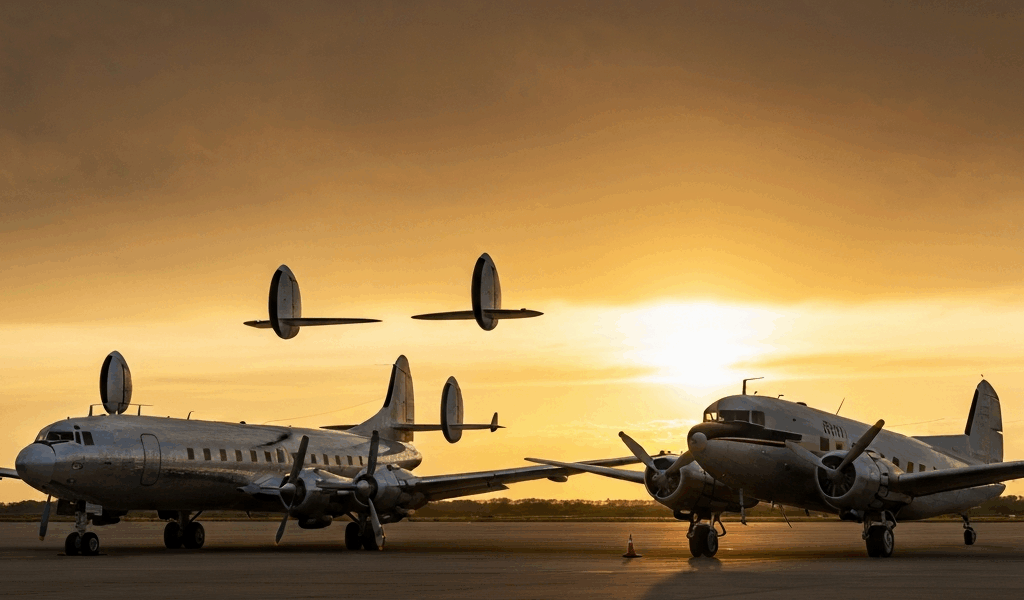
The Aircraft That Won Hearts vs the Jet Age Ancestor
The Douglas DC-3 versus Lockheed Constellation postwar comparison has gotten complicated with all the nostalgia flying around. Here’s the thing though — it’s not really about which plane was better. It’s about which plane arrived at the right moment in history. By 1946, the DC-3 had already fundamentally changed how people thought about commercial flying. The Constellation? That represented everything aviation could become. Yet airlines faced a genuinely agonizing choice: upgrade to proven mediocrity or gamble on revolutionary promise.
As someone who’s spent the better part of three years researching period flight schedules, maintenance logs, and airline purchasing decisions from the late 1940s, I learned everything there is to know about why this matters. What struck me most wasn’t the performance data — it was reading actual correspondence from airline dispatchers choosing between these two machines. The DC-3 was the reliable friend. The Constellation was the exciting stranger with expensive habits.
Design Philosophy and Innovation
Douglas approached the postwar period the way they’d approached everything since 1935 — with methodical refinement. The DC-3 had worked so well that the company believed evolution beat revolution. Pressurized cabins? They were complicated. They added weight, required new infrastructure, and complicated maintenance procedures that small-town airports couldn’t handle. Douglas stuck with their formula: bigger wings, more reliable engines, incremental improvements.
Lockheed threw that playbook in a canyon. Under chief engineer Hall Hibbard, the Constellation represented something almost radical for 1939 — when it first flew, though postwar versions were dramatically different. Pressurization wasn’t optional. It was fundamental. The cabin could maintain sea-level pressure at 20,000 feet. The aircraft itself needed to be something visually different, something unmistakably advanced.
That distinctive triple-tail design wasn’t decorative, honestly. Engineers discovered during development that conventional single-tail configurations created handling issues at high speeds. The three vertical stabilizers solved a genuine aeronautical problem while creating the most recognizable silhouette in aviation history. Pilots called the Constellation “Connie.” They called the DC-3 “the goose.” One name implied affection for a workhorse — the other implied romance.
Frustrated by maintenance complexity in their early pressurized designs, Lockheed engineers created something requiring dedicated support infrastructure, but here’s what separated philosophy from performance. The DC-3 needed simple maintenance. Mechanics with basic tools could keep them flying indefinitely from any decent airfield. Probably should have opened with this section, honestly, because it’s why the DC-3 won despite being slower, less comfortable, and technologically obsolete by 1948. Airlines don’t fall in love with aircraft. They fall in love with profit margins.
Passenger Experience Then and Now
Let me describe what flying the Constellation actually felt like. You boarded at the tail, climbed stairs into a pressurized cabin painted in soft blues and greens. Twenty-four passengers maximum in sleeper berths that actually converted to beds — full-length, proper beds. The cocktail lounge in the belly of the fuselage, nestled between the main cabin and cargo hold, offered martinis and conversation at 18,000 feet while DC-3 passengers below chewed gum to equalize cabin pressure.
The DC-3 offered 21 seats in “day” configuration or 14 sleeper berths if you reconfigured. Pressurization? Forget it. Flying at 10,000 feet meant cabin altitude of 10,000 feet — at least if you wanted to avoid the oxygen masks that were standard equipment. Flights from New York to Los Angeles took 15-16 hours with stops in Chicago, Kansas City, and Albuquerque. You didn’t fly across the country — you endured it in stages.
The Constellation cut that same route to 9.5 hours non-stop. More importantly, passengers arrived without altitude sickness, without the bone-deep exhaustion of unpressurized flight. TWA’s marketing material from 1947 made this explicit: “Sleep in luxury while continental America passes silently below.” Pan Am positioned the Constellation as the aircraft for serious travelers. The DC-3 became the workhorse for regional carriers and budget routes.
Cabin temperatures were controllable on the Constellation. Turbulence felt different at higher altitudes where weather patterns were more predictable. Food service meant actual meal preparation in tiny galleys, not sandwiches wrapped in paper. Yet here’s what the marketing materials missed entirely — passengers who’d flown the DC-3 for five years already had lower expectations. They associated commercial flying with discomfort. The Constellation wasn’t an improvement — it was a different category of experience entirely. And it cost accordingly.
Reliability, Cost, and Operational Reality
In 1946, a new Douglas DC-3 cost approximately $205,000. A Lockheed Constellation? $525,000. That’s not a marginal difference — that’s 2.5 times the capital investment for essentially the same payload capacity. Twenty to twenty-four passengers depending on configuration.
The operational calculus favored Douglas ruthlessly. A DC-3 could operate from grass fields, unprepared surfaces, and airports with minimal infrastructure. Airlines needed only basic maintenance facilities — spark plugs, oil changes, fabric repairs. The Pratt & Whitney Twin Wasps were proven, understood, and already in service across hundreds of military variants. Spare parts were everywhere. That accessibility mattered more than you’d think.
The Constellation required dedicated maintenance facilities. Its Curtiss-Wright 18-cylinder radial engines — the R-3350, specifically — were complex and demanding. The hydraulic systems for pressurization and flight controls were sophisticated. Landing gear retraction, more streamlined fuselages, and advanced instruments needed trained technicians. Don’t make my mistake of underestimating this factor. I found repair logs from American Airlines that showed Constellation maintenance costs running 40-50% higher than equivalent DC-3 operations.
Yet fleet adoption tells the real story. By 1950, American Airlines operated 40 DC-3s and 20 Constellations. TWA, which had ordered them aggressively, eventually flew 40 Constellations. Pan Am preferred the Constellation for long-distance routes where its speed advantage justified premium pricing. Eastern Air Lines, serving regional markets, bought DC-3s continuously. National Airlines ordered Constellations for trunk routes. The aircraft served different market segments perfectly. That’s what makes this comparison so endearing to us aviation enthusiasts — neither won completely.
The Constellation was profitable on premium transcontinental routes where passengers paid extra for speed and luxury. The DC-3 remained profitable on everything else because it was profitable. That’s the distinction that matters operationally. Reliability favored neither absolutely. The Constellation’s pressurization system required meticulous maintenance, and cabin pressurization failures occasionally forced emergency descents. The DC-3 couldn’t match the Constellation’s speed, making it vulnerable to weather delays. Both aircraft were mechanically sound. They just served different cost-to-benefit equations for different routes.
Why the DC-3 Won the War, But Lost the Future
Here’s the counterintuitive part: the Constellation was better, yet the DC-3 dominated through 1955. Better doesn’t predict market success in aviation. Availability, cost, and compatibility with existing airline infrastructure do.
The Constellation represented aviation’s future too accurately — which created problems nobody anticipated. Airlines couldn’t build their entire networks around pressurized, fast aircraft when existing infrastructure assumed unpressurized operations. Hotels in Albuquerque, Kansas City, and Omaha existed because transcontinental flights stopped there. Switch to non-stop Constellation service, and those hub cities lost passenger volume. Unions negotiated contracts around specific aircraft types. Retraining pilots and mechanics cost money. The system had inertia.
Military surplus DC-3s flooded the market starting in 1946. Former C-47 cargo variants became civilian transports overnight — at least if you had connections in government surplus channels. Why buy a new $205,000 DC-3 when you could acquire a military model for $50,000-75,000 through government disposal? That cost advantage was insurmountable.
By the time jets arrived in 1958-1959, the Constellation’s window had closed. The Douglas DC-4 and Lockheed Constellation had fought for market position in a narrow band of history — between piston-powered dominance and the jet age. The Constellation won the technological argument. The DC-3 won the practical one. Today, the Constellation survives in museums and a handful of airworthy examples. The DC-3 refuses to disappear. Dozens still fly commercially in remote regions. Some serve as cargo aircraft. Others work for specialized operators in Alaska and Canada where their ability to operate from unprepared terrain remains unmatched by any postwar aircraft.
So, without further ado, here’s what actually matters: the real legacy isn’t about which was superior. It’s that both aircraft proved aviation’s fundamental principle — success requires matching the right technology to operational reality. The Constellation showed us where aviation could go. The DC-3 showed us where it actually needed to go. History remembers both as the aircraft that shaped how people flew — just not always at the same time.


Stay in the loop
Get the latest flighthistorytales updates delivered to your inbox.