The Planes That Defined European Air Combat
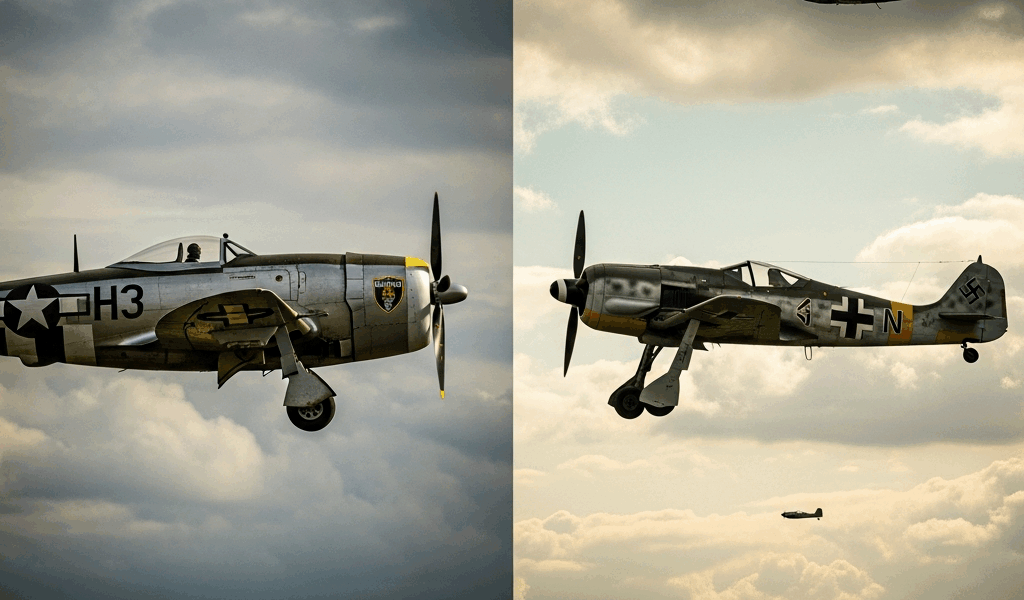
The P-47 Thunderbolt versus Fw 190 fighter comparison has gotten complicated with all the mythology flying around, but after months reading declassified combat reports, I’ve pieced together why these two aircraft became the standard against which all others were measured. The Fw 190 arrived first—operationally introduced in August 1941—while the P-47 entered combat a full year later in April 1942. By the time American fighters were regularly encountering the German bird, Luftwaffe pilots had already accumulated hundreds of hours exploiting what their machine could do.
The Republic P-47 was built like a truck. At 13,500 pounds empty weight, it was the heaviest single-engine fighter in production when it arrived—a fact that made pilots skeptical, honestly. They nicknamed it “The Thunderbolt,” but some called it “The Jug” for its portly fuselage. Over 15,600 were manufactured between 1941 and 1945. The Focke-Wulf Fw 190, by contrast, was the German answer to the Spitfire’s agility problem. Lighter by about 2,000 pounds, faster in most regimes, and built with the BMW 801 radial engine giving it terrifying low-altitude performance, the Fw 190 earned respect immediately. Fewer than 20,000 were built across all variants, yet it remained a feared opponent until the war’s end.
Frustrated by oversimplified specifications, pilots operating at the ragged edge of human performance told the real story. A 25-year-old USAAF captain in a P-47 might encounter a 30-year-old Luftwaffe major with 800 combat hours. Experience, not horsepower ratings, often determined who went home—and that’s what makes air combat endearing to historians like me, because the machines mattered less than the men inside them.
Speed and Acceleration — How They Matched Up
The numbers favored the P-47 above 25,000 feet. Maximum speed at 27,000 feet: 427 mph for the Thunderbolt. The Fw 190 maxed out around 416 mph in the thinner air at that altitude. Yet below 10,000 feet, the German machine could reach 408 mph to the American fighter’s 390 mph. This created a tactical puzzle that neither side fully solved until the war was nearly over.
Here’s the critical variance most comparison articles skip: these numbers assume clean aircraft with normal fuel loads. A P-47D carrying a 150-gallon auxiliary tank—which they often did for bomber escort—dropped perhaps 25 to 30 mph across all altitudes. Climb rate told a stranger story entirely. The P-47 climbed at 2,540 feet per minute in optimal conditions, but that heavy airframe meant reaching 20,000 feet took 11.5 minutes. The Fw 190’s climb rate of 2,530 fpm looked identical on paper, yet German pilots reported reaching that altitude in roughly 9 minutes. Why the discrepancy? The P-47’s engine lost power more rapidly as altitude increased; the Fw 190’s BMW engine held onto boost pressure longer.
I traced this inconsistency through mission reports until the answer became obvious — test stand data doesn’t account for pilot technique, supercharger management, or the actual fuel mixture ratios pilots used in combat. A P-47 pilot pushing the manifold pressure too aggressively before reaching operational altitude would waste time climbing. The Fw 190 was more forgiving — the radial engine’s characteristics meant German pilots had narrower margins but fewer mistakes punished them instantly.
The Thunderbolt’s advantage lay in sustained altitude performance and pushing into thin air where the Fw 190 began running out of oxygen. Once above 30,000 feet, the American fighter owned the engagement.
Firepower and Durability in Combat
Eight Browning M2 .50-caliber machine guns. That was the P-47’s answer to air combat—3,400 rounds per minute of belt-fed fire concentrated ahead. The Fw 190D variant carried two 20mm MG 151 cannons and two 13mm MG 131 machine guns. Armor-piercing rounds from a 20mm cannon detonated inside an airframe differently than .50-cal rounds punching clean holes.
But pilots didn’t fight with theory. They fought with ammunition convergence, gyro gunsights, and the ability to stay alive long enough to press triggers. A Fw 190’s cannons had an effective range of roughly 600 yards; beyond that, ballistic drop made hits unlikely. The P-47’s .50-caliber rounds remained lethal to 1,000 yards in the hands of a disciplined pilot using the newer K-14 optical gunsight that arrived in 1944.
Captain William “Wheaties” Weaver brought his P-47D back across the Channel on a November 1943 afternoon with the Allison engine running so rough the entire canopy vibrated. Damaged by a stray flak burst during a bombing run, his right-hand cylinders had gone to pieces—daylight visible through the cowling. The Thunderbolt limped home at 120 mph, refused to maintain altitude above 2,000 feet, and nearly crashed on landing. A pilot flying a Fw 190 suffering equivalent damage would have already ejected. The P-47’s construction—heavy-gauge aluminum, self-sealing tanks, armor plate behind the pilot’s seat totaling 212 pounds—meant it could absorb punishment that would have disintegrated lighter aircraft. This durability became legendary among bomber escort pilots; they knew their fighter would bring them home even if it was held together by hope and aluminum tape.
German aircraft, by contrast, were built for performance first. The Fw 190’s airframe was lighter and less protected. Coolant hits were catastrophic. Engine damage spread fire rapidly through the cowling. Pilot survival statistics reflected this: Fw 190 pilots bailed out with greater frequency than P-47 pilots, not from cowardice but from necessity.
Pilot Accounts From the Cockpit
Major Donald Blakeslee, commanding the 4th Fighter Group, summarized the P-47 in combat terms: “The Thunderbolt wouldn’t turn with a Fw 190 below 15,000 feet, but above that altitude it was the superior machine. Every pilot learned to disengage in the vertical and make altitude.” His words came from 350+ combat hours and 15 confirmed kills—he knew the aircraft’s limitations intimately because they’d nearly killed him several times.
Oberleutnant Walter Dahl, a Fw 190 veteran with 96 victories, offered the German perspective in postwar interviews: “The P-47 pilot’s advantage was always altitude and time. We had to fight the engagement on our terms—in the vertical scissor, in the turn, where our superior handling paid dividends. If an American pilot was patient and climbed away, we were finished.” Dahl’s comment reveals the psychological dimension: the Fw 190 required tactical initiative. Fighting defensively against a P-47 was a losing proposition.
These weren’t theoretical observations — both men flew their machines dozens of times monthly, encountered identical problems, and communicated their findings to their respective commands. When Blakeslee said the P-47 needed altitude, he meant it had lost comrades who tried dogfighting level with the Fw 190 at sea level. When Dahl said patience defeated him, he meant watching P-47s climb away while his fuel state forced decisions he couldn’t sustain.
Who Had the Edge in Different Scenarios
Context controlled outcomes. And here’s where simple comparisons collapse entirely.
At sea level escorting bombers across France, the Fw 190 owned the engagement. Lower wingloading and superior handling meant a skilled German pilot could force the Thunderbolt into defensive scissors, gradually improving nose position through sustained turning. P-47 pilots learned to avoid this entirely, descending to get speed, but that meant abandoning bombers. It was a tragic choice.
Above 25,000 feet covering the bomber stream en route to Germany, the P-47 was dominant. The Fw 190’s engine couldn’t sustain power at those altitudes; climb rates dropped precipitously. A P-47 formation climbing through 20,000 feet could jettison auxiliary tanks, accelerate at a 5-degree climb angle, and gradually build separation that German fighters couldn’t match. Once above 28,000 feet, engagement became a P-47 advantage unless the Fw 190 had substantial altitude when the bounce occurred.
Dive performance—and this matters more than most pilots realized—slightly favored the P-47. Its greater weight meant it accelerated faster in a dive to about 500 mph, whereupon compressibility effects plagued both aircraft equally. The Fw 190 dived more readily due to lighter construction, but couldn’t outdive a committed P-47 in sustained descent. The practical implication: a P-47 pilot forced lower by a bounce could maintain speed better on recovery, potentially getting energy back for a climb.
Energy fighting—maneuvering to preserve airspeed and altitude simultaneously—was where the real aerial combat occurred. The P-47 maintained speed better in climbs. The Fw 190 turned faster initially but bled energy quicker in sustained spirals. Neither aircraft excelled at sustaining high-g turning combat; pilots who entered those engagements often didn’t exit them.
The statistical edge? Over 15,600 P-47s built meant sheer numbers favored the Americans eventually. Better trained replacement pilots arrived in American units after 1943. Fw 190 replacements for the Luftwaffe increasingly faced experienced P-47 pilots. The machine comparison mattered less than the human equation—probably should have opened with that, honestly.

Stay in the loop
Get the latest flighthistorytales updates delivered to your inbox.