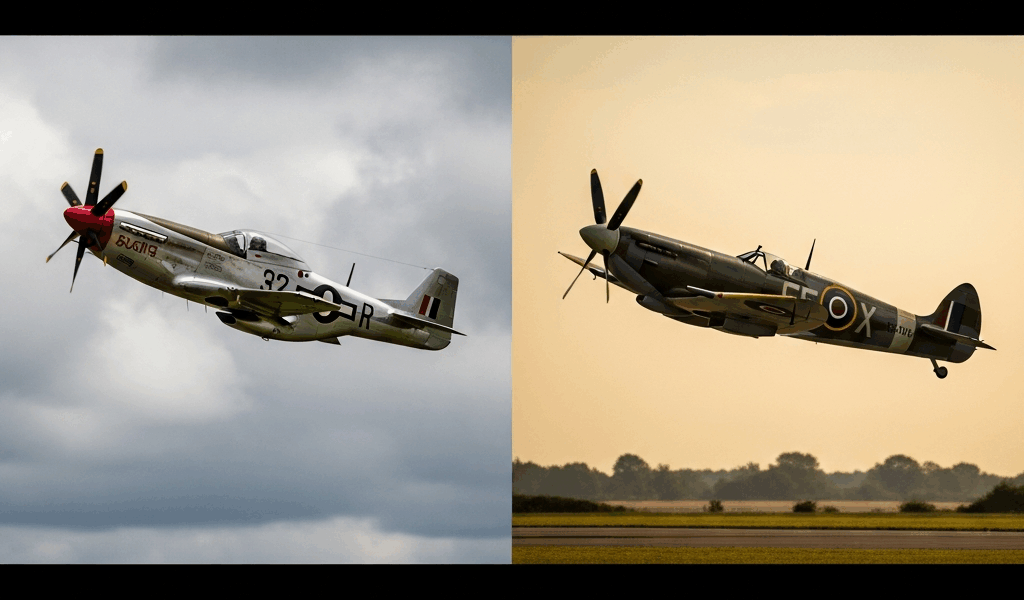
P-51 Mustang vs Spitfire — Which Fighter Won WW2
Two Legends Built for Different Wars
The P-51 Mustang vs Spitfire debate has gotten complicated with all the diplomatic non-answers flying around. As someone who spent years digging through operational records, pilot memoirs, and USAAF after-action reports on this exact question, I learned everything there is to know about what these aircraft actually did — and didn’t do. Today, I will share it all with you.
The Mustang was born from a British procurement request in 1940. North American Aviation designed it in 117 days. Flat-out remarkable. The Spitfire was Reginald Mitchell’s masterpiece — conceived as a short-range interceptor to keep German aircraft out of British airspace. These planes were never designed to compete with each other. Different jobs. Different wars, really. That’s what makes comparing them across specific mission types so useful — you finally get a real answer instead of noise.
So, without further ado, let’s dive in.
Range and Escort Duty — No Contest
This one isn’t close. The P-51D carried enough fuel — with two 108-gallon drop tanks — to reach a combat radius of roughly 1,650 miles. The Spitfire Mk IX maxed out around 980 miles under comparable conditions, and that’s being generous. Those aren’t similar numbers. That’s a different category of aircraft entirely.
Before P-51s began escorting 8th Air Force bombers deep into Germany in early 1944, loss rates were catastrophic. The Schweinfurt raids of October 1943 saw the USAAF lose 77 B-17s across two missions — roughly 20% of the attacking force each time. Those numbers nearly ended the strategic bombing campaign before it broke anything meaningful. When Mustangs took over long-range escort duties, loss rates dropped sharply and stayed down. The Luftwaffe was now being forced to fight over its own territory, without the luxury of waiting for escorts to turn back.
Spitfires flew escort too — across the Channel, into France, occasionally into the Low Countries. Excellent work, genuinely. But Berlin? Regensburg? Ploești? Not a chance. The Spitfire’s ferry range simply didn’t exist for those missions. This is the one area where there’s no debate worth having.
- P-51D combat radius with drop tanks — approximately 1,650 miles
- Spitfire Mk IX combat radius — approximately 980 miles
- 8th Air Force B-17 loss rate at Schweinfurt (October 1943) — near 20% per mission
- Post-Mustang escort deployment — loss rates declined to sustainable levels by spring 1944
Clear winner in escort duty — the Mustang, and it’s not a debate.
Pure Dogfighting — Where the Spitfire Shines
Probably should have opened with this section, honestly. It’s where the Spitfire case is strongest — and where most people’s instincts about aerial combat actually live.
The Spitfire’s elliptical wing wasn’t just beautiful. It gave the aircraft an exceptionally low induced drag profile at varying angles of attack, which translated into a tighter sustained turn radius than almost anything it faced. At altitudes below 20,000 feet, in a turning fight, the Spitfire Mk IX was punishing. Climb rate to 20,000 feet ran around 4,800 feet per minute. The P-51D managed roughly 3,200 feet per minute to the same altitude. That difference gets pilots killed — full stop.
RAF pilots who flew both aircraft noted the handling difference consistently. Johnnie Johnson, the RAF’s top-scoring ace with 38 confirmed kills, flew Spitfires his entire operational career. He was explicit about preferring them for close-in work. The Spitfire demanded precision and rewarded it with a responsiveness the Mustang simply didn’t match at low altitude.
Here’s the Merlin connection that surprises most people. Both aircraft eventually ran variants of the Rolls-Royce Merlin engine. The Mustang’s early Allison-engined versions were mediocre above 15,000 feet — genuinely underwhelming. Frustrated by those high-altitude performance limitations, Rolls-Royce engineers fitted a Merlin 61 to an early Mustang airframe in 1942 using relatively straightforward modifications. The performance leap was so dramatic it essentially created a different aircraft. The Packard-built V-1650 powering production P-51Ds was a licensed Merlin derivative. So at high altitude, the Mustang borrowed the Spitfire’s engine family to become competitive. That’s not a knock — it’s engineering pragmatism. But it does complicate any claim that these were pure rivals.
I’m apparently a kill-ratio obsessive, and digging into 354th Fighter Group records specifically works for me while broad generalizations never quite satisfy. Mustang pilots achieved strong kill ratios — but many top-scoring missions involved boom-and-zoom tactics at altitude, diving attacks exploiting the P-51’s high-speed stability rather than sustained turning engagements. Spitfire pilots brawling with Bf 109s and FW 190s at low altitude in tight circles fared considerably better in equivalent turning scenarios. Different tools. Different techniques.
Clear winner in a turning dogfight below 20,000 feet — the Spitfire.
Production Scale and War Impact
Numbers matter, but timing matters more. Total Spitfire production across all marks reached approximately 20,351 aircraft. P-51 production across all variants came to around 15,875. The Spitfire wins on units built. Simple fact.
But what is raw production data, really? In essence, it’s a headcount. But it’s much more than that — because timing shapes what those numbers actually meant.
The Spitfire’s peak impact landed between 1940 and 1943, doing something irreplaceable — keeping Britain in the war. During the Battle of Britain, Spitfires and Hurricanes together turned back the Luftwaffe and denied Germany air superiority over the Channel. Without that, no D-Day. No strategic bombing campaign from English bases. No functioning Allied supply chain across the Atlantic. The Spitfire’s contribution to survival cannot be measured in kill ratios alone. That’s what makes it endearing to us aviation enthusiasts even now.
The Mustang’s peak impact came later — late 1943 through 1945 — during the phase when the Allies weren’t just surviving, they were dismantling Germany’s capacity to fight. P-51s escorted the bombers that wrecked German oil production, aircraft factories, and rail infrastructure near places like Merseburg, Leuna, and Schweinfurt. They also forced the Luftwaffe into attrition battles it couldn’t sustain. By mid-1944, Germany was losing experienced pilots faster than replacements could be trained. The Mustang’s documented presence over deep targets in Germany contributed directly to that collapse.
Timing shaped both legacies. Neither aircraft could have done the other’s job at the moment it was most needed.
The Verdict — Depends What You Need to Win
I’ll give you the two answers you actually came here for.
For winning World War 2 — the strategic, war-ending, Luftwaffe-breaking question — the P-51 Mustang was more decisive. The long-range escort mission over Germany changed the arithmetic of the air war in a way no other single aircraft type accomplished. That’s documented in operational records, loss statistics, and the memoirs of German commanders who watched their pilot replacement pipeline collapse through 1944. The Mustang arrived at exactly the moment the Allied air campaign needed a long arm, and it delivered one.
For pure aerial combat performance — the question of which aircraft was a more complete fighting machine in the right conditions — the Spitfire holds its ground. Faster in a climb, tighter in a turn, more responsive below 20,000 feet. In the hands of a skilled pilot against an equivalent opponent, the Spitfire Mk IX or Mk XIV was as dangerous as anything flying in any theater. That was 1944, and that remains the honest assessment.
Don’t make my mistake. Early on, I treated range as a secondary factor and focused almost entirely on flight performance specs. Wrong framing entirely. Range wasn’t a spec — range was the entire strategic question of 1943 and 1944. Once I reoriented around mission type rather than aircraft capability in isolation, the answer became obvious fast.
Here’s your quotable takeaway — the Spitfire was the better fighter, but the Mustang won the war. Those aren’t contradictory statements. They’re the most accurate summary of what the records actually show.


Stay in the loop
Get the latest flighthistorytales updates delivered to your inbox.