The Doolittle Raid — How 16 Bombers Changed the Pacific War
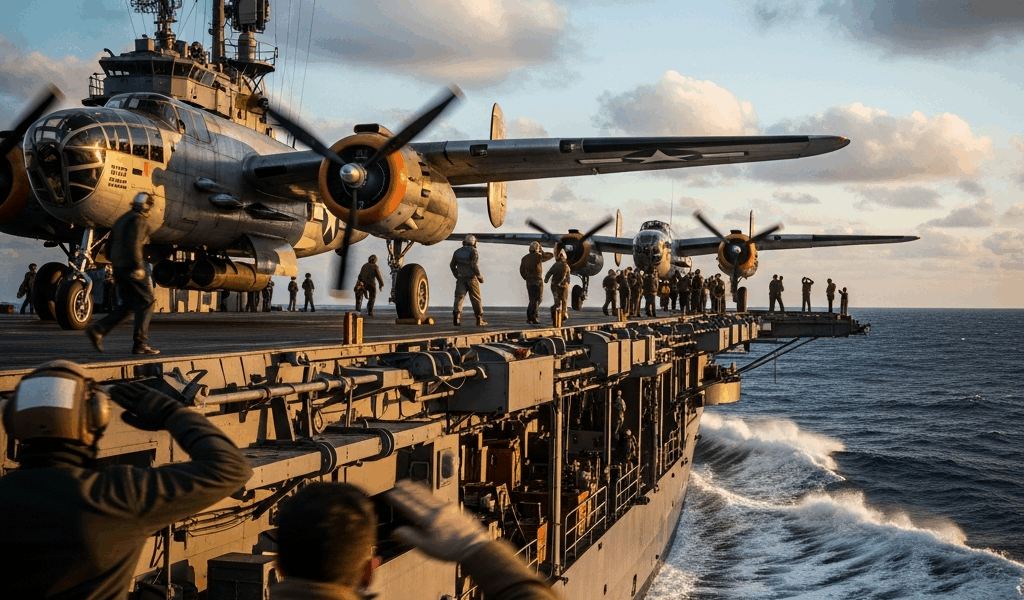
The Doolittle Raid story is one of those things where the more you dig into what actually happened, the more it stops sounding like history and starts sounding like something a screenwriter invented on a deadline. Sixteen B-25 Mitchell bombers. A Navy aircraft carrier in the middle of the Pacific Ocean. Eighty volunteers who were told, more or less honestly, that the odds of making it back were not good. I’ve been obsessed with World War II aviation history since my grandfather left me a battered copy of Ted Lawson’s Thirty Seconds Over Tokyo when I was about twelve years old, and I still find myself stopping cold when I reread the launch sequence. April 18, 1942. Four months after Pearl Harbor. America needed something to hold onto, and Jimmy Doolittle gave it to them — at a cost that the newspapers weren’t allowed to print for years.
The Impossible Mission
Nobody had ever launched a twin-engine Army bomber from an aircraft carrier. That sentence needs to sit for a second before you move on.
The B-25B Mitchell was not a small airplane. Wingspan of 67 feet, 7 inches. Loaded weight approaching 27,000 pounds. A Navy carrier deck — specifically the USS Hornet (CV-8) — offered a runway of maybe 467 feet under ideal conditions, compared to the 1,500 feet a B-25 typically needed on land. The engineering problem wasn’t subtle. It was the kind of problem where the first instinct of most reasonable people would be to say no and find a different plan.
Navy Captain Francis Low gets credit for the original idea, floated to Admiral Ernest King in January 1942. Low had watched Army bombers flying practice patterns near a carrier outline painted on an airfield in Norfolk, Virginia. Something clicked. If Army bombers could simulate takeoffs from a carrier shape on the ground, maybe they could do it for real. King passed the concept to Admiral Hap Arnold, who handed it to Lieutenant Colonel James Doolittle with instructions to figure out if it was physically possible.
Doolittle was not a man who called things impossible without testing them first. A former aerobatic champion and MIT aeronautical engineer — his thesis was on the effect of wind velocity on instrument flight, which is about as dry as it sounds but apparently mattered enormously — he spent weeks calculating load limits, fuel requirements, and minimum takeoff distances. The solution involved stripping weight from the aircraft in ways that made the crews nervous. The lower gun turret came out. A liaison radio was removed. Wooden broomsticks painted black replaced the tail guns because the actual guns added too much weight. Each B-25 was fitted with custom 160-gallon steel fuel tanks in the bomb bays and collapsible 60-gallon rubber tanks in the crawlway above the bomb bay — giving a total fuel capacity of roughly 1,141 gallons per aircraft.
Training happened at Eglin Field in Florida starting in late February 1942. The pilots drilled short-field takeoffs obsessively, using a 500-foot strip marked with white paint to simulate carrier deck length. Lieutenant Henry Miller from the Navy coached them. He told them to get the tail up fast and trust the headwind. Most of them managed it within a few runs. A couple of them took significantly longer. Nobody washed out, which in retrospect was partly determination and partly the fact that Doolittle had already pre-selected volunteers he believed could learn it.
Launch Day — April 18, 1942
The plan called for a launch point 400 to 500 miles east of Japan. That was tight but manageable on paper. The crews would fly to their targets, bomb them, and continue west to friendly airfields in eastern China. Simple enough, if everything went right.
Everything went wrong before dawn on April 18th.
The Hornet task force was spotted by a Japanese patrol vessel — the Nitto Maru No. 23, a picket boat roughly 650 miles from the Japanese coast. The boat sent a radio warning before the cruiser Nashville sank her with gunfire and naval gunfire. But the damage was done. The Japanese navy now knew approximately where the Americans were.
Doolittle made the call. Launch now. Ten hours early. From a point roughly 170 miles further from Japan than planned — some accounts put the distance at 650 to 700 miles. The sea state that morning was ferocious, with waves running 30 feet. The Hornet was pitching hard enough that the bow rose and fell 40 feet between swells. Doolittle’s B-25 was spotted first on the deck, which meant it had the shortest takeoff run — about 467 feet. He went first. He lifted off with maybe 15 feet of deck to spare.
Watching the takeoff from the ship, Lieutenant Edgar McElroy later said it looked like the plane simply fell off the end of the deck before the wings caught air. Fifteen more B-25s followed. All sixteen launched successfully. Not one went into the ocean. Given the sea state, the overloaded aircraft, and the compressed timeline, this was not a foregone conclusion. Several crew members admitted afterward they had written quick notes to family members that morning, tucked into jacket pockets, just in case the takeoff run ended in the Pacific.
The extra distance meant the fuel math, already thin, was now genuinely alarming. The crews had been told before departure that their fuel margins were minimal. After launching early, those margins became theoretical. Some pilots began calculating whether they could make landfall at all. One navigator, Lieutenant Charles McClure aboard aircraft number 7, ran the numbers three separate times and got three slightly different answers, none of them particularly comforting.
Over Tokyo — What the Crews Experienced
Probably should have opened with this section, honestly — because the moment the bombs fell is the part everyone thinks they know, and almost nobody knows correctly.
The B-25s flew most of the route at low altitude, around 200 feet above the water, to avoid Japanese radar. As they approached the Japanese coast, the crews expected fighter interception. They got almost none. Japanese air defenses were not on alert. Some accounts describe Japanese civilians waving at the passing aircraft, apparently assuming they were friendly. The mission planners had timed the raid to arrive over Tokyo around noon, in daylight, which felt insane but was deliberate — daylight bombing gave better accuracy, and the psychological effect of visible aircraft over the capital was considered part of the point.
Captain Ted Lawson, piloting aircraft number 7 — the Ruptured Duck — described flying over Tokyo rooftops at what felt like window-level height. He could see people in the streets below. He remembered thinking the city looked peaceful. Normal. Then his bombardier, Sergeant Robert Clever, called the release, and the first of four 500-pound bombs went down.
The targets were industrial and military — steel plants, oil storage facilities, a naval yard at Yokosuka. The physical damage was real but not strategically significant. A few fires. Some structural damage. No major industrial capacity destroyed. Japanese officials later confirmed 50 people killed and 400 wounded in the raids, which, measured against the scale of destruction that would come later in the war, was almost nothing.
But the psychological impact was immediate and ran in two directions simultaneously. In America, news of the raid — released by the White House with Roosevelt cryptically claiming the bombers came from “Shangri-La” — hit a public that had endured four months of almost unbroken bad news. In Japan, the Emperor had been assured that the home islands were untouchable. The sight of American bombers over Tokyo shattered that assurance in a single afternoon.
After the Bombs — Survival, Capture, Escape
Struck by a combination of darkness, fuel exhaustion, and weather moving in fast over eastern China, most of the crews never reached the airfields they were supposed to land at. Fifteen of the sixteen aircraft either crash-landed or the crews bailed out over China. The sixteenth, unable to reach China, diverted to the Soviet Union near Vladivostok, where the crew was interned for more than a year before eventually being allowed to “escape” into Iran through a series of arrangements the Soviets and Americans preferred not to document too precisely.
Of the 80 men who flew the mission, 69 eventually made it back to Allied hands. The losses among the rest were not abstract statistics. They were specific and brutal.
Eight men were captured by Japanese forces in occupied China. Three were executed by firing squad in October 1942 — Lieutenant Dean Hallmark, Lieutenant William Farrow, and Sergeant Harold Spatz. A fourth, Lieutenant Robert Meder, died in captivity from dysentery and malnutrition in December 1943. The remaining four survived prisoner-of-war camps until liberation in 1945.
The Chinese civilians who helped the American crews paid an even worse price. When Japanese forces swept through the coastal provinces of Zhejiang and Jiangxi searching for evidence of American assistance, they enacted brutal reprisals against villages suspected of harboring the airmen. Estimates of Chinese civilian deaths from the resulting Japanese campaign — sometimes called the Sei-go Operation — run between 10,000 and 250,000, depending on the source and the methodology. That number haunted many of the surviving raiders for the rest of their lives. Lieutenant Colonel Doolittle himself, in his autobiography published decades later, returned to it with visible difficulty.
Corporal Jacob DeShazer, one of the men captured, spent 40 months as a prisoner. He later became a missionary and returned to Japan after the war, where he worked for decades. Captain Ted Lawson lost a leg when his plane ditched off the Chinese coast; a Navy surgeon performed the amputation on a makeshift table using instruments he improvised from what was available. Lawson wrote Thirty Seconds Over Tokyo while still recovering from surgery, dictating parts of it when he couldn’t hold a pen.
I made the mistake early on of reading the sanitized summary versions of this story — the ones that stop at the bombs falling and the morale boost and leave out the China reprisals entirely. That was a significant gap. The full story doesn’t reduce cleanly to triumph.
Why the Raid Mattered More Than the Damage It Caused
The physical damage from the Doolittle Raid was, by any military accounting, minimal. That’s been documented and repeated enough that it can start to sound like a dismissal. It isn’t.
The strategic consequences were enormous and operated on multiple levels at the same time.
At home, the morale effect was real and measurable in ways that go beyond vague sentiment. In the months after Pearl Harbor, American public confidence in the war effort had been battered by the fall of Guam, Wake Island, the Philippines, and Singapore. The Navy had suffered losses it wasn’t fully disclosing. Recruitment was strong but anxiety was higher than official communications admitted. The Doolittle Raid — even stripped of details the censors wouldn’t release — told a population that had been hit that its military could reach back. That mattered.
In Japan, the effect was arguably more consequential in operational terms. Admiral Isoroku Yamamoto had staked significant personal prestige on the claim that the home islands were secure. The raid demolished that claim publicly and humiliated the Japanese military leadership in front of the Emperor. The response was a strategic overcorrection that altered the entire Pacific war.
Japanese planners accelerated and expanded the operation to capture Midway Island — the idea being to push the defensive perimeter far enough east that American carriers could never again approach striking distance of Japan. Capturing Midway required committing a substantial portion of the Japanese fleet, including four fleet carriers. The Battle of Midway, fought in June 1942, ended with all four carriers at the bottom of the Pacific and Japanese naval air power crippled in ways it never fully recovered from.
The direct line from the Doolittle Raid to Midway isn’t speculation. Japanese planning documents captured after the war made the connection explicit. Yamamoto pushed for Midway specifically because of April 18th.
Beyond Midway, the Japanese military diverted fighter units to home island defense that had previously been deployed offensively in the Pacific theater. Resources committed to protecting against another raid were resources unavailable for offensive operations elsewhere. The tactical math shifted, incrementally but persistently, against Japanese expansion.
Doolittle himself, landing in China on the night of April 18th after bailing out of his aircraft, was convinced he would be court-martialed for losing every plane on the mission. He was instead awarded the Medal of Honor and promoted two grades, from lieutenant colonel to brigadier general, skipping the rank of colonel entirely. He later said the promotion was the most surprised he had ever been in his life, which, given that he had just launched a bomber from a carrier deck and flown to Japan, is saying something.
The eighty men who flew that mission held annual reunions for decades. The last toast — a tradition at every gathering — was always raised with a 1896 Hennessy cognac, using a set of silver goblets engraved with each raider’s name. As crew members died, their goblets were turned upside down on the display rack. By 2013, only four men remained to raise their glasses. The final reunion was held in Fort Worth in November 2013. The last surviving raider, Lieutenant Colonel Richard Cole — Doolittle’s co-pilot on the lead aircraft — passed away in April 2019, at age 103.
Sixteen bombers. Eighty men. Thirty seconds over Tokyo, as Lawson titled his account. The damage to Japan was small. What it did to the war was not.



Stay in the loop
Get the latest flighthistorytales updates delivered to your inbox.