The First Commercial Airport in the World — Where Aviation Began
The question of the first airport in the world history books seems like it should have a clean answer. One place. One date. Done. But the more I dug into this, the more I realized aviation history is a mess of competing claims, national pride, and the genuinely complicated problem of defining what an “airport” actually is. I spent the better part of three weeks reading through FAA archives, old RAF records, and a surprisingly entertaining collection of early 20th century newspaper accounts from Hamburg, and what I found was a story far stranger and more interesting than any simple listicle could capture.
There isn’t one first airport. There are at least three serious contenders, each with a legitimate claim, each representing a completely different idea of what aviation would eventually become. And the way those claims collide tells you everything about how chaotic, exhilarating, and genuinely improvised the birth of commercial flight actually was.
The Contenders for World’s First Airport
Let’s start in Maryland. College Park Airport opened in 1909, which means it predates the concept of commercial aviation by about a decade. Orville Wright himself trained the first military pilots there — two U.S. Army Signal Corps officers named Frederic Humphreys and Frank Lahm — using a Wright Military Flyer on a grass strip that was essentially a large mowed field outside Washington, D.C. The “airport” at that point was a shed and some open ground. No terminal. No tower. No runway markings. Just grass, wind, and a biplane.
College Park is significant not because it was purpose-built for commercial travel but because it never stopped operating. It’s been in continuous use since 1909, which is a genuinely staggering fact. It’s currently the oldest continuously operating airport in the world, still active today, sitting on about 30 acres in Prince George’s County, Maryland. You can fly a Cessna 172 out of it on a Tuesday afternoon if you want.
Hamburg comes next. Flughafen Hamburg, which would eventually become one of Germany’s major international airports, traces its origins to 1911 when the Hamburg America Line — yes, the shipping company — began operating DELAG zeppelin passenger services out of a facility at Fuhlsbüttel. This is where the “first commercial” argument gets interesting. DELAG, Deutsche Luftschiffahrts-AG, ran actual ticketed passenger flights on zeppelins between German cities. These were not joyrides. They were scheduled services. Passengers paid real money — around 200 German marks per flight, which in 1912 was roughly equivalent to a month’s wages for a skilled tradesman — and expected to arrive at a destination.
The problem, depending on your perspective, is that zeppelins are not airplanes. Whether a zeppelin port counts as an “airport” is a debate that aviation historians still have with genuine passion at conferences. I am not making that up.
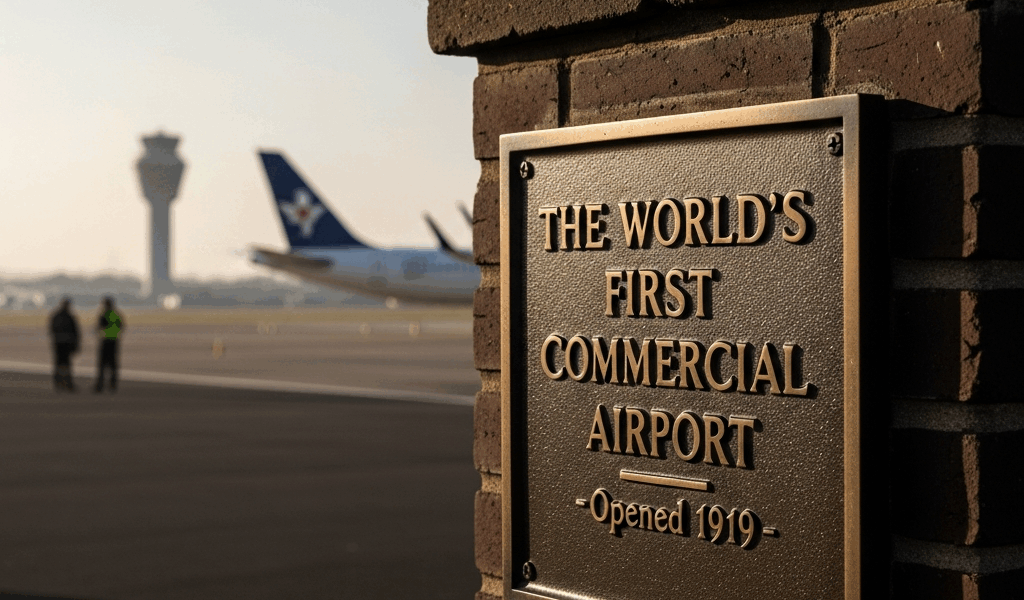
Then there’s Hounslow Heath Aerodrome, just outside London, which opened in 1919 and can claim something neither College Park nor Hamburg can match: it was the departure point for the first scheduled international commercial airplane service in history. On August 25, 1919, Aircraft Transport and Travel Limited flew a de Havilland DH.4A from Hounslow Heath to Le Bourget in Paris. The aircraft carried one passenger, a consignment of leather, some grouse, and a large quantity of Devonshire cream. I find the Devonshire cream detail genuinely charming every time I come across it.
Hounslow Heath was licensed by the British Air Ministry, making it the first officially licensed commercial aerodrome in the United Kingdom. It operated for only about a year before Croydon Airport replaced it in 1920.
What “First” Means in Aviation Context
Probably should have opened with this section, honestly, because the whole argument about which airport came first collapses the moment you ask: first to do what, exactly?
Here are the legitimate definitions, each of which produces a different winner:
- First continuously operating airport — College Park Airport, 1909, Maryland, USA
- First to host commercial passenger services — Fuhlsbüttel, Hamburg, 1911, if you count zeppelins
- First licensed commercial aerodrome — Hounslow Heath, 1919, England
- First to host scheduled international heavier-than-air commercial flights — Hounslow Heath, 1919, England
- First purpose-built civil airport — Croydon, 1920, England, arguably
Aviation did not arrive with an instruction manual. The Wright Brothers flew at Kitty Hawk in December 1903, and within six years there were already arguments about infrastructure and jurisdiction. Early aviators were simultaneously trying to figure out how to keep aircraft in the air for more than 30 minutes and how to convince governments that flying machines deserved the same regulatory framework as railways and shipping lanes.
The concept of a “licensed” airport didn’t exist until there was enough aviation activity to require licensing. The British Air Navigation Regulations of 1919 were among the first formal frameworks in the world for commercial aviation, which is partly why British airports dominate the “official first” claims. It’s not that Britain was necessarily flying earlier or better — it’s that Britain bureaucratized aviation earlier. Whether that’s a point in their favor is a matter of opinion.
College Park existed in a regulatory vacuum for years. It was a military training ground, then a site for postal experiments, then a private flying club. The fact that it never stopped operating is remarkable. The fact that it didn’t need to be licensed to keep operating tells you something about how informal early American aviation infrastructure was.
How Early Airports Actually Worked
Fascinated by a photograph I found in the Smithsonian’s digital archive of College Park in 1912, I spent a long afternoon trying to reconstruct what it would have actually felt like to be a “passenger” at one of these early facilities. The photograph shows a grass field, two wood-and-canvas aircraft, and approximately eight men in suits standing around doing very little. There is no building visible except a small wooden hangar.
Early airports were, by modern standards, terrifyingly informal. The grass strips at Hounslow Heath were mowed to approximately 3 inches — this was actually a specification, because longer grass caused problems with the tail skids on aircraft like the DH.4. Fueling was done by hand from 5-gallon tins, decanted through a chamois leather filter to remove water contamination. There were no instrument approaches. There were no radio communications. Pilots navigated by following railway lines and rivers, and they landed when the weather allowed, which it frequently did not.
Passengers on the early London-Paris route in 1919 were given leather helmets, goggles, and a fleece-lined coat. The aircraft were not pressurized or heated. Cruising altitude was typically between 1,000 and 3,000 feet, which in an open or semi-open cockpit aircraft in November over the English Channel meant temperatures regularly dropped below freezing. The flight took somewhere between 2.5 and 4 hours depending on headwinds. The ticket cost £21, equivalent to roughly £1,200 in today’s money — about the price of a business class transatlantic fare today, except you arrived hypothermic and slightly deaf.
There were no terminals in the modern sense. At Hounslow Heath, passengers assembled at a wooden hut near the aircraft. Baggage was weighed on a postal scale. There was no security screening, no departure board, and no gate. You walked across the grass and climbed into the aircraft when the pilot said it was time.
I once made the mistake of assuming that “early aviation infrastructure” was simply a primitive version of what we have now. It wasn’t. It was a completely different thing — closer in spirit to a harbor for small boats than to a modern airport. The logic was different, the scale was different, and the assumptions about who would use it and why were completely different.
The Airports That Survived — and What Happened to the Rest
College Park Airport is still there. That bears repeating. An airport that opened when William Howard Taft was president of the United States is still accepting takeoffs and landings today. It sits inside the Capital Flight Restriction Zone, which means flying in and out requires specific transponder codes and radio communication with Washington approach control, but it operates. The airport has a small museum on site. The runway is 2,607 feet long — not exactly O’Hare.
Hounslow Heath did not survive. Within a year of opening, it was superseded by Croydon Airport, which had better road access and more space for expansion. The land at Hounslow Heath was eventually absorbed into the suburban sprawl of west London. Today the site is covered by housing estates and a park. There’s no marker, no monument, nothing particularly visible to indicate that the first scheduled international commercial flight in history took off from that ground. Croydon itself survived longer — until 1959 — and the terminal building still stands, Grade II listed, currently used as offices.
Hamburg’s Fuhlsbüttel airport transformed into a full commercial facility as the zeppelin era ended. It became Hamburg Airport in the modern sense, survived World War II with significant damage, was rebuilt, expanded, and today handles around 14 million passengers a year. Of the original three contenders, it’s the one that most directly became a major international airport. The zeppelin sheds are gone. The infrastructure is entirely modern. But the site has been in continuous use since 1911.
Other early aviation sites fared worse. Mineola Field in New York, one of the earliest American aviation venues, became Mitchel Field, then was decommissioned, and is now the Nassau Hub — a mall and county complex. Buc Aerodrome outside Paris, where early French aviation history was written, is now farmland. Brooklands in England, where much of Britain’s pre-World War I aviation happened on the famous motor racing circuit, is now a museum and business park.
What strikes me most about this history is how quickly it was built over. Aviation infrastructure from before 1930 has almost entirely vanished from the physical landscape. The airports that mattered most in the story of commercial flight’s origins are, almost without exception, either gone or completely unrecognizable. College Park survives precisely because it never grew important enough to be replaced by something larger. There’s a specific irony in that — the oldest airport in the world exists partly because the forces that would have destroyed it never had sufficient reason to try.
The first airport in the world, in the end, is less a place than a moment — the moment someone decided that the ground beneath an aircraft deserved as much thought as the aircraft itself. That decision happened slowly, in multiple countries, for different reasons, with different definitions of what they were even trying to build. The mess of competing claims isn’t a flaw in the history. It is the history.




Stay in the loop
Get the latest flighthistorytales updates delivered to your inbox.