The First Transatlantic Flights — When Crossing the Ocean Meant Risking Your Life
Transatlantic flight has gotten complicated with all the mythology flying around. Ask most people who crossed the Atlantic first and you’ll get Lindbergh every time. Wrong answer — but an understandable one, given how thoroughly history got rewritten by newsreel cameras and ticker-tape parades. As someone who spent years buried in pilot memoirs and standing in hangars that smell like old oil and canvas, I learned everything there is to know about how humanity actually punched through one of the most hostile stretches of geography on earth. What I found still gets me. These men climbed into machines that had no business crossing an ocean — no radar, no GPS, no rescue waiting on the other end. Just an engine, a compass, and an extraordinary tolerance for dying cold and wet somewhere in the North Atlantic.
Alcock and Brown — The First Nonstop Crossing Nobody Remembers
Ask ten people who flew the Atlantic first and nine will say Lindbergh. They’re wrong. Lindbergh made the first solo nonstop crossing. The first nonstop transatlantic flight happened eight years earlier, June 1919, and it involved two British men, a converted World War I bomber, and a bog in County Galway.
Captain John Alcock and Lieutenant Arthur Whitten Brown took off from St. John’s, Newfoundland on June 14, 1919, in a Vickers Vimy biplane. Two Rolls-Royce Eagle VIII engines. About 360 horsepower each — roughly the equivalent of eighteen lawnmowers duct-taped together. They were crossing 1,890 miles of open ocean on barely scaled-up garden machinery, and they knew it.
The flight fell apart from almost the first hour. Radio failed. Heating system failed. Ice formed on the aircraft’s surfaces and on the air-speed indicator, leaving them genuinely blind to how fast — or how slowly — they were actually moving. At one point, locked inside a cloud with no visual horizon, they went into an uncontrolled spiral and dropped roughly 4,000 feet before Brown spotted the ocean surface and Alcock wrenched the controls level, wingtips reportedly grazing wave crests. Then Brown climbed out onto the wing — multiple times, in an open-cockpit biplane, over the Atlantic Ocean — to chip ice off the engine intakes with a penknife.
They landed in Derrygimlagh Bog near Clifden, Ireland on June 15. The Vimy’s nose buried itself in soft ground. Total crossing time: 16 hours and 27 minutes. King George V knighted both men within days. Winston Churchill handed over the £10,000 prize from the Daily Mail.
Then history mostly forgot them.
Part of the reason is tragic timing. Alcock died just six months later — December 1919, a delivery flight to Paris in poor visibility, a crash in Normandy. Brown never flew again after that. He lived until 1948, quietly watching Lindbergh collect the parades. If you visit Connemara today, there’s a small white marker in the bog and a modest memorial nearby. Heartbreakingly understated, honestly, for what those two men actually pulled off.
Lindbergh and the Spirit of St. Louis — Why This One Became Famous
Probably should have opened with this section, honestly. It’s the one everyone came here for. But understanding why Lindbergh became a legend requires knowing he wasn’t even close to the first. He was the first to do it alone, nonstop, New York to Paris — and he did it at exactly the moment mass media was starving for a hero.
May 20, 1927. A 25-year-old airmail pilot climbed into a single-engine Ryan NYP monoplane at Roosevelt Field on Long Island. The Spirit of St. Louis weighed 5,135 pounds fully loaded with fuel. Lindbergh couldn’t see directly forward — the fuel tank sat between him and the windshield, so he navigated with a periscope and side windows. The takeoff run was so heavy that witnesses held their breath as the wheels cleared the telephone wires at the field’s edge by what several accounts put at roughly twenty feet.
Obsessed with weight, Lindbergh had stripped out everything he considered nonessential — radio, parachute, navigation lights. He brought five sandwiches. He flew 3,600 miles in 33 hours and 30 minutes, landed at Le Bourget aerodrome outside Paris, and was met by an estimated 150,000 people who tore at the aircraft and nearly crushed him outright.
The engine pushing all of this: a single Wright Whirlwind J-5C, 223 horsepower. For the final third of the flight, Lindbergh fought sleep deprivation so severe he later described hallucinatory figures appearing in the cockpit — speaking to him, apparently. He accepted it calmly and kept flying. Different material, that man.
What made Lindbergh famous where Alcock and Brown were merely honored was convergence — a high-profile $25,000 prize from hotelier Raymond Orteig, a charismatic young pilot without institutional backing, and a global press infrastructure that simply hadn’t existed in 1919. Telegraph wires, newsreel cameras, radio broadcasts — the whole apparatus turned Lindbergh into myth in real time. Alcock and Brown did something more dangerous in worse conditions. Lindbergh did something the world was finally ready to watch.
The First Commercial Transatlantic Flights
Don’t make my mistake — I spent the early part of my research assuming commercial service followed Lindbergh’s crossing within a few years. It didn’t. Regular passenger service across the North Atlantic didn’t begin until 1939. Twenty years after Alcock and Brown nose-dived into that Irish bog.
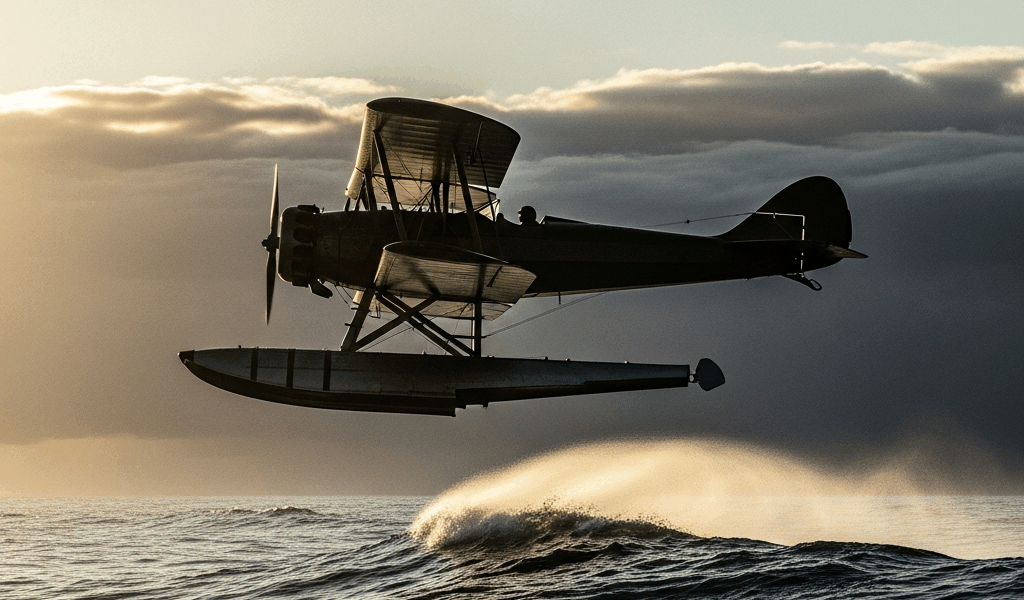
But what made it possible? In essence, it was the flying boat — specifically Pan American Airways’ Boeing 314 Clipper. But it’s much more than that. These were enormous machines: 106 feet long, wingspan of 152 feet, landing on water because there were no airstrips mid-ocean. The Boeing 314 carried up to 74 passengers on daytime routes, converting to sleeping berths overnight for around 40 people in what the brochures called reasonable comfort.
Reasonable is doing a lot of work in that sentence. The crossing wasn’t a single flight — Pan Am’s northern route stopped in Newfoundland, then the Azores, or alternatively routed through Bermuda and Lisbon. New York to Southampton took roughly 29 hours of flying spread across multiple days, with hotel nights sandwiched between legs. A one-way ticket in 1939 ran $375 — around $8,000 today. Passengers were almost exclusively wealthy business travelers, diplomats, and film stars.
Glamorous? Absolutely. Smooth? Not even slightly. Turbulence over open water at 8,000 to 10,000 feet — the Clippers’ operational ceiling — was constant and brutal. The cabin smelled of aviation fuel and seawater. Noise levels ran around 90 decibels for hours straight. That’s what makes the Clipper era endearing to us aviation enthusiasts — the audacity of calling it luxury while passengers white-knuckled their armrests somewhere over the mid-Atlantic.
World War II suspended commercial service entirely. When routes resumed after 1945, surplus military aircraft like the Lockheed Constellation entered civilian service — faster, more reliable, and significantly less exhausting. The Atlantic was becoming something other than an expedition.
How the Atlantic Went From Death Trap to Commute
The real revolution happened on one specific date: October 26, 1958. Pan American Flight 114 departed New York Idlewild Airport in a Boeing 707-120 and landed in Paris Le Bourget 8 hours and 41 minutes later. Not days. Not a multi-stop crawl across island chains. Eight hours and forty-one minutes.
Four Pratt & Whitney JT3C turbojet engines. Cruising at 550 miles per hour, 35,000 feet up — above the weather that had been torturing propeller aircraft for decades. Pressurized cabin. Temperature controlled. Noise levels passengers could actually speak over. Up to 181 passengers depending on configuration, and ticket prices began compressing within a few years as the economics of jet travel reshuffled everything.
Frustrated by Pan Am’s head start, BOAC launched its own 707 transatlantic service within weeks using the same type of aircraft on competing routes. By 1960, the Clipper flying boats — those magnificent, laborious, hotel-hopping giants — were gone from the transatlantic route entirely. The ocean had been domesticated. This new era of jet travel took off rapidly and eventually evolved into the transatlantic network enthusiasts know and rely on today.
While you won’t need much more than a boarding pass now, you will need a handful of hours and the vaguest tolerance for airline food. That’s it. That’s the whole ask. Standing in a boarding queue at Heathrow or JFK, I keep coming back to the compression of it all — forty years separating two men nearly spiraling into the North Atlantic from businesspeople reading newspapers at 35,000 feet, irritated that the Wi-Fi is slow. Alcock used a penknife to keep his engines running. We complain about legroom.
The history of early transatlantic flight is, at its core, a story about what humans will risk when the thing waiting on the other side is extraordinary enough. The ocean didn’t shrink. The machines got better. But the audacity that started everything — that belonged entirely to the people who went first, before anyone had actually proved it could be done at all.



Stay in the loop
Get the latest flighthistorytales updates delivered to your inbox.