The Eighth Air Force Takes Shape
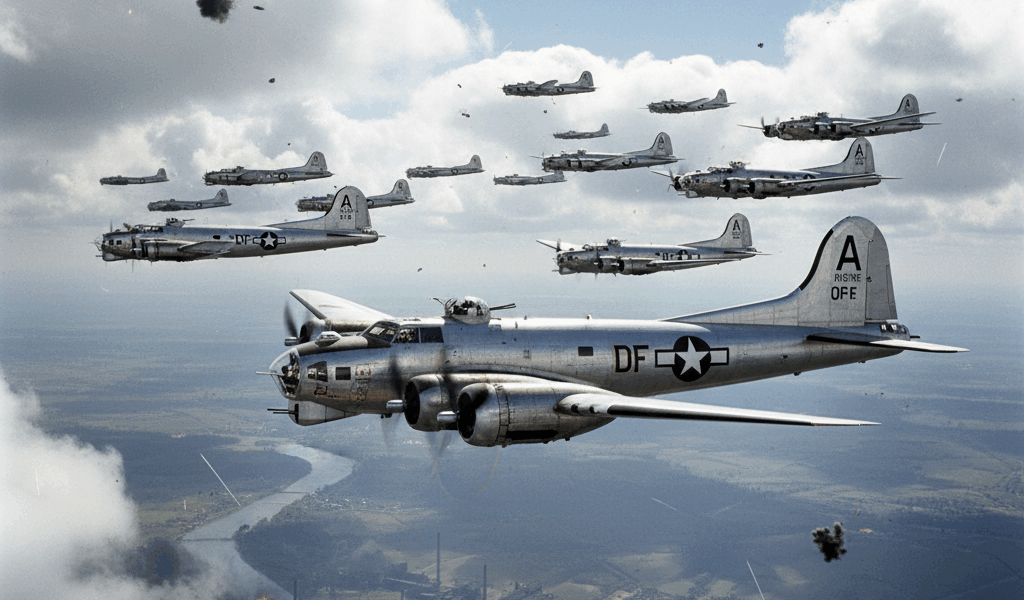
In the summer of 1942, the first Boeing B-17 Flying Fortresses of the United States Eighth Air Force arrived in England, beginning a campaign that would become one of the most costly and consequential in aviation history. The daylight strategic bombing offensive against Nazi Germany would test American theories of air power, demand unprecedented courage from young aircrews, and ultimately help break the German war machine.
The Eighth Air Force was activated in January 1942, just weeks after Pearl Harbor, with a mission that seemed almost impossibly ambitious: destroy Germany’s industrial capacity through precision bombing. Unlike the Royal Air Force, which had concluded that daylight bombing was too dangerous and shifted to nighttime area attacks, American planners believed that heavily armed bomber formations could defend themselves and strike with pinpoint accuracy.
The first B-17 mission from England launched on August 17, 1942, when twelve bombers attacked a railway marshaling yard at Rouen, France. All aircraft returned safely, and the mission was declared a success. But these early operations over occupied France were merely a prelude to the far more dangerous missions that lay ahead.
The B-17 Flying Fortress: A Flying Battleship
The Boeing B-17 earned its “Flying Fortress” name through its remarkable defensive armament and structural toughness. The most common wartime variant, the B-17G, carried thirteen .50 caliber machine guns, including a chin turret added to counter head-on attacks. The four Wright R-1820 Cyclone engines produced 1,200 horsepower each, allowing the bomber to reach altitudes above 25,000 feet while carrying up to 8,000 pounds of bombs.
A B-17 crew consisted of ten men: pilot, co-pilot, bombardier, navigator, flight engineer (who also manned the top turret), radio operator, two waist gunners, ball turret gunner, and tail gunner. These young men, many barely out of their teens, flew in unpressurized, unheated aircraft at temperatures that could reach fifty degrees below zero. Frostbite was common, and oxygen deprivation a constant danger at high altitude.
The B-17’s reputation for absorbing tremendous damage and still bringing its crew home became legendary. Aircraft returned with entire sections of fuselage shot away, engines destroyed, and control surfaces riddled with holes. This ruggedness, combined with the close formation flying that allowed bombers to concentrate their defensive fire, formed the core of American daylight bombing doctrine.
The Norden Bombsight and Precision Bombing
Central to the daylight bombing strategy was the Norden bombsight, a closely guarded instrument that American planners believed could “put a bomb in a pickle barrel from 25,000 feet.” The Norden used an analog computer to calculate the bomb release point, accounting for altitude, airspeed, drift, and ballistic characteristics. Bombardiers spent months learning to operate this complex device.
In practice, precision proved elusive. Clouds obscured targets on many mission days, forcing cancellations or attacks on secondary objectives. German fighters and flak disrupted bombing runs, and the stress of combat degraded accuracy. Still, when conditions allowed, American bombers could achieve concentrations that British night attacks could not match, enabling attacks on specific factories, oil facilities, and transportation chokepoints.
Black Thursday: Schweinfurt and the Limits of Unescorted Bombing
The deepest missions into Germany revealed the terrible cost of unescorted daylight bombing. On August 17, 1943, the Eighth Air Force launched a double strike against the Messerschmitt factory at Regensburg and ball bearing plants at Schweinfurt. Of the 376 B-17s dispatched, sixty were shot down and many more damaged, a loss rate of sixteen percent that no air force could sustain.
Worse followed on October 14, 1943, remembered as “Black Thursday.” A return mission to Schweinfurt cost sixty B-17s and nearly 600 aircrewmen. German fighter controllers concentrated over 300 single and twin-engine fighters against the American formations, attacking in waves that overwhelmed the bombers’ defensive guns. The Luftwaffe employed rockets, aerial bombs, and massed cannon fire to break up the American formations.
These losses temporarily halted deep penetration raids into Germany. The Eighth Air Force’s commanders recognized that their formations could not survive without fighter escort all the way to the target. The solution would not arrive until early 1944 with the introduction of drop tanks that extended fighter range.
Big Week and Air Superiority
The campaign’s turning point came in February 1944 during “Big Week,” a sustained assault on German aircraft production. By then, P-51 Mustangs equipped with drop tanks could escort bombers to any target in Germany. More importantly, General Jimmy Doolittle, the new Eighth Air Force commander, changed doctrine: instead of staying with the bombers, fighters were encouraged to seek out and destroy German aircraft wherever they could find them.
This shift proved decisive. The Luftwaffe lost experienced pilots faster than it could replace them, while American pilot training continued unabated. By the time of D-Day in June 1944, the Allies had achieved air superiority over Western Europe. The Eighth Air Force could now strike with reduced opposition, though flak remained deadly throughout the war.
The Human Cost and Crew Experience
Flying a bombing mission over Germany meant facing extraordinary danger. During the worst periods of 1943, the average survival probability for completing a 25-mission tour was about one in four. Aircrews witnessed friends’ aircraft explode, collide, or spiral down in flames. The psychological toll of repeated exposure to such trauma was immense.
Yet morale among Eighth Air Force crews remained remarkably resilient. Tight bonds formed among crewmembers who depended on each other for survival. The fierce pride in their mission, the camaraderie of base life, and the knowledge that they were striking directly at the Nazi war effort sustained men through experiences that seemed unsurvivable.
By war’s end, the Eighth Air Force had lost over 26,000 airmen killed and another 21,000 taken prisoner. These casualties exceeded those of the entire United States Marine Corps during World War II. The 8th Air Force flew over 10,000 missions, dropping 700,000 tons of bombs on Nazi Germany and occupied Europe.
Strategic Impact and Legacy
The effectiveness of strategic bombing remains debated among historians. German war production actually increased through 1944, despite the bombing campaign, as Albert Speer’s ministry dispersed factories and exploited slave labor. However, the attacks on oil production and transportation infrastructure in the war’s final year contributed significantly to Germany’s collapse.
Perhaps equally important was the attrition of the Luftwaffe. The decision to fight for air superiority, accepting the losses necessary to destroy German fighter strength, ensured that Allied ground forces could operate with minimal interference from the air. The invasion of Normandy was possible because German air power had been broken over the skies of Germany.
Today, preserved B-17s fly at air shows around the world, and museums display the aircraft that helped win the air war over Europe. The men who flew these missions, now passing from the scene, left a legacy of courage and sacrifice that defined an era of aviation history. The Eighth Air Force’s campaign demonstrated both the potential and the terrible cost of strategic air power, lessons that continue to inform military aviation doctrine.


Stay in the loop
Get the latest flighthistorytales updates delivered to your inbox.