The 80-Day Window That Shaped the Pacific War
On December 7, 1941, Japanese carrier aircraft devastated Pearl Harbor, sinking battleships and killing over 2,400 Americans. The attack humiliated the United States and demonstrated Japanese naval dominance across the Pacific. For 80 days, Japan advanced seemingly unstoppable—conquering Philippines, Malaysia, Singapore, and Dutch East Indies while American forces retreated or surrendered.
Then on April 18, 1942—exactly 80 days after Pearl Harbor—sixteen U.S. Army B-25 bombers launched from the aircraft carrier USS Hornet, bombed Tokyo and other Japanese cities, and forced Japanese military strategy into defensive posture that ultimately cost them the war.
The Doolittle Raid delivered minimal physical damage. But its psychological and strategic impacts reshaped the Pacific War in ways that directly led to American victory three years later.
Why 80 Days Mattered
The Crisis Facing American Leadership
By February 1942, America faced catastrophic losses. The Philippines were falling. Singapore had surrendered. Japanese forces controlled vast territories and seemed invincible. American public morale was collapsing.
President Roosevelt and military leaders desperately needed to strike back—not just for military reasons, but to prove America could fight. The question wasn’t whether to attack Japan, but how.
Japan’s home islands sat 5,000+ miles from American bases. No American bomber had the range to reach Tokyo and return. Carrier-based aircraft lacked the payload and range for meaningful strikes. Conventional wisdom said Japan was untouchable.
The Impossible Plan
Captain Francis Low, a submariner on Admiral Ernest King’s staff, observed Army bombers practicing carrier takeoffs at Norfolk Naval Station. This sparked an audacious idea: could Army bombers launch from Navy carriers to attack Japan?
The concept was insane by every conventional measure:
– B-25 Mitchell bombers weighed 35,000 pounds fully loaded—far heavier than any aircraft that had launched from carriers
– Carriers’ flight decks were only 800 feet long—barely sufficient for B-25 takeoff runs with no safety margin
– B-25s couldn’t land on carriers—they’d have to reach China after bombing, over 1,000+ miles of Japanese-controlled territory
– The plan required carriers to approach within 500 miles of Japan—putting invaluable carriers at extreme risk
Every element of the plan violated standard operational doctrine. But conventional approaches couldn’t reach Tokyo. If the plan succeeded, it would prove Japan was vulnerable.
Lieutenant Colonel James Doolittle: The Man for Impossible Missions
The Army chose Lieutenant Colonel James “Jimmy” Doolittle to lead the raid. At 45, Doolittle seemed too old and too valuable for such a dangerous mission. But his credentials were perfect:
– PhD in aeronautical engineering from MIT
– World record holder for transcontinental speed flights
– Pioneer of instrument flying (first pilot to fly blind using instruments alone)
– Test pilot with thousands of hours in diverse aircraft
– Proven ability to accomplish “impossible” aviation challenges
Doolittle personally demonstrated B-25 carrier takeoff feasibility. On February 2, 1942, he took off from USS Hornet with only 467 feet of deck—proving B-25s could launch from carriers despite never having done so before.
Preparation: 80 Days to Learn the Impossible
Crew Selection and Training
Doolittle needed volunteer crews willing to fly a mission they couldn’t fully understand. He asked for experienced B-25 pilots and crews. When told the mission was “extremely hazardous,” “probably one-way,” and “would involve flying from a Navy carrier,” volunteers filled every position.
Training occurred at Eglin Field, Florida. Crews practiced:
– Short-field takeoffs with full combat loads
– Low-altitude navigation over water
– Night flying and instrument approaches
– Emergency bailout procedures
– Chinese language basics for expected landing areas
They practiced taking off in less than 500 feet—far shorter than normal B-25 takeoff distance. Lives depended on this skill.
Aircraft Modifications
Each B-25 received extensive modifications:
– Removed lower gun turret (to save weight)
– Installed additional fuel tanks in crawlspaces and bomb bay
– Added broomstick painted black in tail to simulate rear guns (psychological deterrent)
– Installed special low-altitude bombsights
– Lightened wherever possible to maximize range
These modifications gave B-25s approximately 2,400 miles range—just barely sufficient if everything went perfectly.
The Mission: April 18, 1942
The Approach
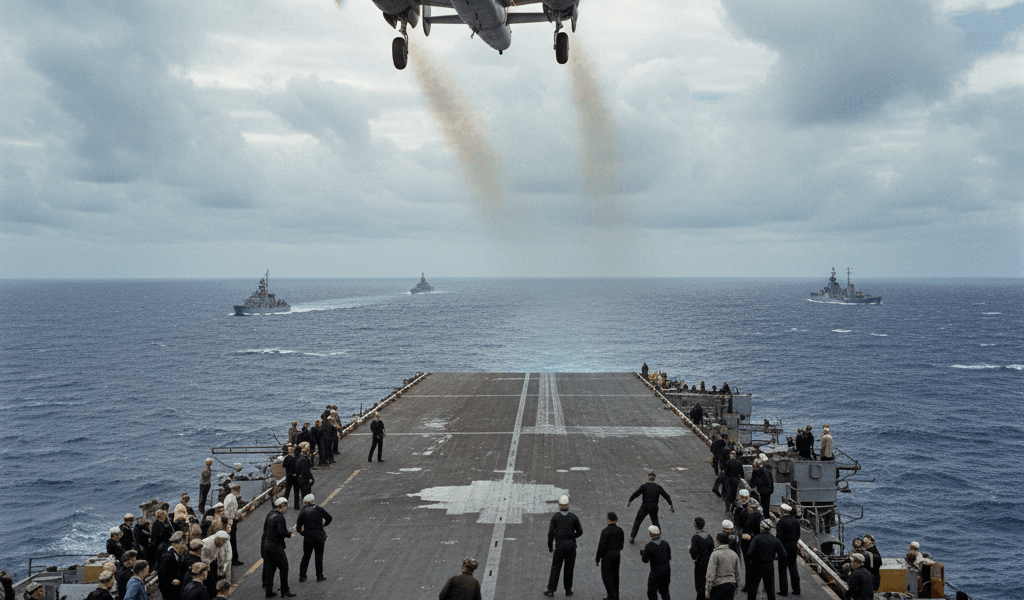
Task Force 16 (carriers Hornet and Enterprise, cruisers, destroyers) sailed from San Francisco on April 2, 1942. Sixteen B-25s crowded Hornet’s deck—so tightly packed that the first aircraft had only 467 feet of deck for takeoff.
The plan called for launching 400 miles from Japan in afternoon, allowing nighttime bombing and landing in China at dawn. But at 650 miles from Japan, Hornet encountered Japanese picket boats.
American ships sank the picket boats, but assumed they’d radioed warnings. Admiral William Halsey ordered immediate launch—10 hours early, 250 miles farther from Japan than planned.
This early launch meant:
– Daylight instead of night bombing (increased danger)
– Arriving in China after dark (dangerous navigation)
– Reduced fuel margins (some crews wouldn’t reach China)
Doolittle’s crews adapted. At 8:20 AM, with Hornet pitching in rough seas, Doolittle’s B-25 lifted off with feet to spare. Within an hour, all 16 bombers launched successfully—an aviation feat never attempted before.
The Attack
B-25s approached Japan at wave-top height, climbing only for bombing runs. Most crews found their targets despite never having seen them before—testament to thorough mission planning.
Bombs hit military targets in Tokyo, Yokohama, Nagoya, Kobe, and Osaka. Targets included:
– Aircraft factories
– Oil refineries
– Power plants
– Military installations
Physical damage was minimal—incendiary and demolition bombs couldn’t destroy major industrial facilities. But the psychological impact was immediate.
Escape and Survival
After bombing, crews flew southwest toward China. Weather deteriorated. Fuel ran critically low. Radio navigation beacons in China weren’t operating.
Fifteen crews reached China and bailed out or crash-landed. One crew landed in Soviet territory (where they were interned for over a year). Of 80 airmen:
– Three died in crashes or bailouts
– Eight were captured by Japanese forces (three were executed, one died in captivity)
– 69 eventually returned to American control
Jimmy Doolittle, certain the mission was a failure because all aircraft were lost, expected court-martial. Instead, Roosevelt awarded him the Medal of Honor and promoted him to Brigadier General—skipping the rank of Colonel entirely.
Strategic Impact: How the Raid Changed Japanese Strategy
The Immediate Japanese Response
Japanese military and civilian leaders were shocked that American bombers had reached Tokyo. The attack humiliated Japan—after 80 days of victories, the enemy had struck the Emperor’s palace area.
Japanese Army demanded the Navy prevent future attacks. Navy leadership faced a crisis: carriers that attacked Pearl Harbor were untouchable, yet somehow American bombers reached Japan.
The Fatal Decision: Midway
Admiral Yamamoto concluded that American carriers must be destroyed to prevent future raids. He designed an operation to lure American carriers into battle near Midway Island.
The Midway operation diverted Japanese naval forces from other objectives and forced decisive battle on American terms. On June 4-7, 1942—less than two months after the Doolittle Raid—American carriers ambushed the Japanese fleet, sinking four carriers and killing thousands of irreplaceable aircrew.
The Doolittle Raid didn’t directly cause Midway, but it created the psychological and strategic pressure that made Japanese leadership choose aggressive operations to prevent future humiliation. Those operations led directly to catastrophic defeat.
Strategic Overextension
Japan also diverted resources to defend home islands. Fighters, antiaircraft guns, and radar systems that could have defended conquests in Southeast Asia or Pacific islands instead protected Japan from future raids.
These defensive measures weakened Japanese forward positions, making them more vulnerable to American counterattacks that began later in 1942.
The Human Stories
The Executed Raiders
Eight Doolittle Raiders were captured by Japanese forces in China. After show trials, three (William Farrow, Dean Hallmark, and Harold Spatz) were executed by firing squad. One (Robert Meder) died from disease and maltreatment in captivity. Four survived imprisonment until liberation in 1945.
These men knew the mission was “probably one-way” when they volunteered. Their sacrifice epitomized the courage required when America faced existential threat.
The Chinese Cost
Japanese forces massacred an estimated 250,000 Chinese civilians in areas where Raiders landed, punishing communities for helping American airmen. This terrible price demonstrates both Japanese brutality and the Chinese willingness to help American allies despite horrific consequences.
Doolittle’s Leadership
Jimmy Doolittle led bombing missions over North Africa and Europe, eventually commanding the Eighth Air Force. He retired as a Lieutenant General. But he never forgot the 80 days from Pearl Harbor to Tokyo—or the men who followed him on that impossible mission.
For decades, surviving Raiders held annual reunions. Each year they toasted “those who have gone,” drinking from specially engraved silver goblets. The last public reunion occurred in 2013 with only four Raiders remaining. The final Raider, Richard Cole (Doolittle’s co-pilot), died in 2019 at age 103.
Why 80 Days Matters in History
The Doolittle Raid proved several principles that shaped the rest of the war:
**Technical Innovation Beats Conventional Wisdom**: The “impossible” carrier launch succeeded because innovators ignored conventional limitations.
**Psychological Impact Exceeds Physical Damage**: The raid damaged Japan’s confidence more than its factories.
**Offensive Action Restores Morale**: American public and military morale improved dramatically despite continued defeats elsewhere.
**Strategic Decisions Driven by Fear**: Japan’s Midway operation—driven partly by fear of future raids—led to decisive American victory.
The raid couldn’t shorten the war by destroying Japanese industry. But it changed Japanese strategy in ways that gave America advantages that accumulated over three years of brutal combat.
80 days after Pearl Harbor, sixteen bombers proved Japan was vulnerable. That proof changed everything. From that day forward, Japan fought defensively, worried about protecting the homeland rather than confident in unstoppable expansion. America went on offense, building the industrial and military might that eventually crushed Japanese resistance.
The Doolittle Raid reminds us that sometimes the most important victories aren’t measured in destruction but in psychology, strategy, and the courage to attempt the impossible when civilization itself is at stake.


Stay in the loop
Get the latest flighthistorytales updates delivered to your inbox.