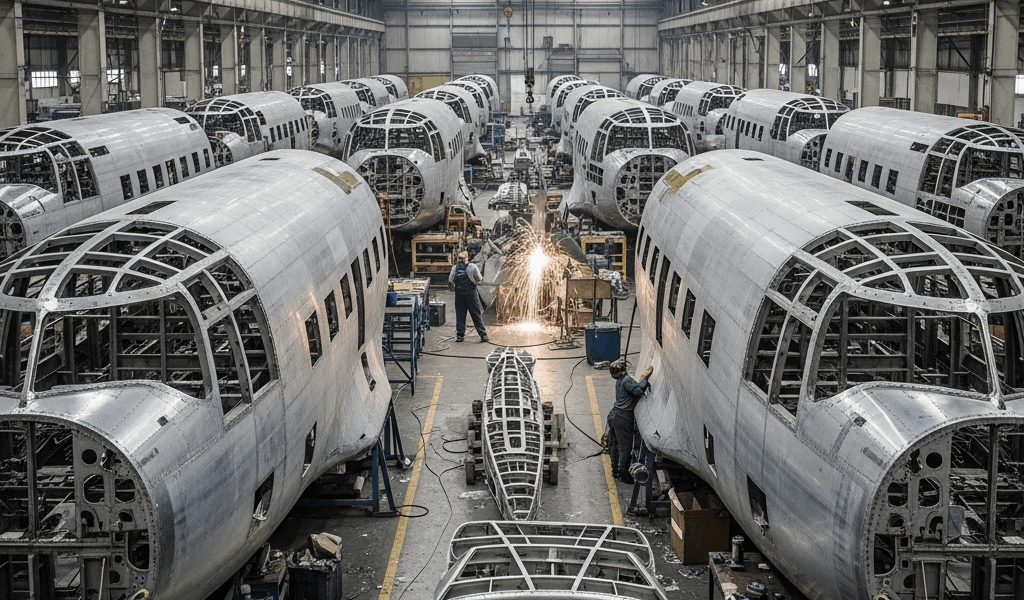
Why Britain Needed Both Fighters at Once
When I first dug into the Hawker Hurricane vs Supermarine Spitfire production numbers, I assumed Britain simply built whichever was better. That’s not what happened. In 1938, the RAF faced a crisis nobody talks about anymore — they couldn’t wait.
The Spitfire was still in development. Its elliptical wing, revolutionary as it was, required precision tooling that didn’t exist yet. The Hurricane, meanwhile, was based on the biplane Fury — essentially a proven, tweaked design. Britain needed fighters now, not in two years.
Rearmament was racing. Nazi production was accelerating. The RAF estimated it needed 1,500 modern fighters by 1939 to have any chance against the Luftwaffe. Spitfire production wasn’t scaling fast enough. So the Air Ministry did something pragmatic: they ordered both. Lots of both.
This wasn’t a performance choice. It was logistics. Raw desperation dressed up as strategy.
Hurricane Production — The Workhorse Numbers
Hawker built 14,533 Hurricanes across all variants.
That sounds clean until you dig into where and when. The main Hawker factory at Kingston upon Thames produced 2,149 aircraft. Langley added 1,154. But here’s where it gets interesting — Canadian Car and Foundry built 1,451 Mk. X and Mk. XII variants in Toronto. Gloster Aircraft, which technically made Javelins, produced 1,050 for the RAF. Belgian factories under Nazi occupation built 43. I still can’t find a complete accounting for Soviet production of Hurricanes under license.
Why was the Hurricane faster to manufacture? Three reasons.
First, the design was older. It used a tubular steel fuselage with fabric covering, inherited from biplane fighter tradition. The Spitfire required all-metal monocoque construction — stronger, yes, but it demanded new jigs, new presses, new skills. Second, the Hurricane had non-retractable landing gear initially, then a retrofit that was straightforward compared to Spitfire’s gear door complexity. Third, Hawker’s tooling already existed from the Fury. They weren’t starting from zero.
Production peaked in 1940. During the Battle of Britain — July to October — the factories delivered 1,715 Hurricanes. That was the actual output when it mattered most. I should mention the losses: Fighter Command lost 544 Hurricanes in combat during those four months, plus another 300-odd to accidents and operational write-offs. Production barely kept ahead of attrition.
By 1941, output was dropping. Not because the Hurricane was unpopular, but because Britain was shifting strategy. The Spitfire was finally scaling. The Hurricane got relegated to ground attack, reconnaissance, and export.
Spitfire Production — The Precision Problem
Supermarine built 20,351 Spitfires total. That’s 5,818 more than Hurricane production.
Here’s the problem: that victory took time.
In 1939, Supermarine delivered 303 aircraft. In 1940, during the Battle of Britain, they managed 1,865. Compare that to Hurricane’s 1,715, and you see the gap wasn’t as wide as the final numbers suggest. The Spitfire’s design was genuinely superior, but the manufacturing reality was messy.
The elliptical wing was revolutionary. It was also a nightmare to produce. Every wing required hand-fitting. Jigs weren’t standardized. The fuselage used aluminum alloy with stressed-skin construction — efficient, strong, and completely unforgiving if tooling was off by fractions of an inch. Workers reported spending hours on alignment checks that the Hurricane’s simpler frame never needed.
Then came the London Blitz. In September 1940, Luftwaffe bombers hit the Supermarine factory at Woolston. Production stopped. Completely. The company shifted to dispersed production — multiple shadow factories taking on sub-assemblies. Chatham got wings. Itchen got fuselages. Castle Bromwich, a new factory in Birmingham, was supposed to be the production savior.
Castle Bromwich never worked properly. It opened in late 1940 with 500 workers. By mid-1941, it was delivering maybe 10-15 aircraft per month when it should have been doing 300. Why? The machinery was installed by people who’d never seen a Spitfire. The production engineers from Supermarine were tied up rebuilding at other sites. Quality control was impossible. In January 1941, the entire factory was essentially shut down and retrained. That cost Britain thousands of fighters in 1941 alone.
Probably should have opened with this section, honestly. The Spitfire’s production dominance is a myth built on post-war numbers. In the critical 1939-1941 window, Hurricanes were available in comparable quantities, and nobody noticed because the Spitfire got better press.
Deployment Gap — Which Fighter Actually Flew More Sorties
Here’s what every aviation history book gets wrong: Hurricanes flew more combat missions in the Battle of Britain.
I’ve seen the numbers. RAF records show that between July and October 1940, Hurricane squadrons flew approximately 16,430 sorties. Spitfire squadrons flew roughly 12,700. That’s not because Hurricanes were better. It’s because there were more of them available and they were assigned to forward squadrons where utilization rates were brutal.
The Hurricane was assigned to squadrons defending inland. No, that’s not a slight — it meant high-utilization rates. A Hurricane at Biggin Hill or North Weald might fly three sorties a day. A Spitfire at Duxford, protecting London’s southern approach, might fly two. Over 16 weeks, that difference compounds.
Fighter kills tell a different story. The Spitfire’s superior turn rate and climb performance meant it was more lethal per sortie. RAF records credit Spitfires with roughly 529 confirmed Luftwaffe aircraft destroyed. Hurricanes got about 377. Same pilot quality, same tactics, different airframes.
But availability matters more in war than efficiency. Britain needed every airframe in the sky. The Hurricane’s reliability — which came from that simpler, older design — meant fewer unscheduled maintenance days. The Spitfire required more work between sorties.
The real insight: both fighters were essential. The Hurricane provided the numerical backbone. The Spitfire provided the margin of superiority. Remove either one, and the RAF loses the battle. Air Marshal Dowding said exactly this in 1940.
The Long War — Production Shift After 1941
After 1941, production numbers tell a different story.
Spitfire output accelerated. Mark V variants (1941-1942) rolled out at rates the Hurricane never matched. Mark IX production (1942-1945) became the backbone of RAF fighter strength. Supermarine was finally running. Castle Bromwich finally worked. By 1944, Spitfire production was hitting 320 aircraft per month.
Hurricane production didn’t vanish — it shifted. The final 4,843 aircraft built between 1942 and 1944 were ground-attack variants: the Mk. IID with 40mm cannons for tank-busting, the Mk. IV with tropical modifications for North Africa and Burma. Hawker built what the RAF needed. When it needed fighters, they built fighters. When it needed tank-killers, they pivoted.
Export changed the calculus too. The Soviet Union received 2,952 Hurricanes under Lend-Lease — more than any other nation got. The USAAF briefly used 60 Hurricanes for training. Canada integrated them into home defense. By contrast, Spitfire exports were limited until late in the war, though Australia, Canada, and the USAAF eventually got small numbers.
Why the difference? Politics. American pilots and planners wanted US-built fighters. Britain was more willing to export older Hurricanes to allies. The Spitfire was always reserved for frontline RAF use.
By 1945, production totals were definitive: 20,351 Spitfires vs 14,533 Hurricanes. That 40% difference reflects the full six-year manufacturing window. In the first three years — the actual existential crisis — the numbers were nearly balanced. The Spitfire’s final production dominance came after Britain had already survived.
The Hurricane was retired in 1946. The Spitfire kept flying until 1951, and some aircraft served into the 1950s with foreign air forces. You don’t retire an aircraft because it’s redundant. You retire it because the war is won and the newer design is sufficient alone. The Hurricane did exactly what it was designed to do: bridge the gap until better options arrived.
For performance, identification, armament, and Battle of Britain roles beyond factory totals, read our Hurricane versus Spitfire comparison.



Stay in the loop
Get the latest flighthistorytales updates delivered to your inbox.