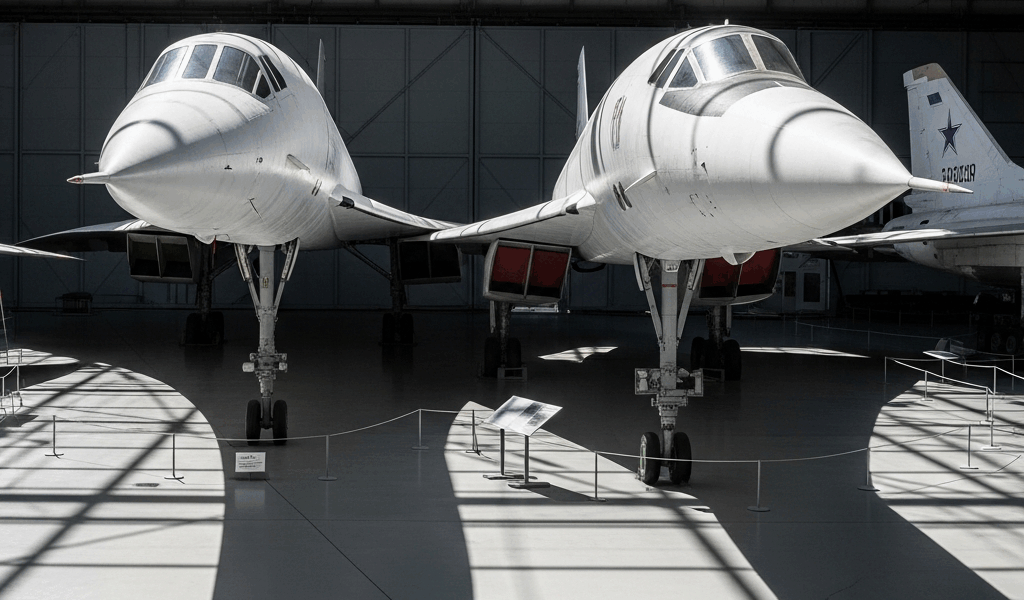
Design Philosophy and Engineering Goals — How Two Superpowers Built Competing Dreams
I spent weeks digging through declassified engineering reports and pilot interviews to understand why the Concorde and Tu-144 were built so differently, despite solving the same problem: getting humans across oceans faster than sound. The answer reveals everything about Cold War priorities.
The Concorde emerged from a partnership between French and British engineers who wanted a commercial airliner for wealthy transatlantic passengers. First flight: January 21, 1969. The project started in 1962 as pure business—BOAC and Air France needed a competitive advantage on the London-New York and Paris-New York routes where speed meant premium fares. Design teams at Aérospatiale and BAC worked methodically, testing subsonic prototypes and wind tunnel models for years before committing to the final shape. That’s what made the Concorde endearing to aviation engineers—nothing got rushed.
The Tu-144? Different animal entirely. Frustrated by Western supersonic development, the Soviet Union built it partly to claim a geopolitical victory—being *first* with a supersonic passenger aircraft mattered more than being best. Andrei Tupolev’s design bureau unveiled the Tu-144 on May 31, 1968, about eight months before Concorde flew. The Soviets reverse-engineered intelligence from CIA documents about Western designs and moved faster, cutting corners on testing that would haunt the program later.
Key distinction: Concorde was designed for endurance. Tu-144 was designed for speed records and propaganda. This single philosophical difference explains why one became a working airliner and the other didn’t.
Speed, Altitude, and Range Compared — Paper Performance Versus Sustained Reality
Probably should have opened with this section, honestly—the specs tell a story people don’t expect.
On paper, the Tu-144 outperformed Concorde. Maximum speed: Mach 2.15 versus Mach 2.04. Service ceiling: 63,500 feet versus 59,000 feet. The Tu-144 could theoretically cruise faster and higher. Then you asked pilots and engineers how often that actually happened in real operations.
Concorde sustained Mach 2.0 for hours. It burned 25,629 liters of fuel per hour at cruise but did so reliably, with engines designed by Rolls-Royce and Snecma that tolerated the thermal stress of sustained supersonic flight — at least if you wanted the airframe to survive. Skin temperatures hit 127°C. The aluminum alloy was specially treated to handle that kind of punishment.
Tu-144 engines—Kuznetsov NK-144 turbojets—couldn’t maintain that performance consistently. Push it to Mach 2.15 and the airframe heated unevenly. Wing cracks developed. Pilots couldn’t sustain maximum speed for commercial routes because structural integrity became questionable after 90 minutes above Mach 2.0. Real cruise speed settled around Mach 1.9 on actual flights, negating the speed advantage entirely.
Range tells the real story. Concorde: 3,900 nautical miles. Tu-144: 4,000 nautical miles on paper, but only 2,200 nautical miles in actual service because fuel consumption was so brutally high and the aircraft couldn’t fly hot routes safely. Neither aircraft could cross the Pacific without refueling. Both were trapped on Atlantic routes—where Concorde had a market and Tu-144 did not.
Passenger Comfort and Cabin Reality — Why Flying Supersonically Felt Miserable
Supersonic flight isn’t comfortable. Period. But one jet was marginally less miserable than the other.
Concorde’s cabin was a physics problem solved with British and French pragmatism. The fuselage diameter was 9.2 feet—cramped for 100 passengers. Seats reclined 5 inches. Windows were tiny, two-inch portholes basically, because heat and pressure at Mach 2.0 made large windows structurally impossible. That was 1969 engineering. The cabin temperature reached 127°C on the aluminum exterior, and passengers could feel it radiating through the walls. Inside temperature was maintained at around 24°C using fuel as a heat sink — yes, jet fuel cooled the cabin before burning in the engines. Efficient and weird.
Tu-144’s cabin was wider at 9.4 feet but the engineering was sloppy. Insulation was inadequate. Pressurization systems failed during test flights. A passenger on one of the few commercial Tu-144 flights described it as “like flying in a metal tube with an oven behind you.” Noise levels inside the cabin reached 130 decibels — loud enough to damage hearing without headsets. Concorde was quieter at 119 decibels, partly because the engines were better-engineered and partly because Rolls-Royce had invested in noise-reduction technology that Soviet engineers skipped.
Ground crews hated the Tu-144 more. Concorde required extensive maintenance between flights — heat-treatment of the airframe, engine inspections, fuel system flushes — but the procedures were documented and systematic. Tu-144 maintenance was chaotic. Replacement parts didn’t fit consistently. Engineers had to improvise repairs. Plane turnaround time for Concorde was 6 to 8 hours. Tu-144 needed 12 or more hours, making frequent flights economically impossible.
Operational Reliability and Safety Record — When Engineering Philosophy Determines Outcomes
The Tu-144 crashed twice during development. The first loss happened on May 31, 1971—a structural failure at high altitude during a test flight near Moscow. The second occurred during an air show demonstration on June 3, 1973, in Le Bourget, France, killing six crew members and eight on the ground. The aircraft was attempting to evade a Mirage F1 chase plane, pushed beyond design limits, and the airframe failed.
Post-crash investigation revealed what engineers suspected: the Tu-144’s wing design was fundamentally flawed under sustained supersonic loads. The aluminum used in the wings was inferior to Concorde’s specification. Microfractures appeared after 400 flight hours. It was a structural time bomb waiting to detonate.
Concorde had one catastrophic accident: Air France Flight 4590 on July 25, 2000, in Paris. A titanium strip from a crashed DC-10 punctured the Concorde’s tire on takeoff. The tire blowout shredded the wing’s fuel tank, causing asymmetric fuel loss and structural failure. All 109 people aboard died. Tragic, absolutely — but it was a single-point failure, not a design flaw. The aircraft had flown 6,017 hours before that incident with an impeccable safety record.
Tu-144 accumulated only 55 passenger flights before being withdrawn from service. Concorde flew 2,898 revenue-generating passenger flights between 1969 and 2003.
Airline crews avoided Tu-144 when possible. Engine fires were reported on at least three separate occasions. Hydraulic leaks appeared without warning. Fuel system blockages happened in flight — mid-cruise. Ground maintenance cost roughly 40% more per flight hour than Concorde, with worse reliability outcomes. Aeroflot, the only airline to operate it commercially, pulled the aircraft after just 55 flights because the maintenance burden outweighed revenue potential.
Why Concorde Outlasted the Tu-144 — Economics, Politics, and the Brutal Math of Aviation
Sustained by economic reality and geopolitical factors, Concorde thrived for 34 years while Tu-144 disappeared after six months of actual service.
Economics first: Concorde was profitable at premium fares. A one-way ticket from London to New York cost $12,000 — inflation-adjusted to roughly $98,000 today. Wealthy passengers, celebrities, and business executives paid it without hesitation. Air France and British Airways could fill seats on transatlantic routes. Fuel costs were brutal at $5,445 per flight hour in 1980 dollars — but premium fares absorbed the margin.
Tu-144’s operating costs were higher with lower reliability. A roundtrip ticket on Aeroflot cost 1,000 rubles, roughly $1,450 in US dollars at the time. The Soviet airline couldn’t charge Western luxury fares on a Moscow-Leningrad route that many passengers could reach by train in 8 hours. The aircraft was economically unsustainable for a domestic route, and no Western airlines would touch a Soviet-built jet.
Geopolitical isolation killed Tu-144 faster than engineering did. Western airlines had no incentive to purchase or operate a Soviet supersonic aircraft. The US rejected Soviet aircraft for commercial service. NATO countries avoided dependency on Soviet maintenance and engines. Tu-144 was locked into Aeroflot exclusivity, and Aeroflot couldn’t support a money-losing route indefinitely.
Regulatory environment favored Concorde. Environmental regulations tightened in the 1980s, but Concorde had already proven it could meet noise standards on established routes. Tu-144 never had international certification to fly to US airports, so it was permanently confined to Soviet airspace.
Concorde’s retirement came in 2003 — 34 years of operation. The 2000 Paris crash damaged confidence. Fuel prices climbed. Maintenance costs spiraled. Airlines eventually concluded the aircraft wasn’t worth the infrastructure investment required to keep it flying. But those 34 years of successful operation proved the concept worked. Tu-144 never got that chance.
The Tu-144 flew from 1977 to 1978 as the world’s first supersonic passenger service. Concorde followed in 1969 and outlasted it by decades. History gave its verdict: engineering reliability, economic viability, and geopolitical positioning matter more than raw speed specifications.


Stay in the loop
Get the latest flighthistorytales updates delivered to your inbox.