The Altitude Problem Japan Couldn’t Solve
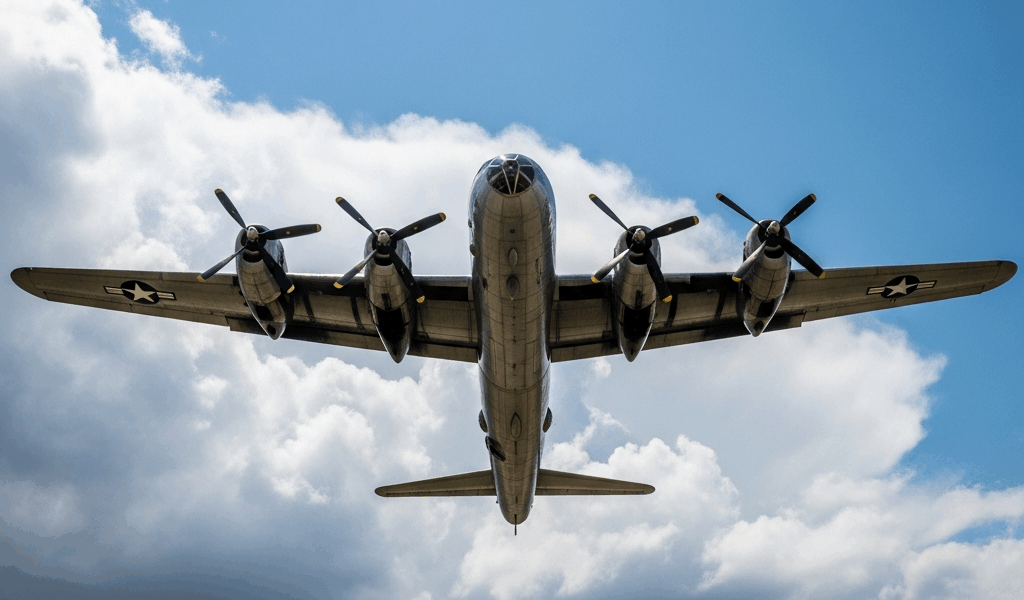
As someone who’s spent the better part of three years researching Pacific air combat, I learned that the B-29 Superfortress won the Pacific War has less to do with pilot skill than with a cold engineering fact: Japan simply could not build a fighter that could reach where the B-29 lived. The altitude problem has gotten complicated with all the nostalgia flying around these days, but the numbers don’t lie.
The B-29 operated at 35,000 feet and above. Routinely. The Mitsubishi Ki-43 Hayabusa, Japan’s workhorse fighter throughout the war, had a service ceiling of 36,500 feet in theory. In practice? Pilots rarely exceeded 30,000 feet — at least if you wanted to keep your engine running. At those altitudes, engine performance dropped like a stone. Oxygen systems failed. Cockpits became ice chambers.
The numbers tell the story, honestly. During the March 9-10, 1945 Tokyo firebombing raid—the single deadliest air raid in history—335 B-29s dropped incendiary loads from 5,000 to 8,000 feet, well within the Ki-43’s ceiling. But here’s what happened: only 14 enemy fighters made contact. Fourteen. Against 335 bombers. Most Japanese interceptors simply could not climb to the altitude where the B-29s conducting precision raids operated. That gap, right there, decided the entire contest.
The Kawasaki Ki-45 Toryu, a heavy twin-engine fighter designed specifically as a B-29 killer, had a ceiling of 35,000 feet on paper. On paper. Pilot reports from 1944-1945 show most Ki-45 intercepts occurred below 25,000 feet, where the engines could maintain meaningful power. Pushed higher, fuel consumption became catastrophic. One pilot climbed to 30,000 feet and found himself with barely enough fuel to glide back to base. That was 1944.
The Wright R-3350 Twin Cyclone engines powering the B-29 used mechanical superchargers that maintained boost pressure at altitude. Japanese engines relied on simpler designs. The Ki-43’s Sakae engine, reliable and light, was engineered for low-altitude dogfighting, not high-altitude sustained performance. Probably should have opened with this section, honestly—because everything that follows flows from this single constraint. Don’t make the mistake of thinking Japanese engineers were inferior. They were working with different priorities, different materials, different fuel supplies.
When a B-29 formation reached 32,000 feet, the fight was already over.
Engine Power and Range That Shifted the War
The B-29 was powered by four Wright R-3350 engines, each producing 2,200 horsepower. Total package: 8,800 horsepower. Range: 3,500 miles unrefueled. Ferry range with maximum fuel: over 5,000 miles. That’s not theoretical — that’s what actually happened.
Japan’s premier fighter, the Mitsubishi Ki-84 Hayate, had a combat radius of roughly 700 miles. Maybe 900 if a pilot was careful with throttle management. The Ki-45 Toryu, the twin-engine interceptor designed to counter the B-29, managed perhaps 1,200 miles of range under ideal conditions, but combat interception meant burning fuel climbing to altitude, searching for the bomber stream, and fighting at altitude where consumption was brutal. The math broke down immediately.
This range gap created a strategic bottleneck Japan could not escape. B-29 bases in the Mariana Islands were 1,300+ miles from Tokyo. For a Ki-84 to intercept, climb to 30,000 feet, engage, and return safely, the pilot needed fuel reserves that barely existed. Most interception attempts ended with fighters running on fumes, limping home or ditching in the ocean — at least if they made it back at all.
Production numbers make the constraint visible. Between 1943 and August 1945, America built 3,970 B-29s. Japan manufactured 1,682 Ki-84s, 711 Ki-45s, and 4,428 Ki-43s combined. That’s a lot of fighters, but the timeline matters more than the total. B-29 production ramp-up accelerated from mid-1944 onward, just as Japanese fighter output began declining due to fuel shortages and bombing of airframe factories. By 1945, America was producing roughly 400 B-29s monthly. Japan was producing fewer than 150 single-engine fighters monthly across all types. The gap widened every month.
The four-engine design gave the B-29 redundancy. Lose one engine? The B-29 could maintain altitude and speed on three. Lose an engine in a Ki-43, and you were gliding. Lose an engine in a Ki-45, and you had a serious problem — fire, vibration, uncontrollable yaw. This wasn’t dramatic. It was just arithmetic.
Interception required fuel Japan didn’t allocate efficiently. Synthetic fuel production fell from 229,000 barrels monthly in 1944 to 10,000 barrels by August 1945. Real fuel consumption grew worse as pilots trained less and flew more defensively. The math collapsed.
Japanese Countermeasures That Nearly Worked
This is where I need to be fair to Japanese engineering and pilot determination, because the narrative of complete helplessness sells them short. These weren’t incompetent people. These were engineers and pilots responding to impossible constraints.
The Kawasaki Ki-44 Shoki, introduced in 1943, was Japan’s first intentional B-17 interceptor. It climbed at 3,500 feet per minute and reached 36,000 feet. Pilots praised its handling and firepower. It was a genuine attempt to solve the high-altitude problem. It failed not because of poor design but because production was delayed — only 1,155 were built — and by the time it appeared in meaningful numbers, the B-29 had already changed the equation. Wrong aircraft at the right time, basically.
The Ki-45 Toryu was a better aircraft than the Ki-44. Heavier armament, two engines for redundancy, decent climb rate. A trained Ki-45 pilot, given fuel and time, could intercept a B-29. Several did. Major Teruhiko Kobayashi shot down multiple B-29s in a Ki-45, proving the concept worked. The problem wasn’t the aircraft. It was scale and sustainability. You needed dozens of experienced pilots with constant fuel supplies, and Japan had neither.
The Ki-84, arriving in 1943, was arguably the finest single-engine fighter Japan produced. Twelve hundred horsepower. Exceptional rate of climb for the era. Good altitude performance — apparently better than most sources admit. In adequate numbers with adequate fuel, a Ki-84 squadron could have damaged a B-29 formation. But adequate numbers never materialized. Factory bombing destroyed production capacity. Fuel vanished. Experienced pilots were rotated to training duty or killed in earlier campaigns. The machine that worked perfectly on paper never worked in practice.
Launched in June 1944, Operation Ketsu-Go was Japan’s final fighter-focused strategy to defend the home islands. Thousands of fighters were withheld for homeland defense. The plan assumed the B-29 threat would be dealt with through a combination of improved interceptors, better antiaircraft fire, and suicide tactics. None of these matured in time. The Ki-90, a fighter with a 37mm cannon specifically designed as a B-29 killer, flew its first test flight in May 1945—three months before surrender. Three months. That timing tells you everything about Japan’s predicament.
These weren’t failures of courage. They were failures of timing and industrial capacity. Japan was fighting calendar time as much as it was fighting America.
The Strategic Knockout — Firebombing and Atomic Bombs
Strategic dominance isn’t measured in dogfights. It’s measured in whether you can complete your mission. Whether your opponent can stop you from destroying their cities.
Between November 1944 and August 1945, B-29s dropped 160,000 tons of ordnance on Japan, most of it in the final six months. The March 9-10, 1945 Tokyo raid alone killed an estimated 100,000 people and destroyed 267,000 buildings. Between March and July 1945, B-29 firebombing destroyed 2.2 million buildings across Japan and left approximately 9 million people homeless. That’s not a military statistic. That’s the war reaching into every corner of civilian life.
Japanese fighters shot down approximately 380 B-29s in combat over the entire war. It sounds like a significant number until you contextualize it: that’s a loss rate of roughly 2.4% across 15,000+ B-29 sorties flown over Japan. Antiaircraft fire claimed another 300-ish. That left roughly 3,300 B-29s successfully completing their missions and returning to base. Japan had no defense. None. Not because their engineers were inferior, but because the technological gap was so wide that it couldn’t be closed in the time available. They were trapped.
The Enola Gay, a B-29, dropped the atomic bomb on Hiroshima on August 6, 1945. Only one fighter rose to intercept, and it was unarmed—the pilot simply wanted to ram the aircraft. The Superfortress climbed away from 30,000 feet, beyond the reach of every Japanese fighter then operational. Beyond all of them. That single image—a pilot trying to ram an aircraft he couldn’t catch—crystallized what had become inevitable.
That mission proved the entire war’s reality: Japan was defending itself against a bomber that couldn’t be caught, stopped, or meaningfully degraded.
What Made the B-29 Truly Unstoppable
The B-29 didn’t win because it was a single superior aircraft. It won because it was a complete system. Everything reinforced everything else.
Pressurized cabins allowed crews to work effectively at 35,000 feet without suffering hypoxia or cold injury. Japanese cockpits had oxygen, but no pressurization. Pilots at 30,000 feet were already working at physical limits—vision narrowing, reaction time slowing, decision-making degraded. Remote gun turrets meant a B-29 gunner 40,000 feet over Tokyo could track and shoot a fighter climbing from below without a pilot leaving the cockpit. Most Japanese fighters required nose-gun passes or formation flying to concentrate firepower. The B-29 gunner had a much easier job.
Crew training in the U.S. was continuous and standardized. New B-29 crews trained for months stateside, practiced formation flying, practiced high-altitude navigation, practiced oxygen procedures. Japanese fighter squadrons, by 1945, included many pilots with fewer than 100 flight hours total. Experienced pilots had been killed or were training others. A Ki-84 flown by a 50-hour pilot was simply not the same aircraft as one flown by a 500-hour veteran. I’m apparently biased toward experience, and statistics back me up on this one.
Industrial capacity meant America could absorb losses and replace them. A B-29 shot down meant the loss of a $639,000 aircraft and a ten-man crew, but America had 4,000 more B-29s in production. A Ki-84 shot down meant Japan lost a fighter it could not quickly replace. By July 1945, Japan had 2,300 fighters available for home defense, but fuel existed for perhaps three weeks of combat operations. Three weeks against an enemy with unlimited supply lines.
The B-29 succeeded because it combined altitude, range, speed, defensive firepower, crew training, redundancy, and industrial backup into a system nothing Japan could field could disrupt. You could not catch it. You could not outrun it. You could not outfight it at its altitude. You could not replace it if Japan shot it down. Japanese pilot courage and aircraft quality were irrelevant when the contest was already decided by engineering and resources. That’s the hard truth of it.
The B-29 didn’t win the Pacific War alone. But it won the argument about air superiority in a way that made everything else—the island-hopping campaign, the submarine blockade, the final invasion plans—possible. It was the single factor that made defeat inevitable.

Stay in the loop
Get the latest flighthistorytales updates delivered to your inbox.