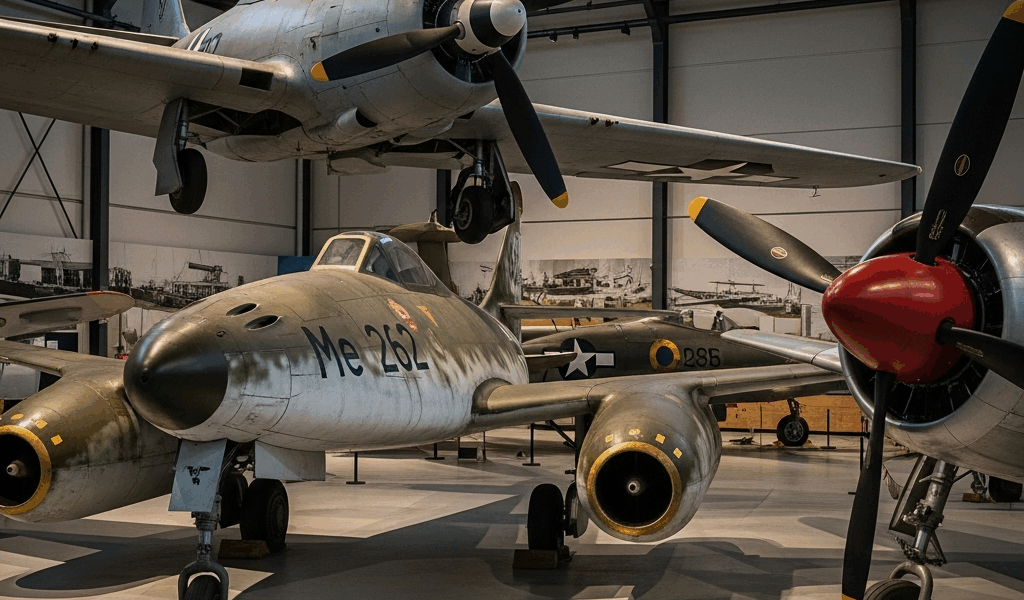
The Messerschmitt Me 262 reached combat first and was the more mature combat aircraft in 1944–45. The Lockheed P‑80 was an American development contemporary, but its preproduction aircraft reached Europe too late to fight in World War II. A later F‑80C was faster, had greater ceiling and range, and was more practical to operate—but that Korean War model benefited from several additional years of jet development.
So who “won”? The Me 262 wins the World War II operational comparison because it was the only one of the pair to fight then. The P‑80/F‑80 wins a later serviceability comparison, but comparing a 1950 F‑80C directly with a 1944 Me 262A‑1a is not a same-year contest.
Me 262 vs P‑80: the comparison in context
| Question | Me 262 | P‑80/F‑80 |
|---|---|---|
| First flight | Jet-powered prototype flight in 1942; earlier airframe tests used a piston engine | XP‑80 first flew in January 1944 |
| World War II combat | Yes, in 1944–45 | No; test aircraft reached Europe, but did not enter combat |
| Primary armament | Four 30 mm MK 108 cannon in the nose; some aircraft could carry rockets | Six .50-caliber machine guns in the nose |
| Engine arrangement | Two Junkers Jumo 004 turbojets in underwing nacelles | One turbojet in the fuselage |
| Korean War combat | No | Yes, as the redesignated F‑80 |
| Fair historical conclusion | First operational jet fighter to see sustained combat | Important early U.S. operational jet, developed into a useful postwar family |
The timelines overlap more than the combat records suggest
The Me 262’s development began earlier, and the type entered Luftwaffe service during the final year of the European war. Its combat record included reconnaissance, interception, fighter operations, and fighter-bomber missions. It was exceptionally fast relative to contemporary piston fighters, but fuel, engines, training, maintenance, airfield vulnerability, and Germany’s deteriorating strategic position constrained its effect.
Lockheed designed the XP‑80 rapidly after the United States obtained a British de Havilland turbojet. The first XP‑80 flew in January 1944. Preproduction YP‑80As went to Europe for operational evaluation before Germany surrendered, but the aircraft did not fly combat missions there. The P‑80 therefore was not “six years behind” as an aircraft program; its combat debut came later.
That distinction matters. The F‑80 flew combat from the opening phase of the Korean War in 1950. On November 8, 1950, the U.S. Air Force credited Lt. Russell Brown with shooting down a MiG‑15 in what it recognizes as the first all-jet aerial victory. That was not the F‑80’s first combat mission. It was a specific milestone months into the war, and historical accounts have debated the opposing aircraft’s loss using Soviet records.
Which variants should be compared?
“P‑80” can refer broadly to a family that changed over time. The designation became F‑80 in 1948, and the Korean War F‑80C was not identical to the XP‑80, YP‑80A, or early production P‑80A. Published speed, climb, ceiling, and range figures vary by model, load, altitude, engine, and test method.
A defensible comparison uses three columns:
- Me 262A‑1a: the principal German fighter version used in World War II.
- XP‑80/YP‑80A/P‑80A: the American development and early-production aircraft closest in date.
- F‑80C: the improved version that fought in Korea and appears in many museum specification tables.
The National Museum of the U.S. Air Force F‑80C fact sheet lists approximately 580 mph maximum speed, 46,000 feet ceiling, and 1,090 miles range for its displayed Korean-era version. Those numbers should not be presented as if the exact same aircraft was available against the Me 262 in 1944.
Likewise, museum figures for the Me 262A commonly place maximum speed near 540 mph and ceiling near 37,500 feet. Different reference tables may describe ferry range, combat radius, or range under different conditions. Mixing those categories produces impressive-looking but invalid “double the range” claims.
Armament and mission
The Me 262A‑1a carried four MK 108 30 mm cannon clustered in the nose—not split between the fuselage and wings. Their heavy projectiles were suited to attacking four-engine bombers, especially B‑17s and B‑24s over Europe. B‑29s were not the normal strategic-bomber opponent in that theater.
The cannon’s destructive power came with tradeoffs: lower muzzle velocity and a more curved trajectory than the P‑80’s .50-caliber guns. Me 262 pilots had to manage closing speed and aim carefully during brief firing opportunities. Some Me 262s also used R4M air-to-air rockets against bomber formations.
The P‑80 placed six .50-caliber machine guns in the nose. This avoided wing-gun convergence and reflected established American fighter armament practice. It produced a higher volume of smaller projectiles rather than the Me 262’s very heavy cannon shells. Which arrangement was preferable depended on the target and engagement, not a universal “wall of lead” verdict.
Engines and reliability
The Me 262’s two Jumo 004 engines were a breakthrough in production turbojets, but their service life was short by later standards. Germany’s shortage of heat-resistant strategic materials forced design and manufacturing compromises. Throttle handling also demanded care, and engine failures, maintenance needs, and parts shortages reduced availability.
The P‑80 program initially used British-derived engine technology and transitioned through different U.S.-built engines during development. Production aircraft used the Allison J33 family. It would be misleading to claim that Lockheed or Allison simply invented a superior cooling arrangement that “prevented thermal shock”; reliability improved through materials, manufacturing, design development, operating experience, and a much stronger postwar support system.
It is equally misleading to call the Jumo 004 “beautiful engineering” but merely a production failure. Engine limitations were part of the operational aircraft’s capability. Yet they should be understood in the context of an early turbojet built under severe wartime material constraints, not treated as evidence that German engineers did not understand turbines.
Handling and combat effectiveness
Public specifications cannot prove that a P‑80 could always “fight on its terms” or that the Me 262 was “trapped by physics.” Acceleration, climb, turn performance, energy retention, and control response change with altitude, speed, load, engine condition, and variant.
The Me 262’s speed made interception difficult for Allied piston fighters in level flight. Allied pilots adapted by attacking jets during takeoff, landing, acceleration, or while near their airfields. Numerical advantage, radar warning, airfield attacks, fuel shortages, and the loss of experienced German pilots mattered as much as a single performance figure.
The P‑80 entered a different combat environment. In Korea it performed air defense, escort, ground attack, and reconnaissance, but the swept-wing MiG‑15’s arrival exposed the straight-wing F‑80’s limits in high-altitude air combat. F‑86 Sabres increasingly handled the air-superiority mission while F‑80s made substantial contributions in ground attack.
Production numbers do not equal available fighters
Roughly 1,400 Me 262 airframes were produced, but far fewer were simultaneously combat-ready. Bombing, dispersed assembly, transportation disruption, engine shortages, fuel shortages, conversion between variants, pilot training, and maintenance all widened the gap between production and operational strength.
The P‑80 benefited from intact factories, fuel, training systems, and time to refine the aircraft after World War II. That industrial advantage was real. But claims of limitless industrial capacity replace analysis with rhetoric. The useful comparison is sortie generation, serviceability, trained crews, spare engines, fuel, bases, and mission requirements—and those data must be tied to a unit and period.
Did German jets directly create every later fighter?
The Me 262 influenced postwar evaluation and demonstrated the combat value and challenges of turbojet fighters. Captured German research and personnel contributed to Allied understanding. But the United Kingdom and United States already had independent jet-engine and aircraft programs. Frank Whittle and Hans von Ohain developed turbojet concepts independently, and the British Gloster Meteor also entered Allied service during World War II.
It is therefore too simple to claim that every F‑86, MiG‑15, or Cold War jet “descended” from the Me 262. Postwar aircraft combined domestic programs, British and German research, captured data, aerodynamic advances, and new engines. For the closer European comparison, see Me 262 vs Gloster Meteor.
Verdict
In World War II, the Me 262 was the operational winner because the P‑80 never entered combat. In a later technical comparison, the F‑80C had the benefit of postwar refinement, a stronger support system, and improved performance—but it was already facing a new generation of swept-wing fighters.
The most important contrast is not “German genius versus American inevitability.” It is an early combat jet fielded under collapsing wartime conditions versus a rapid prototype that matured in an intact industrial and training system after the war. Both were foundational aircraft, and their timelines explain more than a simple specification table.
Sources: National Museum of the U.S. Air Force: Me 262A; National Museum of the U.S. Air Force: F‑80C; Smithsonian National Air and Space Museum: P‑80; Smithsonian National Air and Space Museum: Me 262. Specifications vary by variant and test condition.


Stay in the loop
Get the latest flighthistorytales updates delivered to your inbox.