The Crisis That Sparked the Berlin Airlift
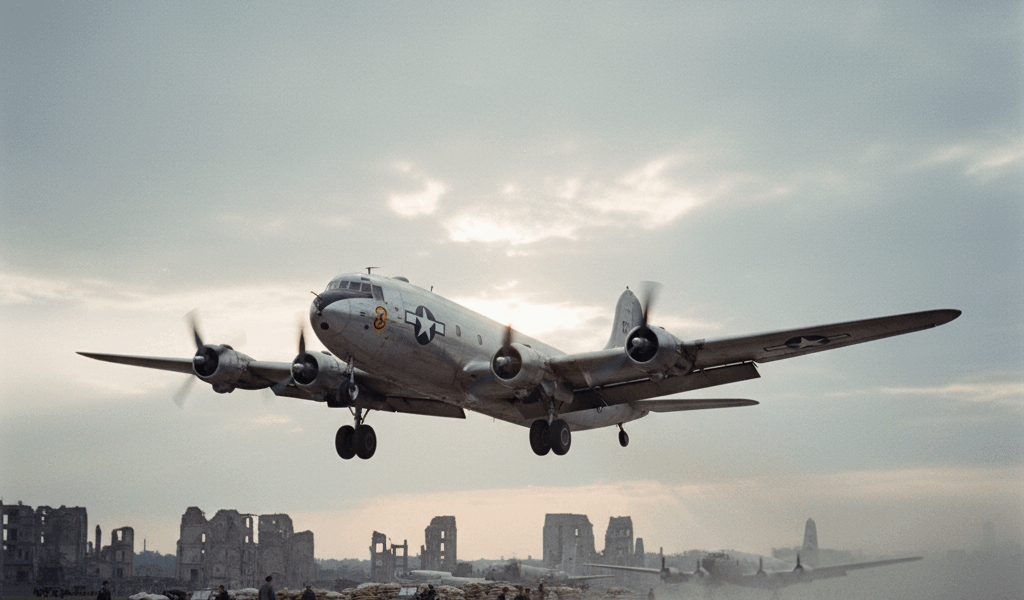
On June 24, 1948, the Soviet Union made a fateful decision that would test the resolve of Western powers and demonstrate the extraordinary capabilities of Allied air forces. Soviet forces blocked all land and water routes to West Berlin, cutting off 2.5 million people from essential supplies. The Berlin Blockade was designed to force the Western Allies out of the city, but it instead triggered one of the most remarkable humanitarian operations in aviation history.
The city of Berlin, deep within Soviet-controlled East Germany, had been divided among the four Allied powers after World War II. The Western sectors, administered by the United States, Britain, and France, depended entirely on supply routes through Soviet territory. When Stalin ordered the blockade, he gambled that the West would either abandon Berlin or face a military confrontation. Instead, the Allies chose a third option that seemed impossible: supplying an entire city by air.
Operation Vittles: America’s Response
The United States launched Operation Vittles on June 26, 1948, just two days after the blockade began. British forces quickly joined with Operation Plainfare. The logistical challenge was staggering: West Berlin needed approximately 4,500 tons of supplies daily to survive, including food, coal, and medicine. When the airlift began, the combined Allied air forces could deliver only about 90 tons per day.
The operation relied primarily on two workhorses: the Douglas C-47 Skytrain (known as the Dakota to the British) and the larger Douglas C-54 Skymaster. The C-47, the military version of the DC-3, could carry about 3 tons of cargo. The four-engine C-54 could haul approximately 10 tons. As the operation expanded, the C-54 became the backbone of the American effort, with over 300 eventually participating in the airlift.
British aircraft included Avro Yorks, Handley Page Hastings, and Short Sunderland flying boats. The Sunderlands, landing on Berlin’s Havel Lake, were particularly useful for transporting salt, as their maritime construction resisted corrosion.
General Tunner: The Architect of Aerial Logistics
The airlift’s transformation from desperate improvisation to precision operation came with the arrival of Major General William H. Tunner in late July 1948. Tunner had previously commanded the Hump airlift over the Himalayas during World War II, and he brought that experience to Berlin with revolutionary effect.
Tunner implemented a system of rigid scheduling that treated the air corridor as a conveyor belt. Aircraft took off at precisely timed intervals, flying at assigned altitudes through three narrow corridors. There was no stacking or circling; if a plane missed its landing approach, it returned to its base rather than disrupt the flow. Ground crews had exactly 30 minutes to unload each aircraft before it departed for its return flight.
Under Tunner’s leadership, the airlift’s capacity increased dramatically. By the spring of 1949, Allied aircraft were delivering over 8,000 tons daily, far exceeding the minimum requirements. On April 16, 1949, during the “Easter Parade,” aircraft landed 1,398 flights in 24 hours, delivering 12,941 tons of supplies.
The Candy Bomber and the Human Element
While the airlift was a triumph of logistics, it was also a deeply human story. Lieutenant Gail Halvorsen, a C-54 pilot, became one of its most beloved figures. While watching children gather at the airport fence during one of his missions, Halvorsen promised to drop candy for them on his next flight. He would wiggle his wings so they could identify his plane.
Using handkerchiefs as miniature parachutes, Halvorsen began dropping candy over Tempelhof. When his commanding officers learned of the operation, rather than punishing him, they expanded it into “Operation Little Vittles.” Eventually, American confectioners donated tons of candy and gum, and the program continued throughout the airlift. Halvorsen became known as the “Candy Bomber” or “Uncle Wiggly Wings,” and his actions helped transform the airlift’s image in the eyes of Berliners and the world.
Tempelhof: The Heart of the Operation
Tempelhof Airport became the symbol of the Berlin Airlift. The airport’s distinctive curved terminal building, designed during the Nazi era, witnessed an unprecedented volume of air traffic. At the operation’s peak, aircraft landed at Tempelhof every 90 seconds, around the clock.
The demands on Tempelhof were extraordinary. Additional runways were constructed, and the airport operated in conditions that would be considered impossible under normal circumstances. Ground crews worked in shifts, unloading cargo regardless of weather, while German workers helped extend and maintain the runways. A second airport, Tegel, was constructed in the French sector in just 90 days using volunteer labor, including German women who cleared rubble by hand.
The Blockade Ends, The Legacy Remains
The Soviet Union lifted the blockade on May 12, 1949, recognizing that the airlift had defeated their strategy. The operation continued until September 30, 1949, to build up reserve supplies in the city. By its conclusion, the Berlin Airlift had accomplished what many thought impossible:
- 277,569 flights into Berlin
- 2.3 million tons of supplies delivered
- Over 160,000 tons of coal monthly at peak capacity
- 78 Allied personnel lost in crashes during the operation
The Berlin Airlift shaped the early Cold War in profound ways. It demonstrated Western resolve and capability, contributed to the formation of NATO, and cemented the division of Germany that would last until 1990. The airlift also established a lasting bond between Berliners and the Western powers, particularly the United States.
Remembering the Airlift Today
Today, memorials to the Berlin Airlift stand at Tempelhof (now closed as an airport but preserved as a park), Frankfurt, and other locations. The “Luftbruckendenkmal” at Tempelhof features three curved spires representing the three air corridors, reaching toward the sky.
Gail Halvorsen, the Candy Bomber, became a lifelong ambassador of the airlift’s memory, visiting Berlin many times before his death in 2022 at age 101. His simple act of kindness reminded the world that even massive military operations can have a human face.
The Berlin Airlift remains one of aviation history’s finest hours, demonstrating that determined people with aircraft and organization can achieve what seems impossible. It proved that air power could serve humanitarian purposes as effectively as military ones, a lesson that continues to inform humanitarian relief operations around the world.


Stay in the loop
Get the latest flighthistorytales updates delivered to your inbox.