Why This Matchup Actually Mattered
Pacific air combat history has gotten complicated with all the spec-sheet arguments flying around. As someone who spent years digging through combat records and after-action reports from the Solomons campaign, I learned everything there is to know about what actually happened when the F4U Corsair met the A6M Zero in the skies over Guadalcanal. Today, I will share it all with you — and the honest answer probably isn’t what you’ve heard before.
By early 1943, the Zero had already spent two years making Allied fighter pilots look foolish. P-40 pilots. Buffalo pilots. Early Wildcat pilots who hadn’t yet learned the hard way. The Zero’s reputation wasn’t propaganda. It was earned, flight by flight — over China, Malaya, Pearl Harbor, and a dozen other places where Japanese naval aviators flew rings around opponents who simply didn’t understand what they were up against.
The Solomons campaign is where this matchup crystallized. That theater, that timeline, those specific conditions. The grinding air war fought over Guadalcanal and up the Slot toward Bougainville through 1942 and 1943 decided something real: whether Japan could maintain air superiority long enough to strangle the Allied foothold in the southern Pacific. The Corsair arrived right in the middle of that question.
The Zero at Its Best — What Made It Dangerous
But what is the A6M Zero, really? In essence, it’s a carrier-based fighter engineered around a single radical idea — strip everything non-essential and maximize range and agility. But it’s much more than that. It represented an entire design philosophy, one that produced an aircraft so capable it genuinely shocked the world in 1941.
I made the mistake early on of skimming past the Zero’s qualities because I already knew the ending. Don’t make my mistake.
The Mitsubishi A6M2 that appeared over Pearl Harbor on December 7, 1941 was, by almost any reasonable measure, the best carrier-based fighter in the world at that moment. Combat radius exceeding 1,000 miles — an almost absurd figure for a carrier fighter of that era. That range came from an obsessive weight-reduction philosophy that stripped out armor plate, self-sealing fuel tanks, and structural redundancy down to nearly nothing. Loaded, the aircraft weighed roughly 5,300 pounds. The F4U-1 Corsair, for comparison, came in around 11,000 pounds in combat trim. The Zero was a feather.
That lightness produced a turning radius that genuinely shocked Allied pilots who tried to follow it through a break. In low-speed maneuvering combat — the kind most pilots were trained for in 1941 — the Zero went places other fighters simply couldn’t follow. Over China in September 1940, thirteen Zeros from Imperial Japanese Navy air groups engaged twenty-seven Chinese Air Force fighters. Zero losses. Thirteen kills.
Paired with pilots who had logged hundreds of hours on the type, this aircraft was a genuine problem. Two 20mm cannons and two 7.7mm machine guns gave it enough punch to destroy Allied fighters with short, precise bursts. Respecting that record isn’t sentimentality. It’s context. That’s what makes the Zero so enduring to historians who study this era.
What the Corsair Brought to the Fight
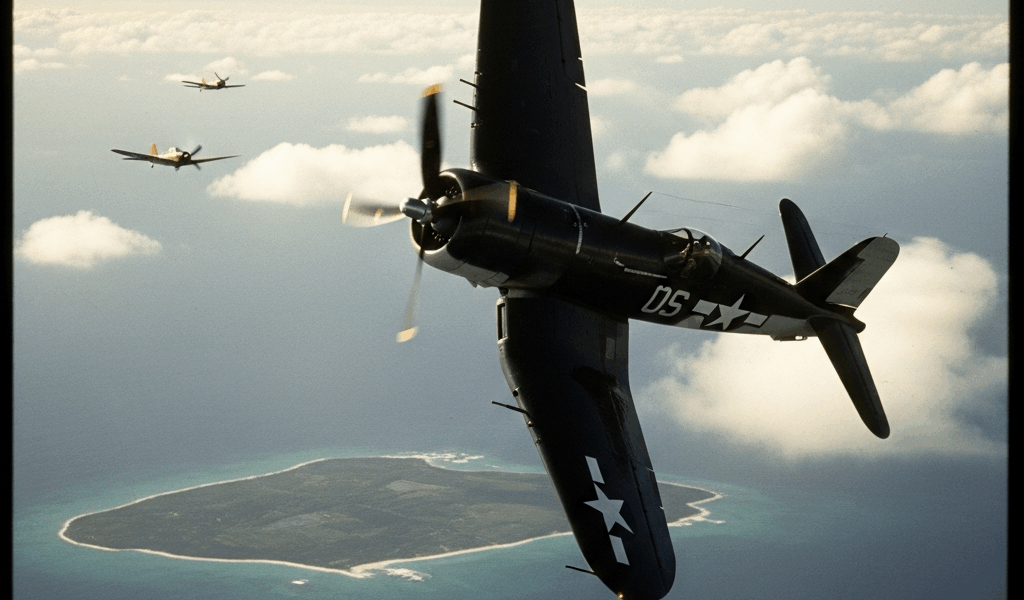
Designed around the Pratt & Whitney R-2800 Double Wasp — an 18-cylinder radial producing around 2,000 horsepower — the F4U Corsair was a fundamentally different kind of aircraft than anything Japan had encountered in large numbers before. The engine was so physically large that Vought’s engineers bent the wings into that distinctive inverted gull shape specifically to keep the enormous three-bladed Hamilton Standard propeller off the ground without requiring absurdly tall landing gear. That’s not a trivia footnote. The R-2800 was the whole point.
Six .50-caliber M2 Browning machine guns. Roughly 2,350 rounds total across all six. Structural strength engineered to handle high-speed dives that would shed the Zero’s control surfaces or tear the airframe apart entirely. And genuine top speed — 417 mph at altitude in the F4U-1A variant — that the A6M2’s 332 mph ceiling simply couldn’t match in a straight chase.
Probably should have opened with this section, honestly. Because the Corsair’s early carrier qualification problems — a vicious bounce on landing and poor forward visibility over that long nose — pushed the aircraft to land bases first. VMF-124 flew from Henderson Field on Guadalcanal starting February 1943. The rough-strip, long-range, scramble-and-intercept environment of the Solomons actually suited the Corsair’s strengths better than early carrier operations would have. The aircraft found its context before it found its carrier deck.
How the Fights Actually Went Down
Fascinated by the gap between theoretical performance numbers and actual combat outcomes, I spent a considerable stretch tracking down records from VMF-124’s first weeks in theater. So, without further ado, let’s dive in — because the early results weren’t clean.
February 14, 1943. Marine aviators sometimes call it the Saint Valentine’s Day Massacre. VMF-124 escorted B-24 Liberators on a raid toward Kahili on Bougainville and flew directly into a large Zero formation flying from Buin. The Corsairs lost two aircraft. Several more came home damaged. Zero pilots, flying coordinated high-cover formations, exploited the Corsairs’ tight escort obligation to force exactly the kind of low-speed turning engagement where the A6M excelled.
The lesson landed hard — specifically in the tactical thinking of Marine and Navy fighter leaders who immediately modified their approach. Stop escort-hugging. Use altitude. Use the dive.
The Thach Weave, developed by Navy Commander Jimmy Thach originally for the F4F Wildcat, carried over and adapted. Two-plane sections that couldn’t be separated. If a Zero latched onto one Corsair, his wingman turned into the attacker with the .50-calibers already walking through the space the Zero had to cross. But the Corsair added something the Wildcat couldn’t offer: the option to simply run. A Zero pilot who found himself below and behind a Corsair that chose to dive away was not catching that aircraft. Full stop.
Documented accounts from Major Gregory “Pappy” Boyington’s VMF-214 — the Black Sheep Squadron, flying F4U-1As out of Munda in late 1943 — describe the emerging tactical doctrine with real clarity. Boom and zoom. Altitude is energy. Never turn with the Zero below 200 knots. Boyington accumulated 22 of his 28 kills in the Corsair using these principles — though he’d be the first to acknowledge that the quality of opposition changed significantly from early 1943 onward. I’m apparently someone who notices these qualifications in primary sources, and it turns out that caveat matters more than most summaries admit.
Who Won and Why the Answer Is Complicated
The Corsair won. By late 1943 the tactical matchup had shifted decisively, and the kill ratios from the Solomons campaign document that shift without needing any apology. But the reason it won involves several threads that don’t reduce to a clean headline.
The Zero’s design philosophy — radical lightness, extreme range, agility above everything else — had no room to grow. Adding armor, self-sealing tanks, or a more powerful engine meant adding weight, and adding weight killed the performance characteristics the entire aircraft existed to provide. Mitsubishi’s engineers knew this. The A6M5, introduced in 1943, squeezed modest improvements from the airframe — a few extra mph, slightly better dive limits. The fundamental trade-off, though, couldn’t be engineered away. Meanwhile, the Corsair kept improving. The F4U-4 variant arriving by 1945 produced around 2,450 horsepower. The Zero was aerodynamically near its ceiling by 1943. That was the trap built into its own brilliance.
Pilot quality degradation on the Japanese side was real and it mattered. The experienced aviators who flew A6Ms through 1941 and 1942 were not replaced in kind — Japan’s training pipeline couldn’t absorb losses from Coral Sea, Midway, and the Guadalcanal campaign and still produce veterans at the rate they were being lost. American Corsair pilots in 1944 were often fighting opponents with fewer total flight hours than the aircraft those same Americans had faced two years earlier. That asymmetry shaped outcomes considerably.
Reducing the verdict to pilot quality alone, though, sells the engineering story short. The Corsair beat the Zero’s design concept as much as it beat individual pilots. One aircraft was built to be brilliant, lethal, and fundamentally fragile — a throwaway weapon for a nation betting on early decisive victory. The other was built to take hits, absorb punishment, grow with better engines, and keep fighting a long war.
Both choices reflected something true about the nations that built them. That’s probably the most honest verdict available.
For the two major American R‑2800 naval fighters, see our sourced Corsair vs Hellcat comparison covering variants, carrier integration and combat records.



Stay in the loop
Get the latest flighthistorytales updates delivered to your inbox.