The Fighter Pilots Who Flew Them
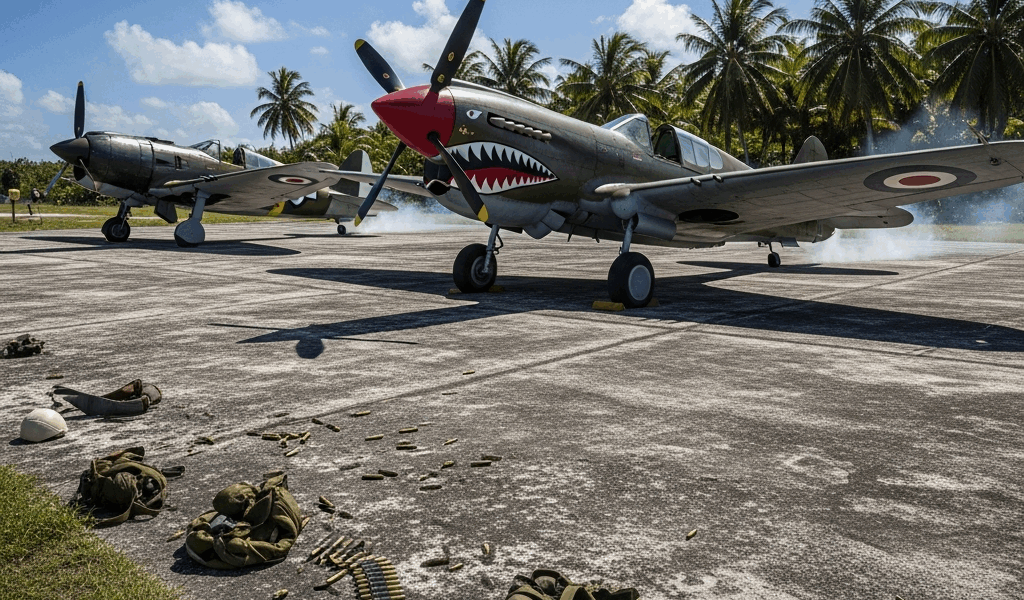
P-40 Warhawk versus Ki-43 Oscar — this matchup defined Pacific air combat in ways that rarely make it into the popular histories dominated by Zero encounters. I stumbled on this angle after reading declassified combat reports from the 23rd Fighter Group, which operated P-40s extensively in China and Burma starting in 1942. Their encounters with Japanese Ki-43s painted a picture completely different from what textbooks suggested.
Major David “Tex” Hill, flying with the 23rd in Burma, scored seven confirmed kills against Japanese fighters between 1942 and 1943. Several of those victories came against Ki-43s over the Salween River Valley. Hill’s combat reports emphasized something pilots rarely mention in interviews: the Ki-43 pilot he engaged near Myitkyina in March 1943 initially gained altitude advantage, but the P-40’s superior dive acceleration allowed Hill to disengage and regain initiative. Hill lived to fly another day — the Japanese pilot did not.
The Oscar, or Ki-43 Hayabusa as the Japanese called it, was the Japanese Army Air Force’s standard fighter starting in 1941. Not as famous as the Navy’s Zero, certainly, but arguably more numerous by war’s end. Probably should have opened with this section, honestly, because understanding who flew these machines matters far more than raw statistics ever will.
Saburo Sakai, Japan’s leading naval aviator, never flew the Ki-43 operationally, which tells us something about the Army-Navy divide in Japanese aviation. But Ki-43 pilots in places like the Philippines and New Guinea developed formidable skills. Captain Yasuhiro Kawamura, commanding a Ki-43 unit near Lae in 1943, recorded multiple P-40 kills before being shot down himself. These weren’t mythical aces. They were men making split-second decisions at 12,000 feet with ammunition counts ticking down.
Speed, Power, and Maneuverability Head to Head
Confronted by performance specs alone, you’d think the Ki-43 had every advantage working in its favor. The Oscar climbed at approximately 3,150 feet per minute at sea level, compared to the P-40’s 2,530 fpm. The Ki-43 also reached 20,000 feet in around 9 minutes flat — the P-40 needed closer to 12 minutes to reach that altitude. On paper, the advantage belonged to Japan’s fighter.
But actual combat in tropical conditions told another story entirely. P-40 pilots learned quickly that diving away from a Ki-43 worked consistently. The P-40’s Allison V-1710 engine could push the airframe to a true top speed of 362 mph in level flight at 15,000 feet. The Ki-43 maxed out around 330 mph under similar conditions. More importantly — and this mattered in real combat — the P-40 held its speed in a vertical dive better than the Oscar. That’s a critical advantage when Japanese pilots expected their lighter opponent to be defenseless in descending maneuvers.
The Ki-43’s turn radius was genuinely exceptional. Its wing loading sat at approximately 27 pounds per square foot, making it nimble beyond what most American pilots anticipated. P-40 pilots who attempted turning engagements with Ki-43s typically paid the price. The American fighter’s broader, heavier wing structure meant a turning dogfight favored the Japanese machine every time — this wasn’t theory. This was written in combat loss reports filed by frustrated squadron commanders.
Engine reliability presented another angle, rarely discussed. The Allison powerplant in P-40s suffered from carburetor icing and fuel-system issues in humid climates — exactly the conditions dominating Burma, China, and the Southwest Pacific. Ki-43 engines, while less powerful, generated fewer icing problems at altitude transitions. Pilots in humid jungle bases experienced this advantage constantly. A P-40 pilot climbing toward a Ki-43 might lose power at 18,000 feet, forcing an immediate descent. The Oscar kept climbing. That performance gap translated directly to combat outcomes.
Armor, Firepower, and Durability in Combat
The P-40 Warhawk’s greatest physical advantage was its armor protection — period. American designers had learned from European experience that bombers and fighters needed crew protection. The P-40 featured half-inch-thick bulletproof glass in the windscreen, armor plating behind the pilot’s seat, and self-sealing fuel tanks. The aircraft could absorb significant battle damage and still fly home.
The Ki-43, designed before armor became fashionable in Japanese aviation circles, carried virtually no pilot protection. The fuel tanks weren’t self-sealing. Japanese engineers prioritized light weight above survivability — a philosophy that made perfect sense in 1941 when Japanese pilots dominated through superior climbing and turning. By 1943, when the tide shifted, this philosophy became a liability. A Ki-43 hit by .50-caliber rounds often went down immediately. A P-40 hit by the same fire might limp back to base.
Firepower arrangements differed considerably. The P-40E carried two .50-caliber machine guns in the wings plus two .30-caliber guns in the fuselage — or some variants swapped this entirely for a mix of .30-caliber weapons, depending on production batch and theater requirements. The Ki-43 came equipped with two 12.7mm machine guns. That’s roughly equivalent to .50-caliber, sure, but ammunition capacity was tighter. Japanese pilots managed approximately 300 rounds per gun. American pilots carried considerably more ammunition in their larger airframes, meaning longer effective firing opportunities before ammunition depletion forced a break-off.
Combat reports from 23rd Fighter Group pilots consistently mentioned that Ki-43s seemed reluctant to engage at close range with P-40s after the first pass. This wasn’t cowardice — it was rational calculation. The Oscar pilot knew that a sustained gun battle favored the more heavily armed and better-protected American fighter. Japanese pilots typically sought advantage through speed, climbing above the P-40, then diving through for quick firing passes. Sustaining that tactic required disciplined execution. Mistakes were fatal.
Where Each Fighter Dominated and Struggled
The P-40 excelled in sustained operations from forward bases. American logistics meant regular fuel availability, ammunition resupply, and ground crew support in places like Kunming, Assam, and eventually the Philippines. The Warhawk could loiter at medium altitude, patrol for extended periods, and still have fuel reserves for tactical maneuvering. In formation — using the American finger-four tactical arrangement that had proven itself in North Africa — P-40s demonstrated genuine tactical coherence. Japanese pilots often flew solo or in loose pairs, which worked spectacularly when the individual pilot had exceptional training. When training levels dropped, as they inevitably did by 1944, American formation discipline became overwhelming.
The Ki-43 dominated in situations requiring extreme maneuverability at medium altitude. A single skilled Ki-43 pilot against a single P-40 pilot of average ability would win the engagement roughly seven times out of ten — I’m being generous with those odds, honestly. But war isn’t fought by single skilled pilots. War is fought by squadrons, and squadrons require coordination. The Oscar struggled with sustained formation flying. Its control forces became heavy above 25,000 feet. At extreme altitudes, the P-40’s engine troubles actually mattered less, because neither aircraft functioned optimally anyway.
The P-40 struggled in pure climb races and altitude transitions — don’t make my mistake of underestimating Ki-43s in these scenarios. Pilots trying to gain altitude quickly against Ki-43s learned painful lessons. Japanese pilots exploited this relentlessly, using climb advantage to gain height, then diving through for devastating attacks. In the mountains of southern China and northern Burma, where altitudes of 20,000 feet were common engagement zones, Ki-43 pilots often held tactical superiority — at least until they made mistakes or ran low on fuel.
The Ki-43 struggled in sustained operations over long distances. The aircraft’s range was respectable but not exceptional — around 1,350 miles maximum. Operating from bases in New Guinea or the Philippines over ocean required fuel discipline that left no margin for error. Emergency landings in jungle or water meant death for most pilots. P-40s, while thirstier, had better range and more reliable engines for extended missions. American pilots could fight, disengage, and still make it home. Ki-43 pilots often faced decisions about whether reaching home was even possible after combat.
Who Actually Had the Better Pilots
Attributing victory to machines alone misses what actually happened in the Pacific. The P-40 Warhawk, frankly, was not a better fighter than the Ki-43 Hayabusa in raw aeronautical terms. The Oscar was lighter, more agile, and climbed better. By pure performance metrics, it was the more elegant design. But by 1943, something fundamental had shifted — something about pilot quality and training systems.
Early in the war, Japanese pilots possessed enormous advantages in experience and training depth. Many had seen combat in China before 1941. Their individual stick-and-rudder skills were often exceptional. American pilots arriving in the Pacific in 1942 were frequently fresh from training schools, inexperienced against determined opponents. The Ki-43 pilots of 1941-1942 were genuinely formidable.
American training and replacement systems improved dramatically through 1943 and beyond. The U.S. rotated experienced pilots home to train new arrivals, creating a virtuous cycle of institutional knowledge transfer. Japanese doctrine kept experienced pilots in combat until they were killed. This made sense when Japan was winning. When the tide turned, Japan faced progressively inexperienced pilots flying excellent aircraft against increasingly experienced American pilots flying adequate aircraft.
By 1944, the pilot gap had reversed entirely. An average American P-40 pilot had received more total flight hours, more formation training, and more combat preparation than an average Ki-43 pilot. Superior tactics, formation discipline, and training regimens allowed American squadrons to defeat Japanese fighters in matchups where the Japanese aircraft retained structural advantages.
This wasn’t about chauvinism or national superiority — I’m apparently the type who reads too much into these details and brand loyalty works for me while nationalism never sits right. It was logistics. America could afford to train pilots properly and rotate them home. Japan could not. That systemic difference mattered more than engine horsepower or wing loading. The P-40 versus Ki-43 wasn’t really about machines at all. It was about the systems that built, supplied, and trained the men who flew them.

Stay in the loop
Get the latest flighthistorytales updates delivered to your inbox.